





GamingTop Gear
Nvidia’s DLSS 5 generative AI graphics reveal has… not gone well
People have likened it to AI slop, but “they’re wrong” says CEO Jensen Huang
Nvidia, the world’s largest company and the artist formerly known as ‘that graphics card lot’, has revealed a new technology which it calls an "AI-Powered breakthrough in visual fidelity for games". And which we call “a nightmarish AI effect that makes characters in your games look like they were designed by a Google Gemini prompt".
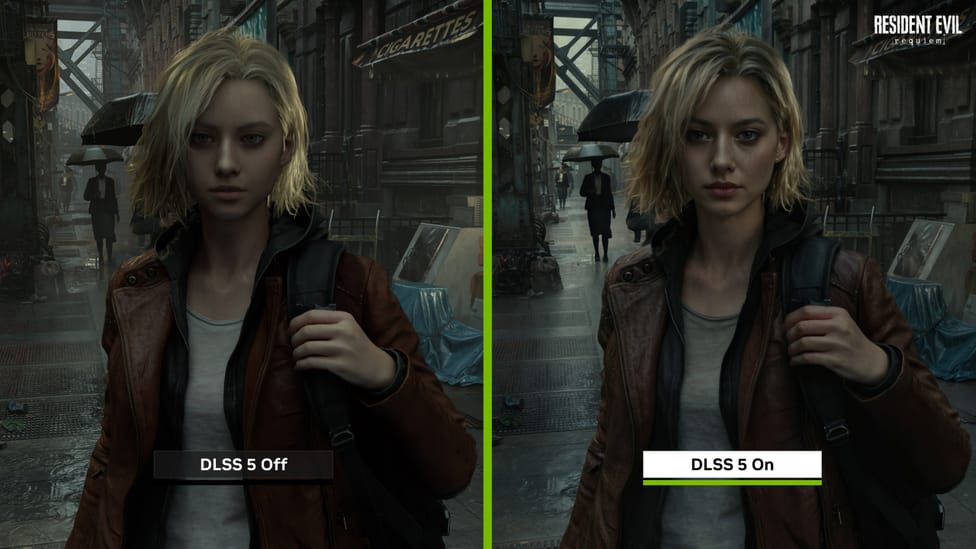
DLSS 5 is an impressive technical feat in many ways, as is detailed over at Nvidia’s newswire. It uses compatible Nvidia graphics cards to “infuse” onscreen pixels with photoreal lighting and materials. You can see it at work in Nvidia’s example clips. It appears to add a lot of new detail to game characters.
Advertisement - Page continues below
The problem with that is that the technology appears to be quite literally painting over the work of the creators who designed those characters. And the effect? Utterly homogenous. Resident Evil Requiem’s Grace Ashcroft looks like an AI girlfriend with an ozempic prescription. And Marika Boros takes on a remarkably similar complexion when DLSS 5 is applied to Starfield.
Context matters here, too. We’re all well aware of the AI bubble now. If you weren’t, then reading the first line of this story and being reminded that somehow a PC graphics card company has become bigger than Apple and Meta is a pretty handy reminder. Companies like Nvidia have invested massively into AI tech, and are now looking for any and all opportunities to add it to our lives.



Prominent developers have praised the tech. Bethesda’s Todd Howard said in the Nvidia announcement: “We’re excited to work with this new technology and look to bring DLSS 5 to Starfield and future Bethesda titles."
Capcom's Jun Takeuchi is similarly enthusiastic: "It represents another important step in pushing visual fidelity forward, helping players become even more immersed in the world of Resident Evil."
Advertisement - Page continues below
That sentiment stands in stark contrast to the wider public reaction, which likens the effect to turning games into AI slop and raises the issue of the sanctity of a game’s original art direction.
However, Nvidia Jensen Huang has hit back at those critics. “First of all, they’re completely wrong,” he told Tom’s Hardware, responding to a question about the negative reception to DLSS 5.
“The reason for that is because, as I have explained very carefully, DLSS 5 fuses controllability of the geometry and textures and everything about the game with generative AI.”
Huang also added that “it doesn’t change artistic control” and that “it’s not post-processing at the frame level, it’s generative control at the geometry level".
Top Gear
Newsletter
Get all the latest news, reviews and exclusives, direct to your inbox.
But Huang’s response seems to be focusing on how the effect works, rather than what the end result looks like, which has been the focus of the criticism. If creators still retain artistic control, why do the sample clips look so homogenous?
Expect to see some very careful technical explanations and, hopefully, some games not looking like a Nano Banana prompt in the near future as Nvidia attempts to regain control over the DLSS 5 narrative.

Trending this week
- Long Term Review
Alfa Romeo Junior Ibrida Sport Speciale vs Ford Puma ST