



25
We’ll start with the diesel. The old D-Max was fairly workmanlike to drive on the road, and the current third gen isn’t actually that much different. But then it needs to be to excel in other areas. Despite that commercial vehicle feel, the D-Max can actually be driven at passenger car speed limits in the UK thanks to its sub-2,040kg kerb weight. Something that its 200- to 300kg-heavier rivals can’t match.
So, the four-cylinder diesel clatters away like it’s from a 25-year-old Transit, but it does provide a useful 162bhp and 266lb ft of low down torque no matter what trim level you go for. That’s good for a 0-62mph time of 12.7 seconds (or 13.0 seconds if you’ve gone for a fancier trim, double cab and an auto box), and on to a top speed of 112mph. Not bad.
Right you are. If you want to go really basic, there's a two-wheel drive single cab ‘Utility’ spec. One up from that is still Utility but adds Isuzu’s shift-on-the-fly four-wheel drive setup and a rear diff lock. These white or silver workhorses can only be combined with a manual gearbox. The first few gears are short so you’ll be working the ‘box fairly hard, and there’s little feel to the brakes or steering. Still, there’s certainly some joy to be found in a proper boggo spec truck.
Anything up from Utility is four-wheel drive with the locking rear diff and available with a six-speed manual or the aforementioned auto gearbox. And yep, even the burly AT35 just gets the standard diesel four-pot engine – though this latest version is available with the automatic transmission only.
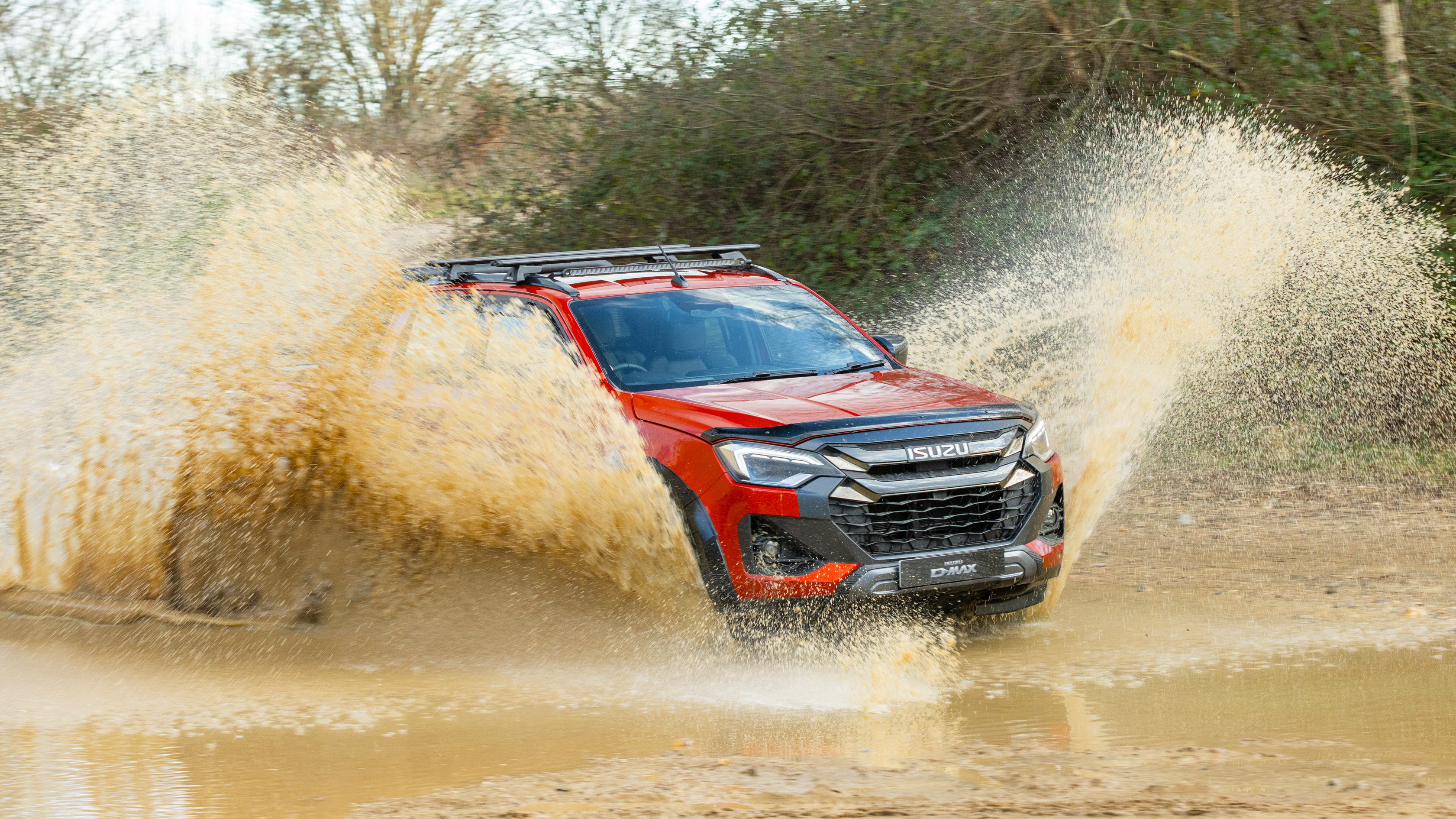
All D-Max models are mightily impressive off-road, though, whatever spec you choose. Worth noting that the wading depth was also improved to 800mm for this generation.
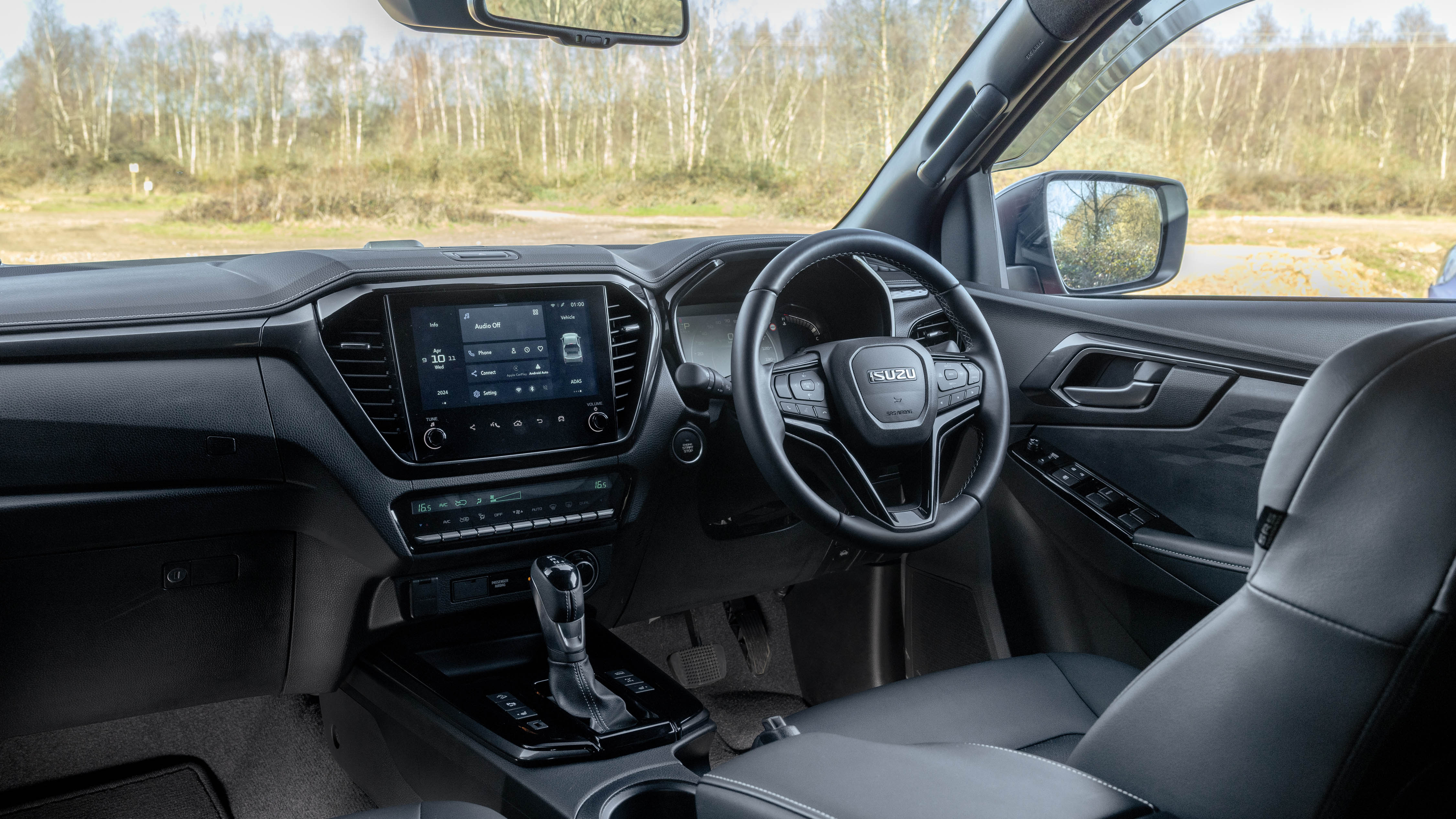
The best-selling V-Cross trim in double cab form with the auto gearbox – the one you’re most likely to buy if you rarely venture from the tarmac – is certainly not as refined as a Ford Ranger or even the bulletproof (figuratively speaking) Toyota Hilux, with its rough 'n' ready diesel chuntering away and plenty of road and wind noise making its way into the cabin.
The power steering is supposedly speed sensitive, too, but we found it a little heavy in town at times and it’s sometimes reluctant to self-centre.
The auto gearbox is fairly smooth if you leave it to do its thing, although changes are still a bit glacial in manual mode. The suspension was also new for this third-gen D-Max, but while the leaf spring setup at the rear helps for a minimum payload of 1,090kg, it also means it’s a little firm and bouncy on rutted roads.
Oh, and in case you were wondering – you’ll get around 33mpg from the 1.9-litre diesel, while CO2 emissions sit between 220 and 241g/km.
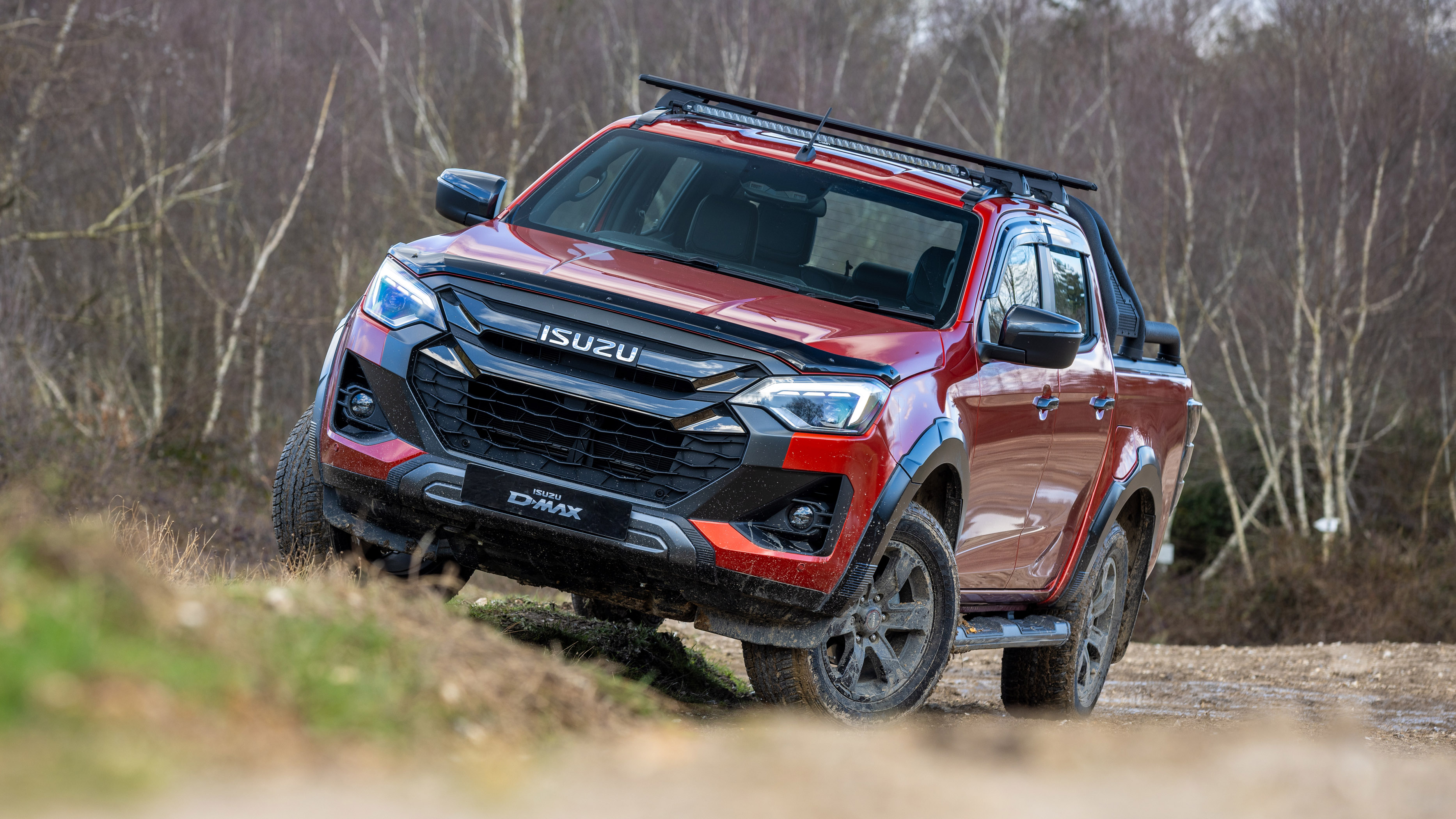
Then you want the Arctic Trucks AT35. It gets a strengthened chassis. A 40mm raised ride height courtesy of Bilstein suspension. Approach, breakover and ramp angles of 35, 34 and 29 degrees respectively. Oh, and we’re not forgetting the huge 17in alloys fitted with 35in BF Goodrich all-terrain tyres.
This version also gets a new Rough Terrain Mode, which distributes power to the wheels with the most grip on low traction surfaces, while there’s also the usual on-the-fly 4WD setup and a rear diff lock to help you avoid getting stuck.
Needless to say, it’s slightly compromised on firmer ground, where the 1.9-litre engine quickly gets out of breath and there’s an alarming delay at higher speeds when you put your foot down. There’s also even more road roar in the cabin, and we averaged a slightly reduced 27.5mpg on account of those monster tyres. Looks mighty, though.
At the front you’ll find a 62bhp/85lb ft electric motor, and at the rear a 137bhp/172lb ft motor, for a combined 200bhp/256lb ft. They’re mated to a 66.9kWh battery (64kWh usable) for a WLTP range 163 miles.
We’ll gloss over that number for a moment, because electric propulsion does have its benefits here. It accelerates much more smoothly, the 0-62mph sprint seen off in 10.1 seconds – around three seconds quicker than the diesel – despite the increased kerbweight (2,345kg). And the absence of a clattery diesel means it's more refined and it’s kinder to the very environment you're likely to be clambering over with it. Win win!
Some other figures for you to consider: one-tonne plus payload (which Toyota's Hilux EV can't match), 3.5-tonne towing capacity, 30.5-degree approach and 24.2-degree departure angles, all of which are identical to the diesel. Only the 210mm ground clearance and 600mm wading depth are worse off, by 20mm and 200mm respectively.
But the range is pretty limiting. We achieved 2.5 mi/kWh on our test drive, which equates to 160 miles total. Okay, so this isn't likely to matter to the farmers and construction site workers who'll be running this thing, but for everyone else? Forget it.
Get all the latest news, reviews and exclusives, direct to your inbox.
