

25



Mercedes-Benz CLA 250+ AMG Line Premium Plus
452 miles
1cc
268.2bhp
6.7s
That wasn’t a car crash. That was a bloody explosion.
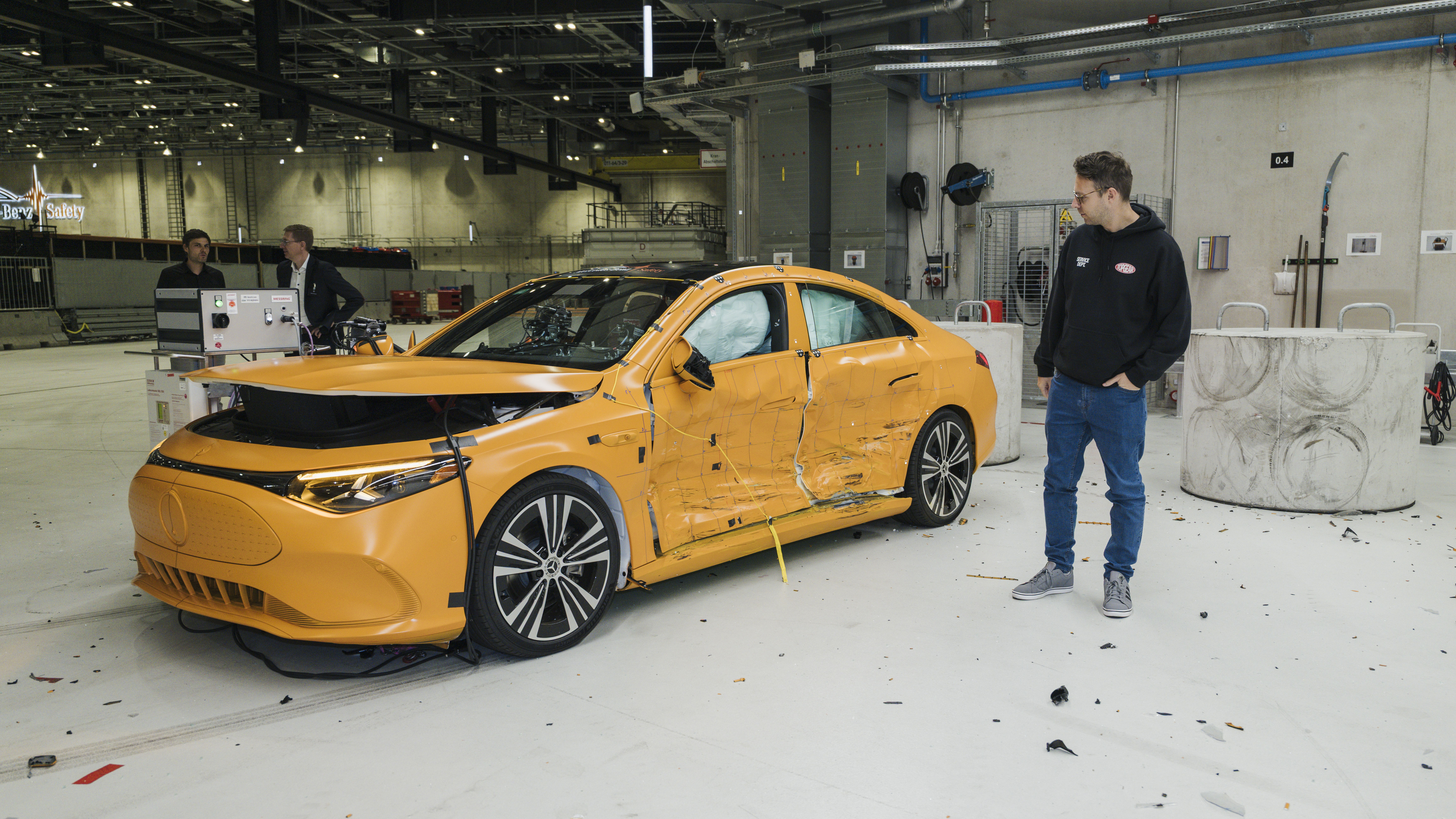
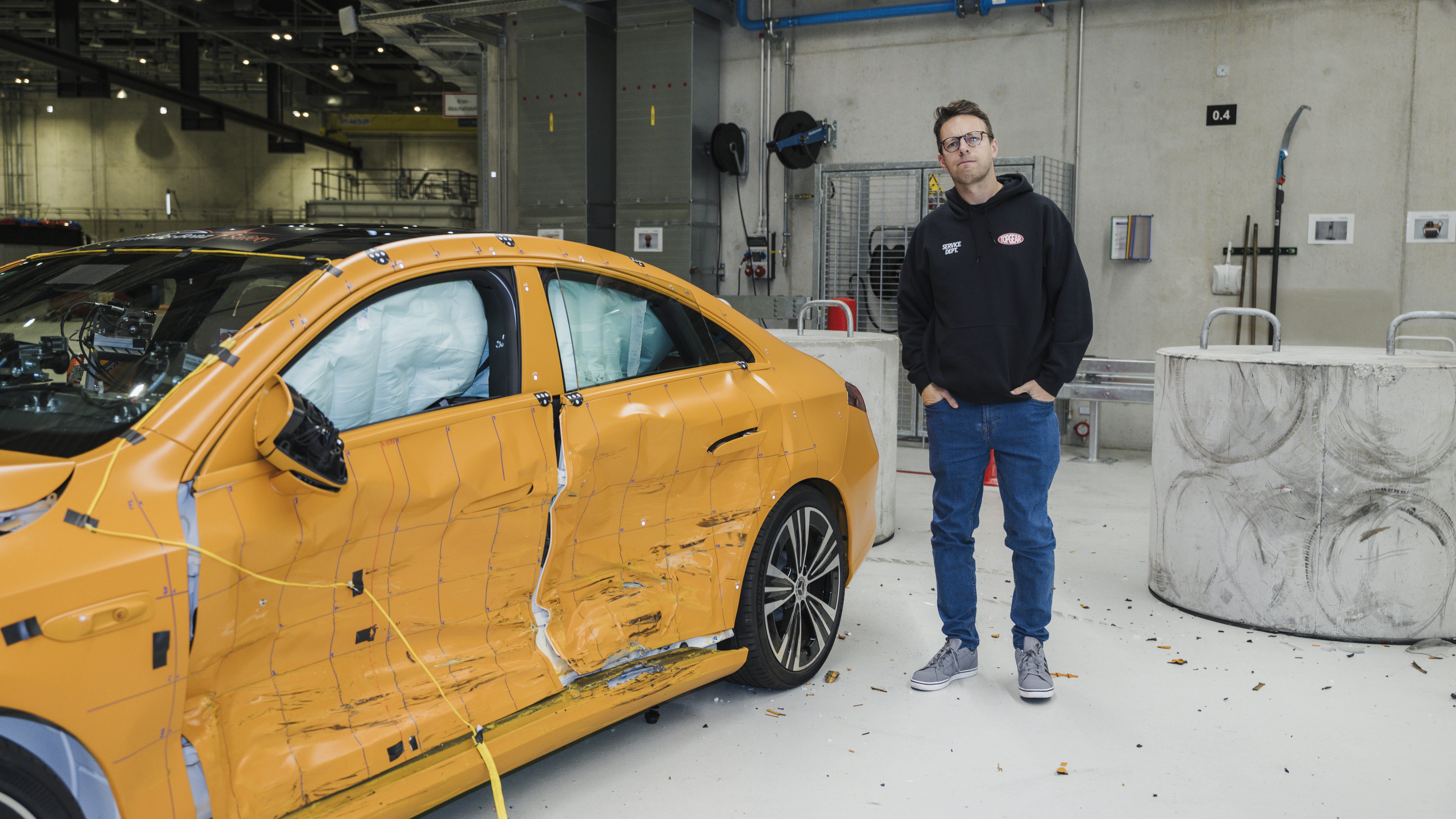
The smell of airbag explosives drifts up my nostrils. Two Mercedes CLAs have just killed each other right in front of me. Happily, neither was the Sapphire Blue CLA 250+ I’ve been living with for the last few months.
The reason I’ve just watched an act of CLA-on-CLA violence is tied to last month’s tale of a trip to Germany. See, Mercedes is celebrating ‘140 years of innovation’ in 2026, as it’s the anniversary of the Benz-Patent Motorwagen being, um, patented.
Essentially, it’s 140 years since Carl Benz laid the egg which hatched into what we know as the modern automobile. And to celebrate that, I was invited to Stuttgart, into the inner sanctum of Mercedes R&D… for a tour of its brain.
Some of the stuff they’re working on down here in the Benz bunker is quite fun. I’m shown a prototype for an animated rear window display. Invisible when you look through the glass from behind the car. This, reckon the Benz boffins, could show messages to drivers behind you. Perhaps a warning triangle if you’re busy doing an emergency stop, or stranded on a dark lane. An icon to politely ask a following driver to cancel their searing high-beam headlights. Even arrows animating which way you’re turning, in addition to the indicator flashing.
Naturally, there’s huge potential for this to be hacked for rude purposes. But Mercedes has a whole department dedicated to cybersecurity these days. Indeed, in one seminar with boffins from chip colossus Nvidia (who are partnering Mercedes in the race for a Level 4-automonous car) they confess they regularly invite hackers to have a crack at breaking their systems. Because until it’s unhackable in the lab, it’s not going on the road. Feeling reassured? Me neither.
In another building, Mercedes is sweating the issue of solid-state batteries with Taiwanese partner Prologium. The very EQS which managed a 1,200km drive on a single charge last year is parked up nearby awaiting its next adventure, once Mercedes can find a volunteer with a big enough bladder. Or train a camel to drive.
But the building I’m most interested in is the vast crash lab. It’s the size of seven football fields (proper football, Americans, not your silly men-in-tights version) and contains enough steel to build a 1:1 scale replica of the Eifel Tower.
This arena is so big Mercedes had to account for the curvature of the Earth when making sure the floor was perfectly flat. Apparently there’s a mere 5mm of deviation from one end to the other.
This 42,000 square-metre cathedral is where Mercedes sacrifices hundreds of brand new cars every year, in its own private crash tests. There are 70 different configurations of crash they can simulate here. Head-on or offset barrier impacts, sideways pole crashes, rear-endings, rollovers, you name it. They could probably figure out who would come off worst in a meteor strike on a G-Wagen if you asked nicely.
Today it’s CLA-jousting. A worst-case scenario – combustion-engined version T-boning an EV. That means the car with the engine takes an impact head-on, and the one with the battery pack is smashed into on the flanks.
The two cars are festooned with recording gear and filled with dummies daubed with paint to analyse where their flailing bodies impact. Top Gear’s money where-your-mouth-is request to drive one of the cars is politely declined. So, I watch from behind ballistic glass as cables drag the CLAs on their final journey.
The impact speed is 56kph (34.7mph). Essentially, a textbook recreation of you, minding your own business bumbling over a crossroad, being T-boned by another driver running the red light. And the noise – the explosive collision, the release of energy – is horrifying.
What’s most sobering in the seconds after isn’t the shattered plastic or dented metal. It’s how far the T-boned CLA has been punted. If that’s been mid-crossroads, the ‘victim’ car would’ve ended up on the pavement. If you were stood there waiting to cross the road, you’d have been a goner.
Mercedes, like many carmakers, is working on a solution for that. Using connected cars to make sure that accident never happens in the first place, or red-light reading cameras and automatic emergency braking to mitigate the impact speed. And if you do still crash, the cars truly are built like tanks.
I hadn’t fully appreciated quite how different the combustion and electric CLAs are under the skin. Different load paths, changes in materials, and a completely separate crash ‘philosophy’, because while the engine can be used to absorb energy, the engine mounts are designed to dissipate energy doing just this – the battery pack simply can’t be penetrated or dented in any way.
The last thing an engine does if a crash happens is try its best to save your life, by absorbing the forces. The best thing a battery pack can do is hold on tight and hope its ballistic shield isn’t penetrated.
On the scene, only the doors in the direct impact zone fail to open easily. Many airbags have deployed, but not all of them at once. Because Mercedes has learned that secondary impacts can be even more deadly if you fire off all the airbags which then start to deflate before the car comes to rest. I was especially impressed by the central airbag which inflates between the front seat occupants, to stop them clashing heads or limbs and causing each other injury in a side impact. They should sell that as an accessory for mosh-pits.
Smashing up two CLAs might seem like an odd tone for TG’s long-term test car to bow out on. We normally spend these final reports summing up how we’ve warmed to (or been infuriated by) a car over the past few months. But safety – and the good or evil of technology – will be my abiding memory of this car.
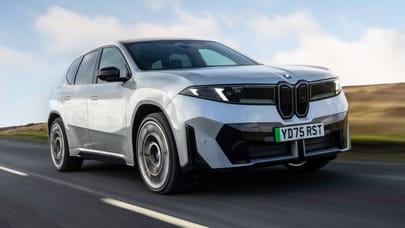
Because this is the first EV I’ve ever spent time in where I forgot it’s an EV. Like Ben Pulman’s experience with his TG Garage BMW iX3, once you have an easy real-world range north of 350 miles, you simply stop worrying it. You never get caught out, even in a cold snap, even in a diversion. The CLA is hugely efficient and charges quickly. I would have no hesitation buying one as a daily, even though I usually drive around 15,000 miles per year. That’s twice the UK national average.
On cheap rate overnight electricity, a full recharge (or more usually, from 20 per cent to full) cost less than ten quid. Under a tenner, for over 350 miles. That’s a very rare thing these days: a bargain.
And yes, having seen how tough these cars are under the skin, I felt cocooned and confident in its engineering. I just can’t quite shake the grievance that dominating the interior with screens undoes some of that worthy work on safety, though. This car isn’t as easy to use without taking your eyes off the road as its predecessor, which had rocker switches for heating, shortcut keys for its menus, and no touch-sensitive buttons on its steering wheel.
Even the voice control, which is pretty good, isn’t a distraction-free substitute. I hate interrupting the radio just to turn on my massage seat subscription.
My point is, Mercedes is obviously continuing to push the boundaries of worst-case scenario crash safety. It has largely cracked EV battery range, recharging time and strategy. I just hope this is peak-screen for Mercedes, ahead of a backtrack towards higher quality physical controls like we’ve seen from Volkswagen and even Ferrari.
This car is so close to being complete. The CLA is a terrific mini-luxe barge, because so much of it feels like it’s from the future. Now bring back the classiness of Mercedes cabins from the not-so-distant past.
Get all the latest news, reviews and exclusives, direct to your inbox.
