



Big Reads
Up close with the twin-turbo V8 Toyota GR GT: "a long bonneted thunderstorm"
Toyota, better known for flogging Corollas in their millions, has unleashed a supercar... this we had to see for ourselves
Fuji Mountain Speedway, Saturday 7 December, 2025. A precious, white gloved Japanese man has just dropped very gently into the seat of Toyota Gazoo Racing’s new GR GT and has proceeded to absolutely rev the bejeesus out of it. Whup-blam, crackle. WHUP-BLAM, crackle. WHUP-WHUP-HISS-CRACKLE.
Sound carries in cold air, and as the third rev dies away, the 40-odd people in the pit garage all simultaneously mutter a small swear in the language of their homeland. All I can think is that the wash of hot gas from the quad of exhausts has deposited tiny bits of dead dinosaurs directly into my nose. And I really like the smell.
Advertisement - Page continues below
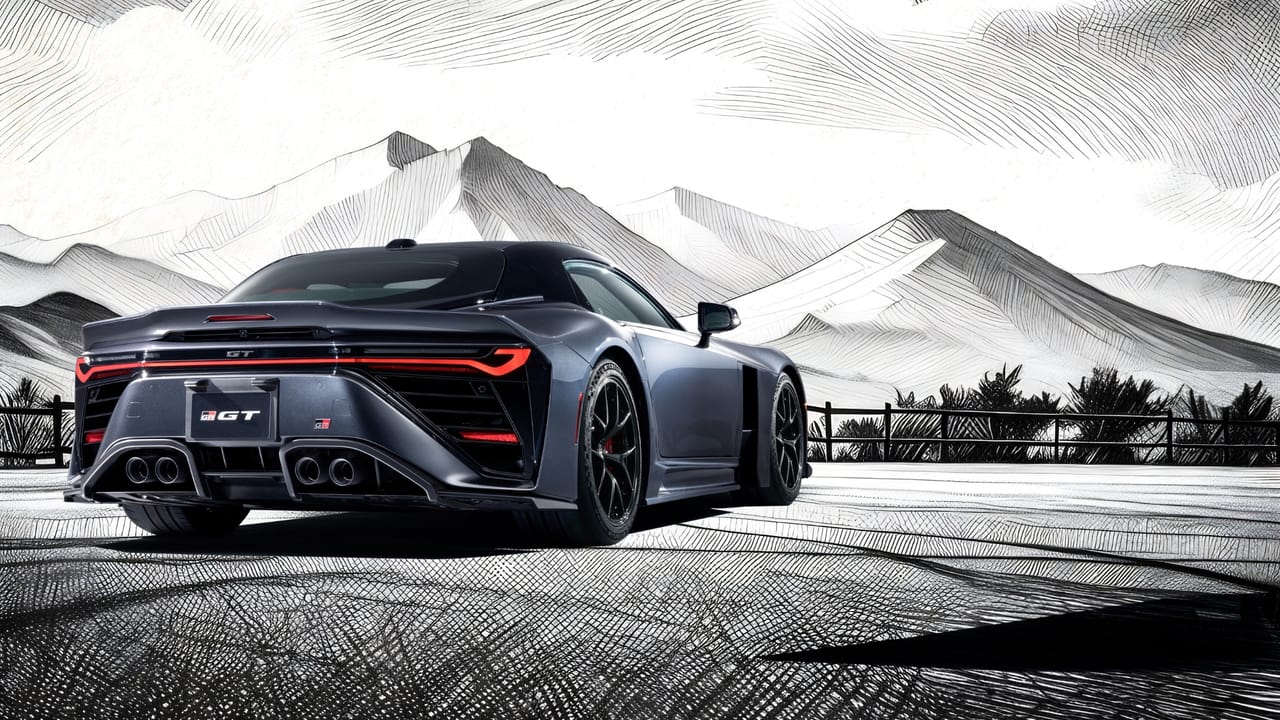
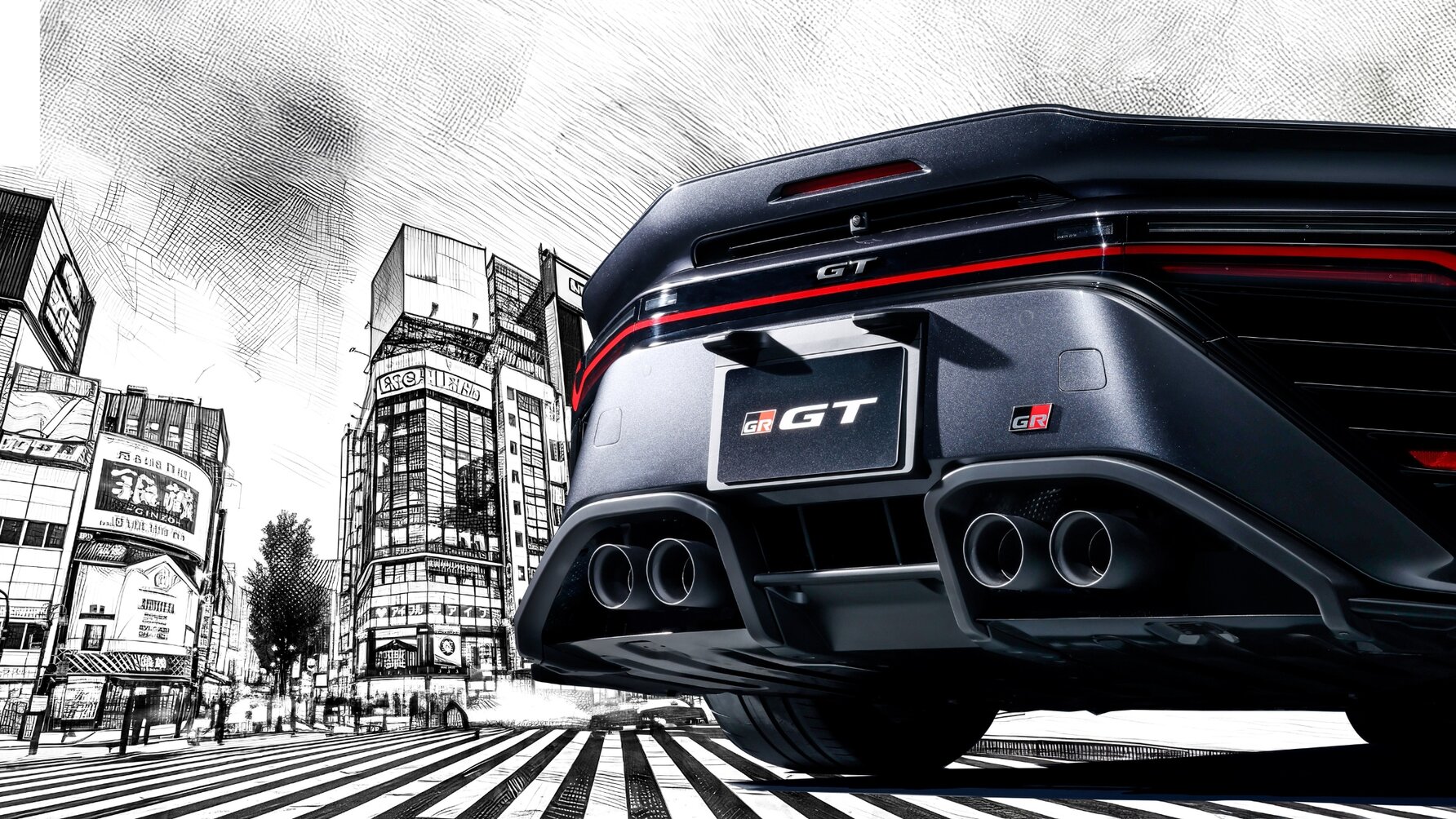
I really like the car, too. A low slung missile of a thing that doesn’t so much pull up as arrive and pose, a blend of Japanese aesthetic practicality and nascent brutalism. A long bonneted thunderstorm that pokes you in the eyes and absolutely fails to apologise. Yes, you’ll do the mental riffling through the paperwork of memory that tries to associate it with something else, but you’ll eventually discard them all. Mercedes-AMG GT, Chevrolet Camaro, Dodge Viper? Sort of. But also no. It gets more interesting the more you look at it, and it’s nothing if not worth a good stare.
Headlines? It’s a two seat, 4.0-litre V8 twin turbo with rear wheel drive and a glancing blow from a mild hybrid system that’s small enough to barely count as electric. There’s an eight speed auto with paddles, tightened up with a wet-start clutch instead of a gluey torque converter, 641bhp, 627lb ft of torque, and it weighs 1,750kg. Although TGR is still being remarkably cagey about specifics and keeps putting brackets after everything. The power figure brackets basically said ‘or a bit more’ and the weight brackets ‘or a bit less’.
Based on those metrics, you’re probably looking at 0–62mph in under four seconds, and although the 199mph top speed was quoted, the inevitable brackets (‘or more’) indicated that this will be a 200mph car. We’re kinda reading between the lines here, but it’s not exactly invisible ink. It’s also not that prescient to note that there’s probably quite a lot of headroom possible in those figures.
But what we’re looking at is an all new super sports car with a bellyful of brand new V8. Which, given the current climate feels joyous, a bit mad and utterly wonderful, if not destined for excessive production longevity. It’s also not a special, or limited run, and likely to be priced in the realms of other cars a bit like this – think obvious stuff like that Mercedes-AMG GT, or various Porsche products – and therefore sits quite comfortably in the ‘possible’ range of achievable aspiration – think £160k-ish.
Advertisement - Page continues below
This is our first experience of the car here in Japan, and there’s a lot to take in. Especially because nobody was really expecting anyone to just get in the car and bang it off the limiter. Still, you can mine the experience, and I’m turning over all the rocks I can find. So, the noise. TGR insists that the pops and bangs are natural, but they’re so syncopated they actually sound a bit fake.
Saying that, it’s got a weirdly raw, bluesy rasp when revved, the usual offbeat V8 burble higher and more mid-chest than low bass, and it sounds more racecar than old school American eight cylinder. It also gains and drops revs a bit like a four pot – not perfectly zingy, but more accurate sounding than some big capacity turbo cars that fall out of higher rpms like they can’t be bothered. And no, it’s not the heart in mouth sound that the OG LFA’s V10 used to make the hairs on the back of your neck snap to attention, but that’s the world we’re living in.
It is however, very much alive, with the rest of the technical specifications verging on the simplified. Because the GR GT seems absolutely stone cold focused on nailing the fundamentals rather than the tinselly bits. So there’s an aluminium spaceframe underneath, supported by a swathe of CFRP (carbon fibre reinforced plastic) bolt-ins. The bonnet, roof, inner door skins, rear bulkhead and boot lid, plus a few bonus bits, are all carbon fibre adjacent. The rest is aluminium. So this is a cheaper, more mass produceable way of getting – almost – the strength and rigidity of a carbon tub, and also Toyota’s first go at this kind of architecture.
It’s low – the bonnet is just above knee height if you’re 6ft tall – a couple of metres wide and very cab rear. And here’s where the packaging gets interesting, because TGR seems wonderfully obsessed with the centre of gravity and raw balance. The V8 sits so far back as to have the front of the block a few inches aft of the front axle centreline (hence it’s very much front/mid-engined and likely to keep your knees warm), buried as far down as it’ll possibly go and dry sumped. There’s a structural carbon torque tube that carries the driveshaft back towards the rear wheels, feeding into the front of the eight speed auto.
Although it first engages with a small electric motor that props up torque losses during hard acceleration and gearchanges, it’s small enough that it’s not going to move the car about on EV power. But to keep the rear of the car compact, the drive then exits the back of the ‘box into a set of conical gears that punch another driveshaft back left and forwards, through a limited slip diff and out to the rear wheels.
Weirdly for a car so obsessed with keeping everything so low, the battery pack for the e-motor sits quite high in the profile above the ‘box, but apparently the battery is so small and the overall roll centre so grounded it was deemed acceptable.
Top Gear
Newsletter
Get all the latest news, reviews and exclusives, direct to your inbox.
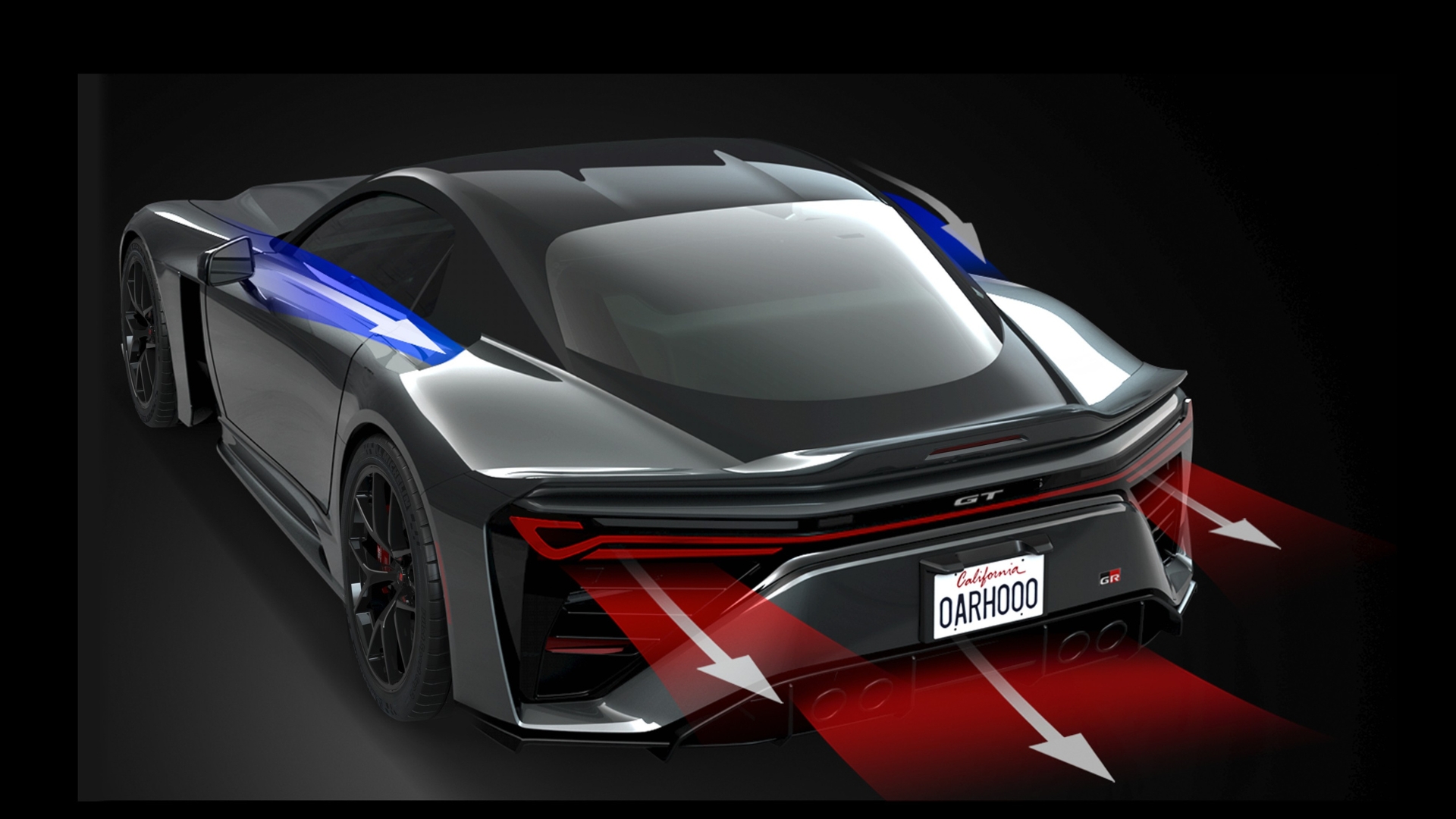
Four wheel drive possibilities? Well, everything is possible if you throw enough money at it, but looking at the packaging on this car, it’d be a massive hassle. There’s also a distinct lack of active aero – Toyota citing added complication and higher centre of gravity, as well as the fact that the GR has all the aero and cooling functionality that it needs. Which is interesting in itself. No downforce figures have been given. Not even with brackets.
The driver and passenger sit well back and down, staring out over an absolute plane of bonnet, the suspension electrically damped but otherwise just double wishbones and coils all round, supporting 20in lightweight wheels and Michelin Cup 2s with the usual dinner plate sized Brembo carbon ceramics. Which again, feels pared back. It’s not inferior, but where manufacturers seem keen on adaptive and ‘intelligent’ suspension systems and PR-able moments, this is straightforward. It’s got a nose lift – there’s a button on the centre console that no one mentioned – but that’s about it.
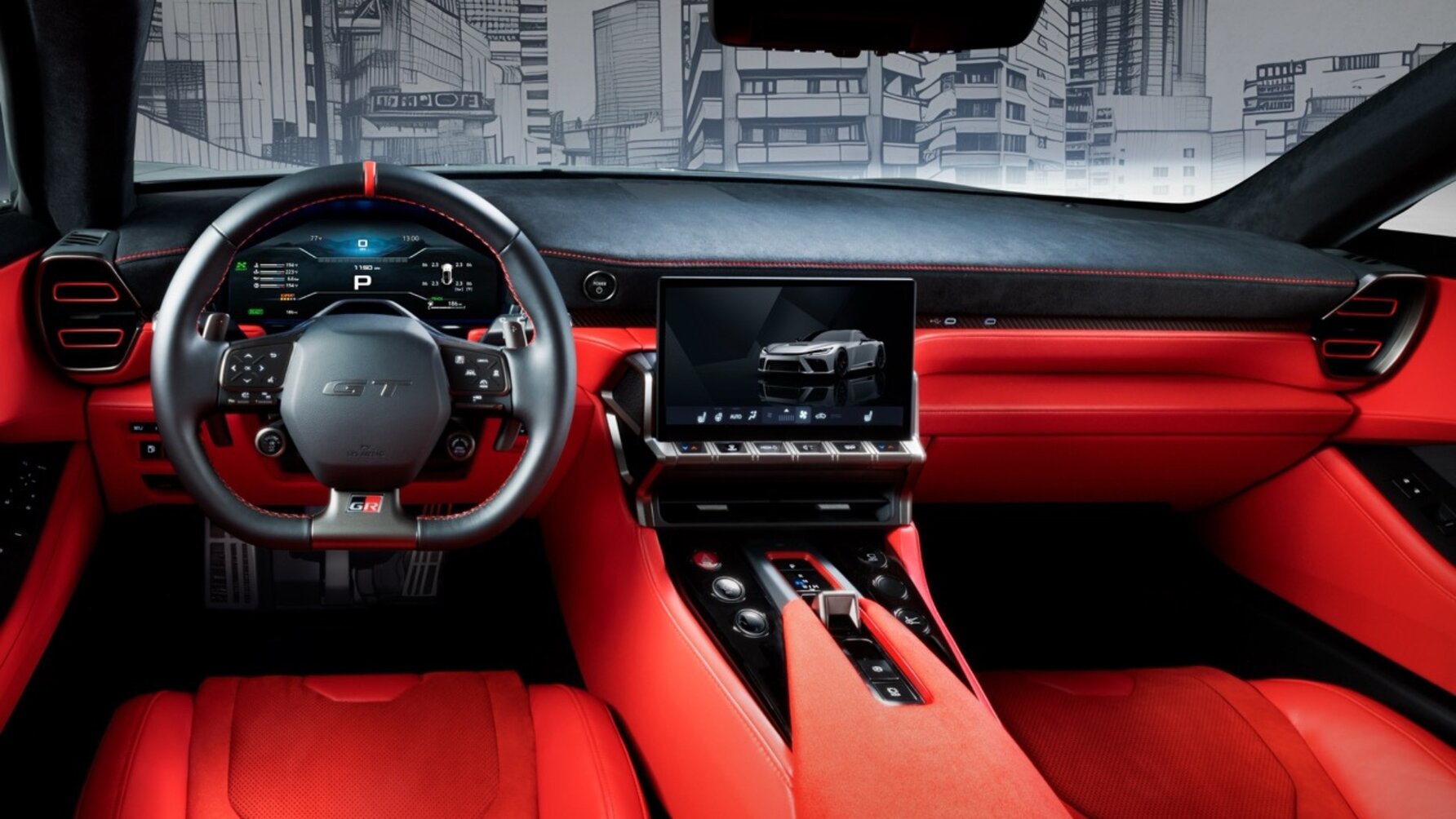
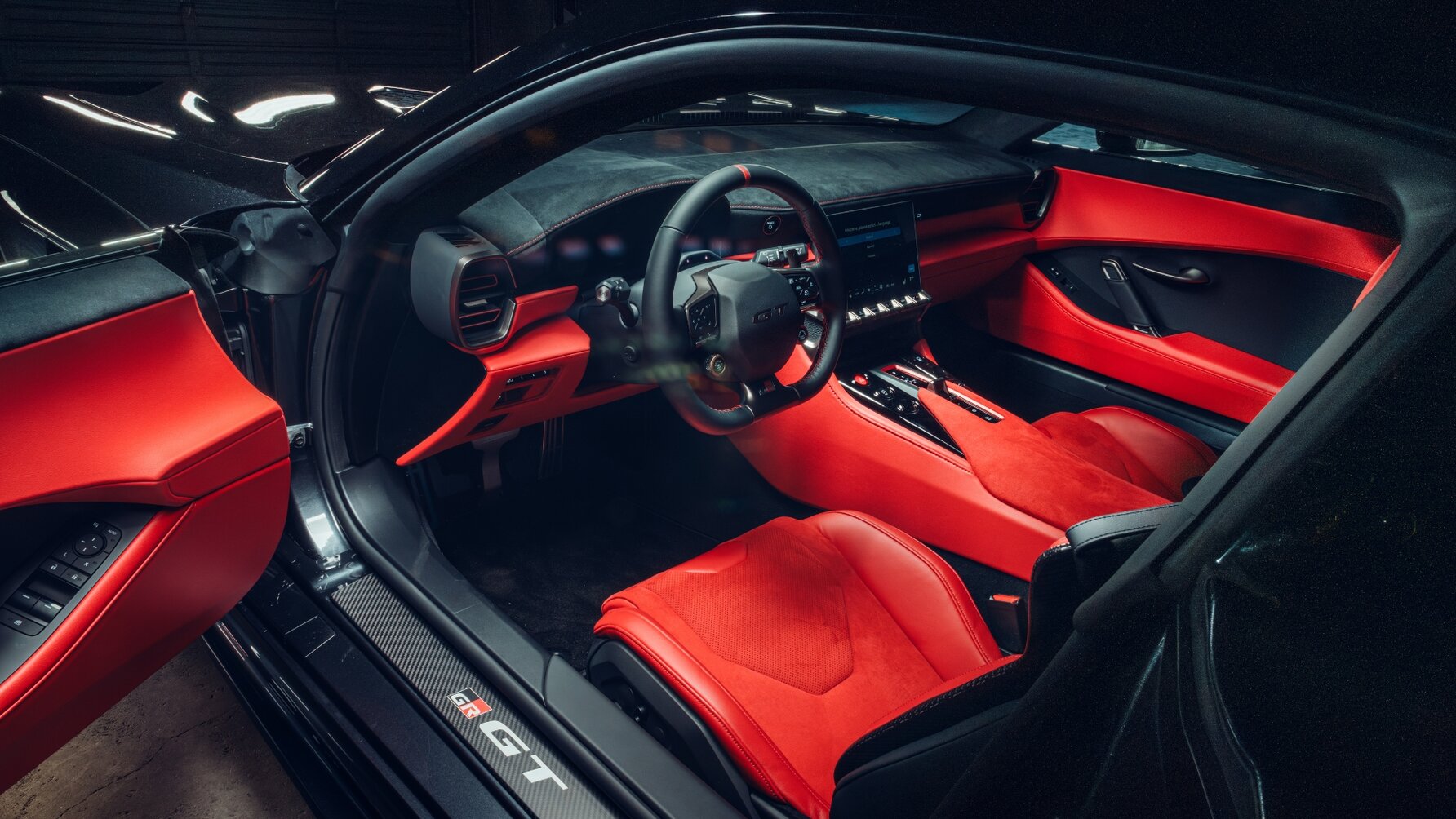
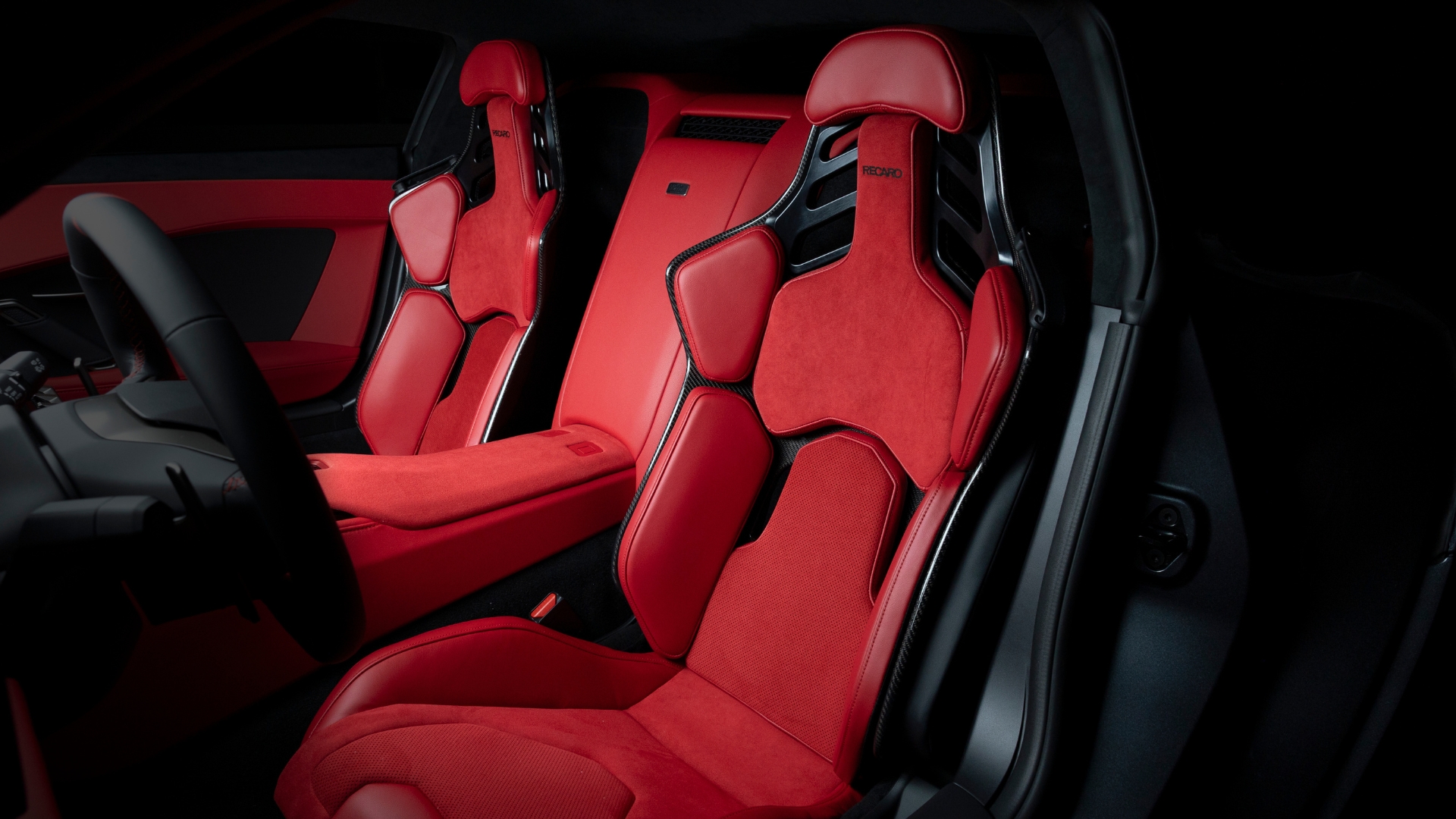
Similarly, inside it’s restrained. Ignore the intestinal red leather and you’ve got a pair of carbon buckets with individual padding, excellent ergonomics when posting up towards the pedals and flat bottomed wheel. There’s a digital dash up front with big shift lights and gear display icons, a couple of rotary controls on the bottom of the wheel – the right hand side for the four drive modes, the left hand side for traction control severity, just a little label that says ‘Expert’ and a plus and minus. Though it’s not clear which way you rotate depending on how expert you might be feeling.
Other than that, there’s a big transmission tunnel shrouding the driveline, a small paddle for gear engagement and a relatively modest touchscreen in the middle. And yes, there are physical switches underneath for oft used functions. Pre-production prototype? It feels real, and sorted and quality, not even close to science fiction. There’s nothing in here that even hints at unnecessary gizmos. To be honest, it could actually probably do with a couple of theatrical flourishes, but it feels likeable and honest. Although the cupholders are in a really daft place behind your elbows.
So it’s all gravy as far as desperately wanting to have a go, but there are more than a few arguments going on about what this car actually represents. There are hints of LFA in the styling (think mini buttressed intakes on the top of the rear wings and triangular cutouts on the bonnet), but it’s actually more than that. In fact, Toyota has explicitly indicated that this car follows in the intellectual footsteps of the 1960s 2000GT and original LFA, making the whole ‘new LFA’ argument slightly muddy.
It’s called ‘Shikinen Sengu’ in Japanese. A tradition in which a Shinto temple is periodically rebuilt every couple of decades to represent eternal renewal (Tokowaka) and the passing down of ancient craftsmanship. The reference? Toyota keeps referring to the transfer of generational knowledge, the ‘secret sauce’ of car building, from the engineers that created the original LFA to the new guys, a strangely incongruous phrase for a Japanese company to employ. But it makes the point that truly great cars have that extra little something that can’t be found down the back of the coding sofa. Data doesn’t drive the smile on your face, or the look back when walking away; emotion does.
The slightly confusing bit here is that while the world was waiting for a new LFA, Toyota has actually birthed... two. The GR GT feels more like a literal successor – combustion engined, rear drive, two seat supersports with utterly Japanese sensibilities – while the Lexus LFA Concept becomes the intellectual son, sporting more involved and forward thinking tech, more expense and sophistication.
One is the everyman thrasher enhanced by a real world racing car programme, the other the cultured science experiment. But whichever way you look at it, Toyota isn’t just talking about this stuff – it’s actually doing it. Bringing the drama back into the lineup, being brave, exciting and V8 powered. And we’re absolutely here for it.
Toyota GR GT
Price: £160,000 est
Powertrain: 4.0-litre biturbo V8, 641bhp, 627lb ft
Transmission: 8spd auto with transaxle-mounted single e-motor
Performance: 0–62mph in <4.0secs est, 199+mph
Weight: 1,750kg