





Big Reads
Salt Fever: behind the scenes as the wild JCB Hydromax hit 406mph
All manner of wacky racers come together at Bonneville Salt Flats. This year, there was a very special guest
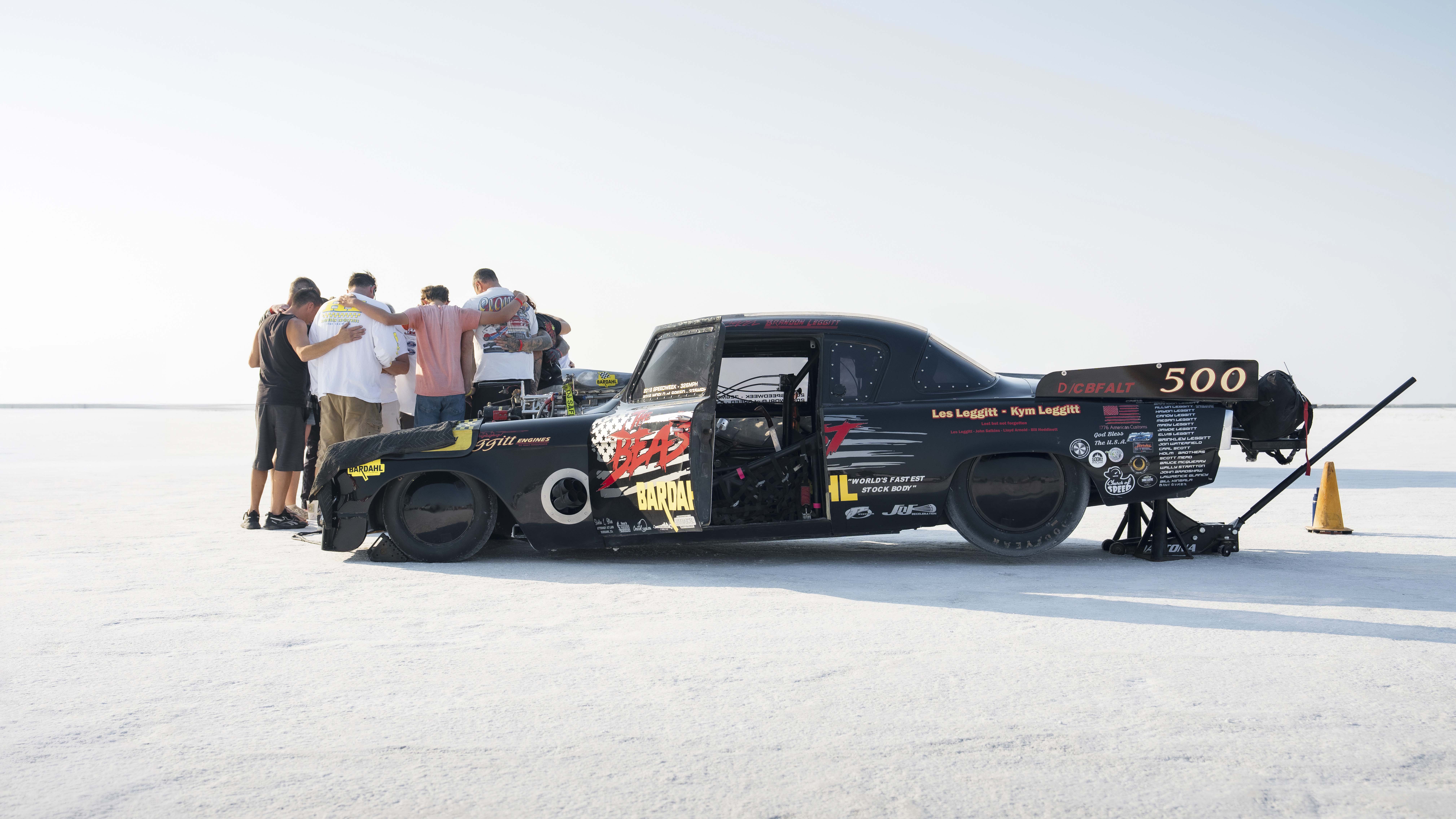
It's called The Beast. A 1953 Studebaker in black with dark riveted windows and black disc wheels. The Hemi V8 that periscopes up through the bonnet runs nitromethane, up to 8,000bhp. It’s like something from a Stephen King novel, a sense of pent up evil flows from it, the most sinister car on the salt.
And then: “Gather round everyone.” Big guys with tattoos and beards go into a huddle and from the centre of it comes, “I want to pray to God for a fast run, a safe run today.”
Advertisement - Page continues below
Bonneville is a religion. Every year believers come out here for a week to prostrate themselves at the altar of speed. Speed Week, they call it. Hardly imaginative, but as far as accuracy goes, you can’t fault it. Land speed records have been broken in other places, but as far as they have a home, these stark, empty salt flats are it, the place where the 300mph, 400mph, 500mph and 600mph barriers were broken.
Photography: Simon Thompson

And records are still being broken. Just not the big one. Because while Bloodhound LSR languishes in Coventry Transport Museum and with it any hope of once again pushing beyond the sound barrier, out here the creed of speed is a broad church where all worshippers are welcome.
I open the SCTA (Southern California Timing Association – the organisation that runs Speed Week) rule book. It lists 12 engine capacity classes, with further subdivisions for engine categories and fuel types. It then lists something like 27 categories of car body shape and style. Multiply one by the other and it’s hardly surprising the list of record holders runs to 20 pages. And that’s before you start counting the two wheelers. And the three wheelers.
Advertisement - Page continues below
Ian Arnold, a Brit, sits astride his completely unmodified 350cc Royal Enfield. It’s a 2022 bike, limited to 71mph. But if he can average 68mph across a measured mile, he’ll get a record. Because he has a sidecar bolted on the side.
Meanwhile a pair of Norwegians have turned up with Moped Dick – a self-designed, home made 50cc bike that’s essentially two wheels joined by an extruded aluminium post. Somehow, despite looking like they flew over with it in their hand luggage, it’s passed scrutineering and Per-Henrik Bernstrom is about to point himself down 10 miles of desert in a quest to turn 32bhp into 94mph.


It’s not just Americans then. The pull of the salt extends to Japan, to New Zealand, to Germany and more. What binds them all is Salt Fever, a quasi-religious sensation, an involuntary reaction to this weird and wonderful place. One morning I drive out on to the flats before dawn, drive way down the side of the twin 10-mile tracks, far beyond the two-mile stretch of paddock where teams work on their cars, until all signs of life are no more than black dots on the horizon.
I stop and get out, walk away from the car. Already the heat is oppressive, the salt sucks the moisture from your mouth, there are no echoes when I shout. It feels like I could reach out and touch the pastel-painted mountains. In this emptiest of places I feel claustrophobic. It skews my perspective and when I drive back there’s no sensation of speed, no sensation of movement. Everything is just whiteness.
It feels completely permanent, as though life has never intruded into this hostile environment, as though nothing out here has ever moved. And yet each year it floods. The salt dissolves into water and as it dries is relaid as an uneven crust. To run Speed Week the organisers have to drag and roll it flat, packing it down hard. This year there are mutterings that it’s dusty down at mile three, cars are wheelspinning there, and everywhere else it’s bumpy and rough.
You expect more of the start than a spray-canned line
Top Gear
Newsletter
Get all the latest news, reviews and exclusives, direct to your inbox.
The truth of it is that there isn’t much salt left, just a couple of inches depth where once it was measured in feet. No one appears to know where it’s gone – climate shifts and cycles account for a proportion of the loss, but the one place people can lay the blame is with the nearby industrial potash plant.
It has a licence to remove salt, extract the potassium for use in fertiliser and ammunition, and return it. But instead of scattering it back flat, it dumps the salt in giant mounds. The Save The Salt Coalition is campaigning to restore Bonneville to its former glory, but no one is quite sure what exactly should be done.
In the meantime the racing continues. For a place with such heritage and history, you expect more of the start than a spray-canned line on the salt flanked by awnings and deck chairs. But there’s nothing to see here. No one leaves the line in a fury of wheelspin, most are so long-geared that they’re pushed off the line and up to 50mph by a truck, so as a spectator it’s about the queueing up rather than the spectacle of the run.
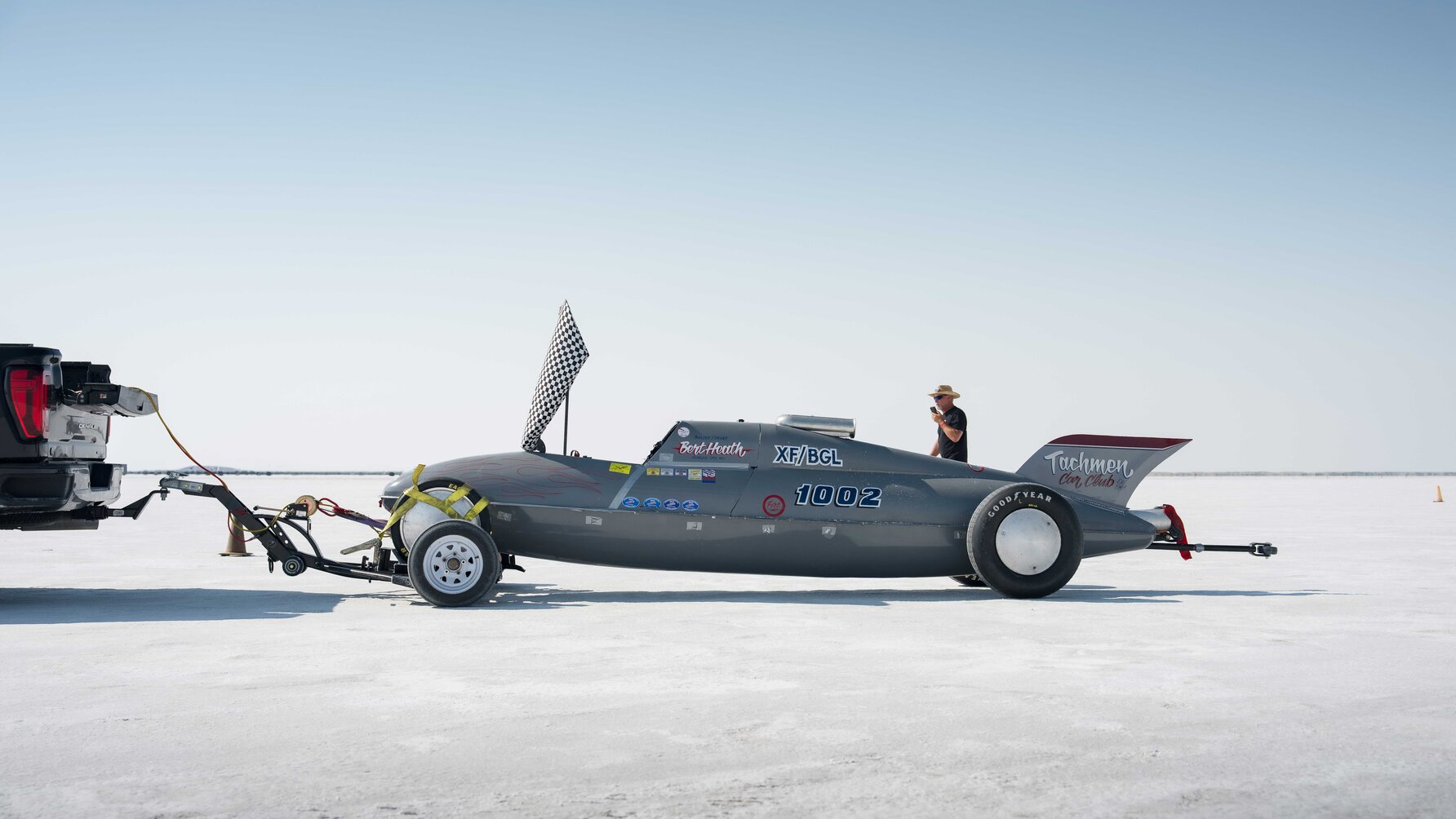
There are plenty of weird and wacky racers to pore over. The lakesters are my favourite, outrigger wheels holding up a body often formed from a military aircraft’s auxiliary fuel tank. One has inserted a 750cc bike engine in an F86 Sabre fuel tank, another has used the reservoir from an F4 Phantom and combined that with a Dodge Flathead engine from the 1920s, forming the most steampunk thing I see on the salt. Not least because the push car is a 1934 Studebaker chassis topped with home-beaten panels.
It’s the inventiveness I love, that you just don’t see anywhere else that motorsport calls home. There’s a bastardised Triumph Spitfire out here – well, it’s actually a GT6 but we can forgive that as only the cabin conforms to the description. The front end has been massively, comically elongated to contain nothing more than a 750cc turbocharged Suzuki bike engine driving the front wheels.
The queue is too long, so they’re debating heading back to the paddock, disconnecting the turbo so they can run in a different class on the other track. A couple of cars ahead of it there’s what looks like a quarter mile open cockpit dragster, sporting a beefy V8, but with one side blanked off – no inlet trumpets or exhausts.
I ask what’s going on. “It never did run right as an eight, so I’ve switched it to a four,” comes the laconic reply. “I don’t know why, but it’s much sweeter now,” he says scratching his head.
Toyota’s 2JZ is a popular engine choice. There’s a Toyota Tacoma pickup vying to be the world’s fastest if it can hit 272mph, but traction issues mean it’s having to run 1,450bhp, instead of the 2,500bhp it’s capable of. Valley Fever, a streamliner, has a twin turbo installation and posts 340.405mph through the measured mile, making it one of the fastest cars this year. Another streamliner, Catzilla 2, looks fearsome, but six peashooter exhausts tell a different story. Inside lurk a pair of 1.0-litre three cylinder snowmobile engines.
But it’s not just a matter of getting your car into a class, through scrutineering and then nailing it. The SCTA insists you build up speed gradually, proving that both you and the car are up to the task in this hostile landscape where the only markers are the mile flags, which gradually lower themselves against the earth’s curve. And that’s not as easy as it sounds.
A 1930’s V8 coupe has just been pushed off the line, now a speck at the centre of a fluctuating engine note. It’s left behind a dejected-looking mechanic scuffing the salt with the toe of his boot. I ask him what’s up with the car. “Ain’t nothing wrong with the car. It’s the driver. He’s 78 years old and he still ain’t learnt to keep his foot in.”
I don’t blame the old guy. Trying to earn your red 200mph T-shirt and badge isn’t for the faint hearted when the car is the product of thumb in the wind engineering. Better to be travelling slowly. Which could well be the motto of the four jolly, bearded gentlemen from Texas, friends for over 40 years, who potter around a 1950s Crosley economy car looking like a Santa Claus tribute act.
“We come out here every few years with a new project. It stops us gathering dust and getting in the way back home.” This is homespun racing, small teams of tinkerers scratching their heads and trying to figure things out. They’re the rule.
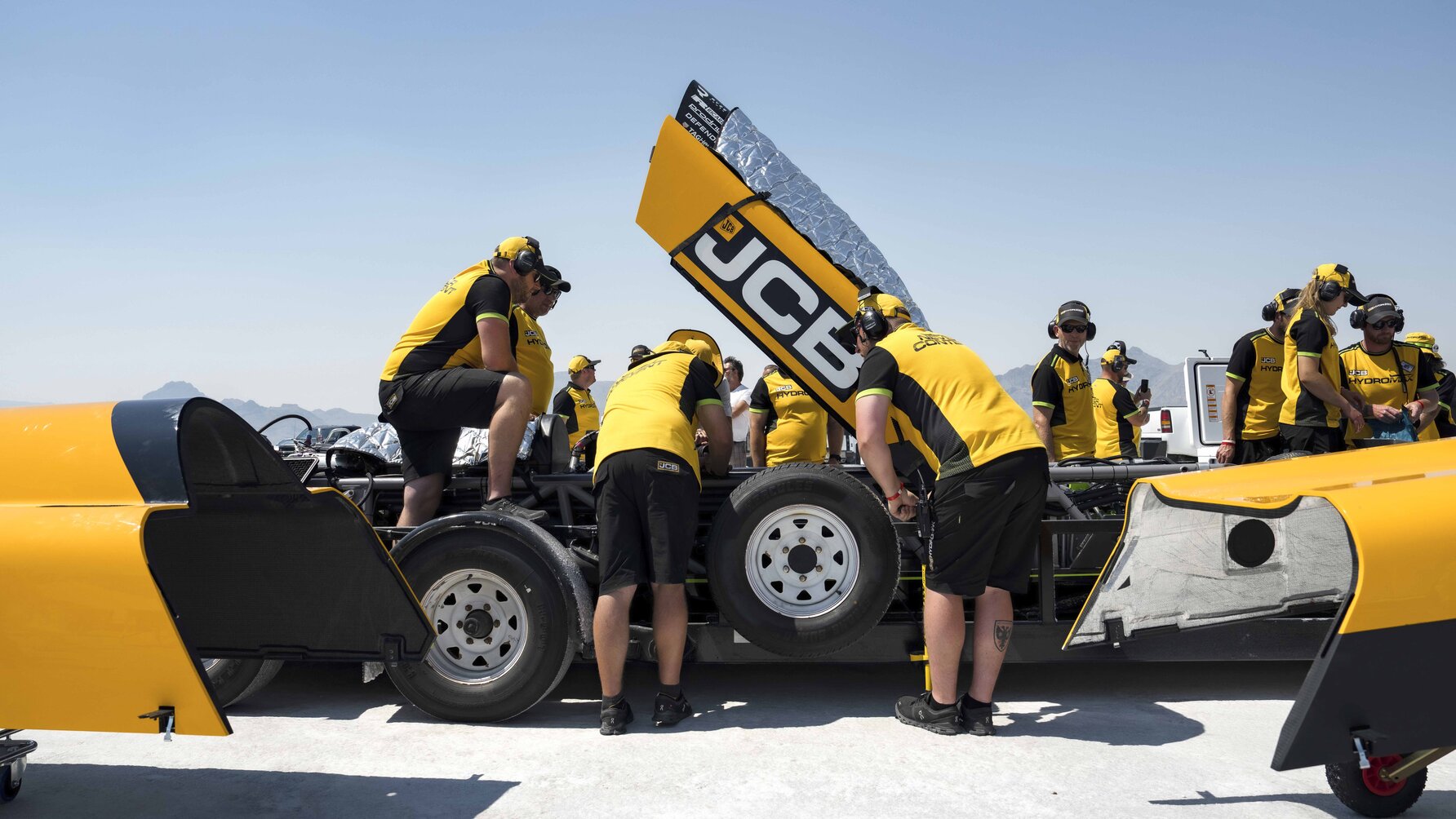
Now meet the exception. “Y’all think you got enough guys here, or you wanna hire some more?” someone drawls at a sea of busy yellow backs. At the last count JCB had 45 people out here on the salt. While everyone else is here to have fun and chase records, JCB has a grander plan: the promotion of hydrogen as a fuel for its excavators and plant machinery.
Battery electric is impractical, fuel cells can’t hack building site dust and dirt. Twenty years ago it came here with Dieselmax, now it’s back with Hydromax. Same colour scheme, similar look, but only two components have been carried over: the tyre valves and wing commander Andy Green.
As far as salt flats have a celebrity, he is it, still the fastest man on earth, and the possessor of a steely gaze that appears to see all the way to Bonneville’s distant corners. The Black and White bar in nearby Wendover, the place everyone gathers when they’re not on the flats, that keeps Speed Week’s candle burning year round, loves it when he turns up. JCB posters sit proudly on the walls.
The SCTA has no hydrogen class, so it runs as a BGS – Blown Gas Streamliner. At its heart sits a pair of hydrogen combustion four cylinder engines lifted from a digger. But where in normal use they develop 74bhp, here, tuned by Ricardo, they now develop 800bhp each.
One drives the front wheels, the other the rears, each driving through a regular digger clutch to cope with the colossal torque and an Xtrac motorsport gearbox where first runs to 120mph.
Cooling, in common with many of the streamliners which seek to minimise drag by doing away with radiators, is by ice tanks. The tyres run at 9bar/135psi of pressure, while behind Andy’s cockpit twin hydrogen tanks store 4kg of the smallest molecules on earth at 700bar/10,150psi.
A total output of 1,600bhp is nothing out here
A total output of 1,600bhp is nothing out here, where most competitors seem to have blown up at least one dyno back home. But in terms of converting power to speed, no one has done it more efficiently. Hydromax is 10 per cent more slippery than Dieselmax, has neat channels behind the front wheels to duct salt crystals out the side, minimising drag further back. It is, unquestionably, the star of Speed Week. SCTA competitors love that their event has attracted such a high profile project.
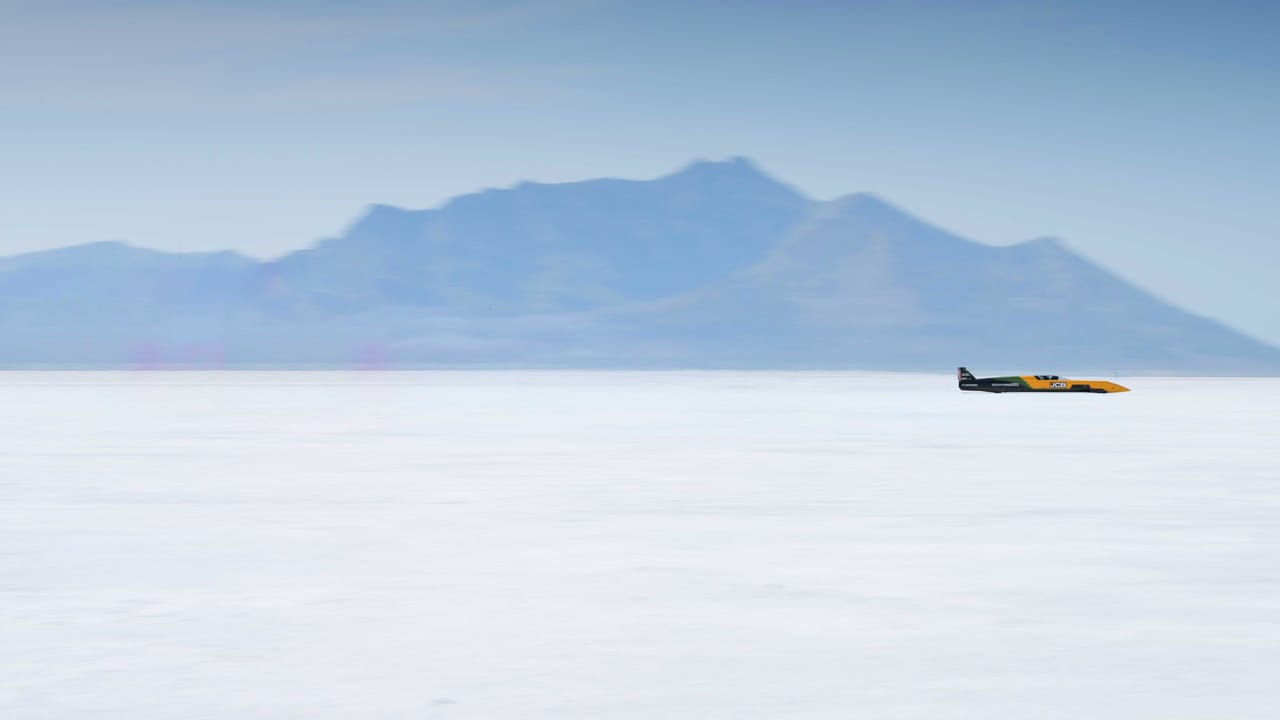
But not because it sounds good. At idle it still sounds like a digger, rattling and chugging until it’s pushed off the line by a Defender Octa driven by three-time Le Mans class winner Darren Turner. On the last day of Speed Week I go and watch it from the four mile mark, down near the timing hut where competitors go to pick up their slips. Having finally found its voice it howls past, but hundreds of yards out across the salt and without any sense of perspective, I’d never have guessed it came out of the measured mile at 370.681mph.
The following morning, having spent the night in Impound (think Parc Ferme) it makes a near identical back up run, averaging 368.347mph. Not the fastest car at Speed Week 2026, that honour going to the 396.949mph achieved by the Ferguson Racing streamliner, but enough for class honours.
But that wasn’t the end of Hydromax’s mission. After SCTA Speed Week, the FIA turns up for globally sanctioned record attempts, run in two directions with the car turned around and back through the measured mile in under an hour.
Everyone else has gone. It’s just JCB and the desert. And an extra 400bhp. Because it turns out the team had wound back the power to 1,200bhp for Speed Week. And now, fully unleashed, it records a two-way average of 406.320mph. Everyone celebrates and throws their hats in the air, JCB calls it mission accomplished.
They won’t be back to fight for a fistful more mph next year, to pray for safe runs, to weld up belly tanks or squint into the dazzling whiteness. Because unlike most round here they never caught Salt Fever.
Trending this week
- 2027 TopGear.com Awards
The best cars of the year: welcome to the 2027 TopGear.com Awards
- Top Gear Advice
Here are 17 cars that’ll (probably) do 300,000 miles or more