
25



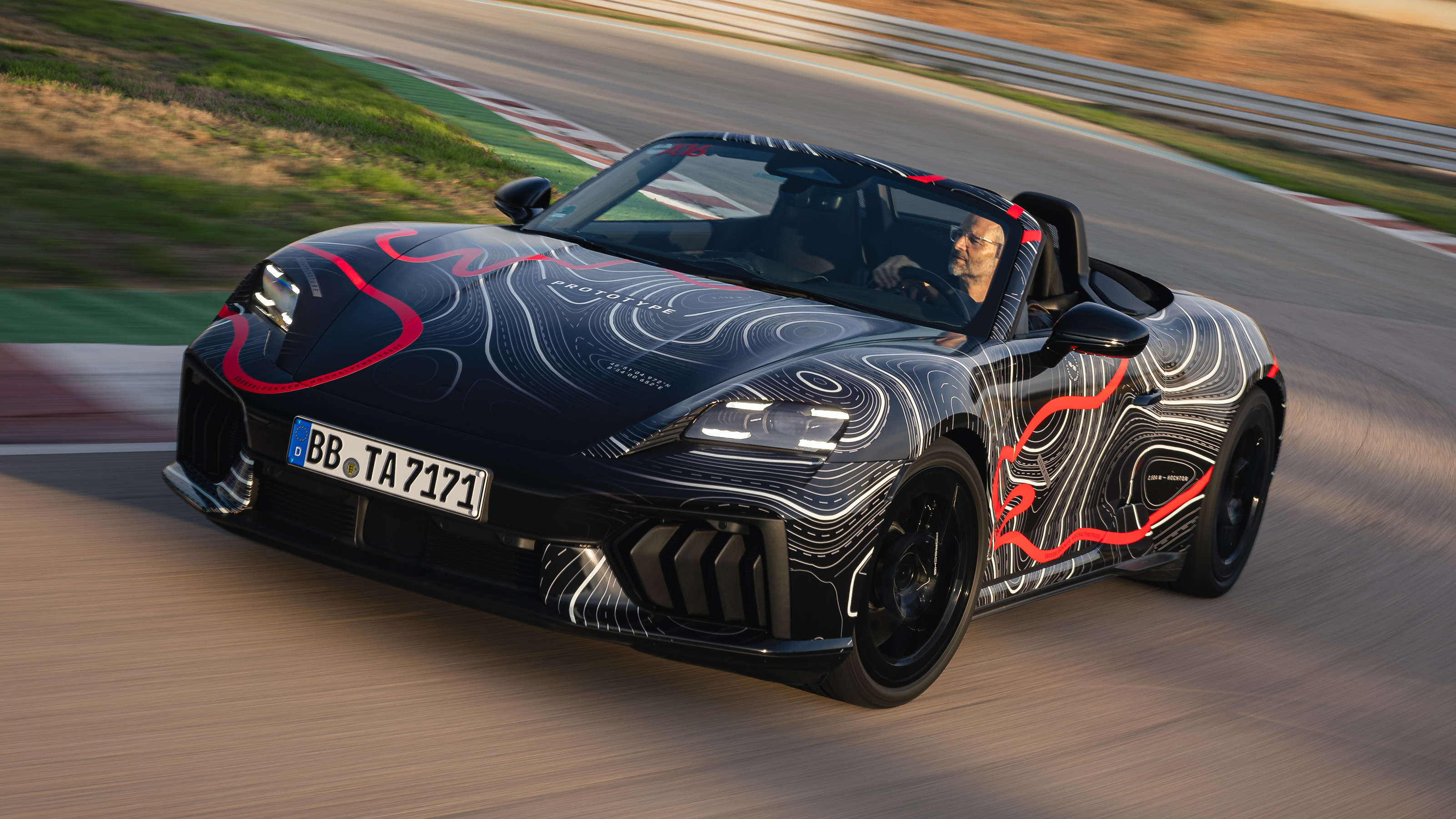
You can surely guess. Dark murmurings out of Zuffenhausen at the start of 2026 suggested incoming CEO Michael Leiters was pulling the plug on the Boxster EV in favour of ICE and hybrid. Wrong. We’ve just watched a Porsche engineer very much plug a car in, and it’s suspiciously Boxster-shaped.
Well, yes. The electric 718 Boxster was threatening to become a saga to rival the travails of Odysseus. Along with its previously inviolable German colleagues, Porsche has been battling a collapse in demand in China, tariff headaches in North America, and industrial turmoil in its home market. To recap, Porsche’s operating profit fell from £4.72bn to £345m in 2025, and it spent a fortune rethinking its product strategy. But it has also invested heavily in the Boxster EV, so binning the whole thing off was surely unconscionable.
Exceptionally. We’re on the circuit Mallorca Llucmajor, a 3.2km-long facility on the south of the island, a stone’s throw from Palma. A sneaky peek in one of the garages reveals an Audi R8 LMS GT3, so although this is no Nürburgring it’s still a usefully shaped hunting ground. I got a scant handful of laps but it was enough to allay any fears that electrifying the Boxster has killed the qualities that made the ICE version so appealing.
It has terrific steering feel, turns into corners incisively, and pivots around the driver exactly like you’d expect a mid-engined car to do. It also sounds fabulous, more on which in a moment. We’re on a track we’ve never driven before, following a pro driver – in this case a certain Timo Bernhard, the man who holds the lap record round the ’Ring – yet we’re largely able to hang on to the 911 GTS he’s piloting.
Never. But the electric Boxster really is a gem. Porsche is clearly no slouch when it comes to chassis engineering so our expectations are high. Nonetheless, there’s nuance and texture to the handling that’s easily the compare of the very best ‘conventional’ sports cars. It brakes with tremendous fidelity, changes direction with unfailing accuracy, and allows you to make fine corrections through higher speed corners.
Rear-axle steering is fitted for the first time, and it makes its presence felt without feeling over-zealous. Remember also that the throttle pedal in an EV is more of a torque demand switch than anything else. Naturally, there’s also fun to be had with the slip angles on the slower corner exits. It’s an absolute blast.
It really is. Porsche needed to get this right, but it seems to have figured out what really counts in the battle to convert the cynics. Which is to say, audible as well as physical involvement. As with the use of special effects in the movies, though, a certain suspension of disbelief is still required.
The new Mercedes-AMG GT 4-Door and Hyundai’s Ioniq 5 and 6 N models have shown what’s possible when it comes to synthesising sound, and the Boxster’s E-Shift and virtual engine sound is arguably the critical component when it comes to unlocking its full potential. There’s a button below the drive mode one on the lower right part of the steering wheel; push that and the effect is transformative.
Yep. It emulates – to use Porsche’s word – the character of a seven-speed PDK transmission, the audio output modelled closely on the sound made by a 981-generation Boxster GTS. That’s the era that used the 3.4-litre flat-six engine with a 7,800rpm redline, and the plump induction noise is expertly evoked. Perhaps Porsche could have mimicked something even fruitier from its historic product matrix, but that would have been inauthentic. This sounds and feels appropriate, and more importantly allows you to dial your brain into what’s happening with real accuracy.
What you hear, particularly as you downshift on a corner approach, allows you to control and exploit what happens at apex and exit. Someone in Weissach will have done a PHD on this stuff, no question. I reckon my lap times are faster with the E-shift engaged. And even if they weren’t, I was definitely having more fun.
Get all the latest news, reviews and exclusives, direct to your inbox.
Indeed. You can drive the car like a regular automatic or use the flappy paddles. Or if you’re crawling along the M25, just leave it in standard electric mode and listen to something else. Tyre noise or wind rustle, perhaps, although both are well contained. Or the sound of your life passing by. The cabin is typically Porsche: there are three main dials in the instrument cluster in front of the driver, a central touchscreen, and a centre console with a stubby little drive controller. Happily, there are lots of physical buttons for the climate control and audio.
If the E-Shift is inactive, the paddles offer three levels of brake regen. I had a quick play with it but preferred to use them for shifting. Besides, the friction brakes are terrific. Four drive modes are available: wet, normal, sport and sport plus. The latter two sharpen everything appreciably but to be honest I did a fair few laps in normal mode and found it perfectly responsive. Basically, it feels like a typically well calibrated Porsche, only this time it’s electric. And if you’ve got the sound on, you’d be hard pushed to even be able to tell that.
Porsche is keeping its powder dry on the key numbers for now, so we don’t know the exact configuration of the motor, the power output, or how big the battery is. But we know that it uses an 800-volt architecture called ‘E-core’, that there are three battery modules, and that they use prismatic rather than cylindrical cells. The battery pack sits behind the cockpit in proper mid-engined style rather than under the floor; it’s a stressed member which helps reduce weight because it doesn’t need separate protection. So as well as sounding like a fully caffeinated Porsche, the driver also sits in the correct place: low down.
Weight distribution is 40/60 front-to-rear, which is close to optimal for a mid-engined car; the overall weight is said to be similar to a 911 PDK’s. So, around 1,600kg. Though the engineers I spoke to remained tight-lipped, I suspect they’re targeting 500km of range, which equates to 310 miles.
Many of the chassis components are shared with the 911. The steering is from the Carrera GTS, and the wheel/tyre combos and brake system are also 911-related. The all-electric Boxster will also be the most powerful 718 ever. Although Porsche hasn’t confirmed it, we expect there to be two versions initially, both single motor but one more powerful than the other, and exclusively rear-drive.
The most powerful car – let’s say 600bhp – will hit 62mph in under three seconds and has a top speed of 155mph. It could be called Boxster Turbo. Porsche says the electric 718 Boxster has completed more than four million kilometres of testing. I added about 35 to that tally and nothing malfunctioned.
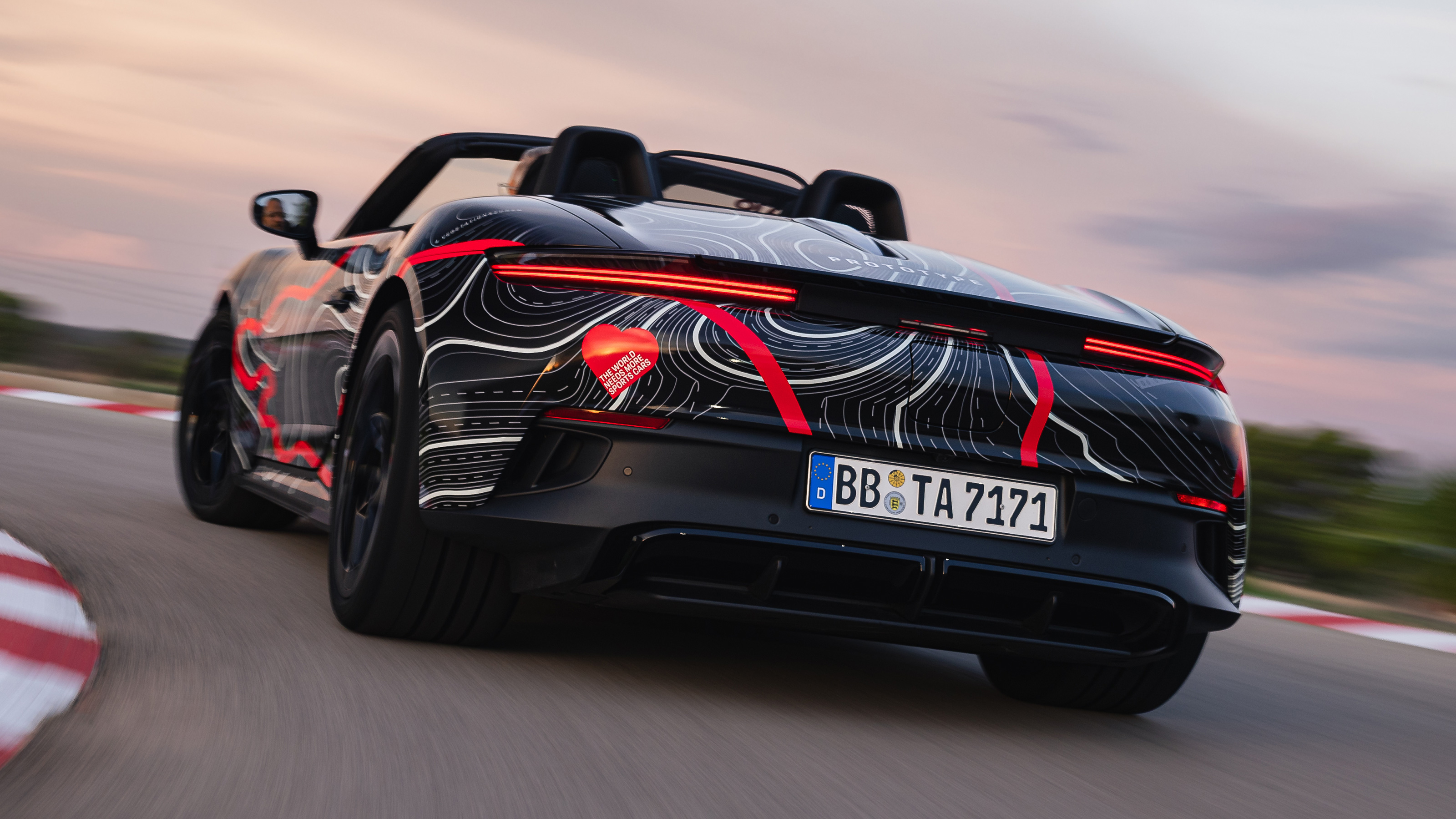
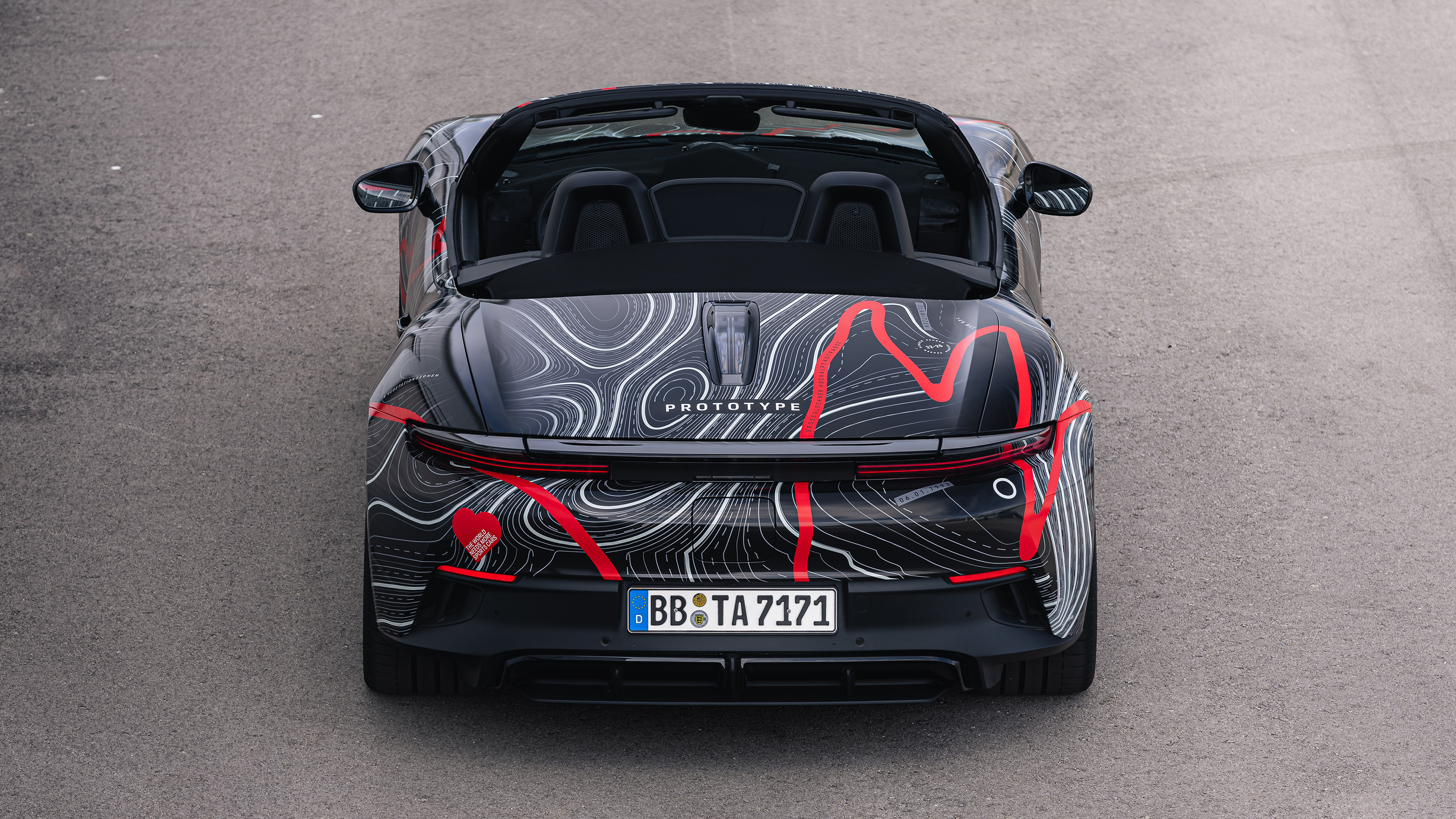
I haven’t mentioned the exterior design but you can judge for yourself. Beneath the camouflage is a contemporary Porsche: the headlights are new, it looks longer and curvier across the rear three-quarters, and there’s a light bar at the rear. Desirable but unflashy.
True enough. It’ll land in 2027 into a market that’s still sniffy about fully electric sports cars, but the Boxster itself has a strong sense of purpose. The all-electric Alpine A110 is due at the same time, and pretty soon we’ll get a production version of the Audi Concept C, which uses the same PPE platform as the Porsche but will get a Quattro iteration. Their arrival signifies a changing-of-the-guard, and each of them promises to have its own distinct character. We can ask no more than that.
Get all the latest news, reviews and exclusives, direct to your inbox.
