


12

/* Style Definitions */ table.MsoNormalTable {mso-style-name:"Table Normal"; mso-tstyle-rowband-size:0; mso-tstyle-colband-size:0; mso-style-noshow:yes; mso-style-parent:""; mso-padding-alt:0cm 5.4pt 0cm 5.4pt; mso-para-margin:0cm; mso-para-margin-bottom:.0001pt; mso-pagination:widow-orphan; font-size:12.0pt; font-family:"Times New Roman"; mso-ascii-font-family:Cambria; mso-ascii-theme-font:minor-latin; mso-hansi-font-family:Cambria; mso-hansi-theme-font:minor-latin; mso-ansi-language:EN-US;}
The Hypercar of the Year is not going to revolutionise personal transport, reinvent motorsport or solve the looming energy crisis. Far from it, in fact. Unlikely to squeeze very much to the gallon, it will be made in tiny numbers and, at around £800,000 – more than three times the price of a Lamborghini Aventador – it will be bought by just a very few, very rich characters who will enjoy the exquisite qualities of a machine so unlikely ever to be a real, material presence in most of our lives that it may as well be a unicorn. And there it is: the Pagani Huayra, perhaps unicorn is the best way to think of it.
Photos: Justin Leighton/Rowan Horncastle
This article originally appeared in the December 2012 edition of Top Gear magazine
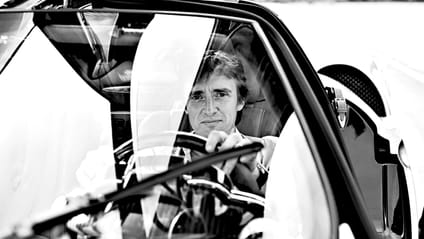
You're reading this mag, so you're probably familiar with the story of Pagani's rise from a supercar upstart who set up shop right next door to the big players in Italy, through to the launch of the first Zonda to a truly astonished world in 1999. In just over a decade, Pagani has become established as a mythical maker of fabulous machines whose performance, price, looks and sheer presence have captivated dreamers, car freaks, billionaire playboys and eight-year old kids.
Maybe bedroom-wall posters are too often quoted as barometers of a supercar's desirability. But I am going to do it again. The editor of this magazine grew up with a poster of a Lamborghini Countach decorating his wall. So did I. His son now has a poster featuring a Pagani Zonda on his wall. So do I. And I'm not joking. I'm 42 years old, have two kids, a mortgage and eye bags like an elephant's nutsack, but I have a poster of a supercar on my wall. Not just any poster either. This one isn't particularly large and it's a bit creased from where I stuffed it in my bag to bring it home, but it features a beautifully executed, pencil design sketch of a Pagani Zonda and it's by Horacio Pagani. And it's signed by the man himself. Therein lies a clue: "the man himself".
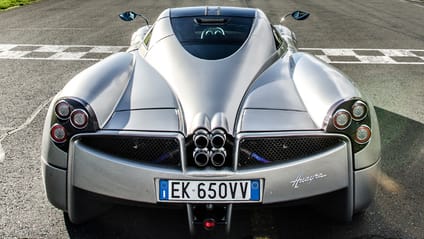
Here's what Horacio Pagani has to say in the first paragraph of his overview of the outgoing Zonda. He's just giving you the headline points here, the basics you need to know about his £800,000 car. "And like a passionate lover, the melodious performance arises from the engine and gradually growsto a fascinating and vertiginous crescendo until blazing bright-blue flames come spurting out..." Yes, "spurting", he actually says spurting.
Compare, if you will, words taken from the Lamborghini website giving a similar overview of the Aventador. "Going far beyond what was previously thought possible is just as much a part of our brand as our core values: uncompromising, extreme, Italian." Brand? Core values?
On the one hand, we've got an actual man, the man whose name appears on the product, apparently tipping his concrete over the way the car delivers its power and spurts blue fire, and on the other, we're being lectured on the company's corporate mission statement. I don't want a PowerPoint presentation, I want my trousers to sizzle with the sheer exuberance and thrill and wonder of it all. That's why a Pagani graces my wall on a poster, even if it's not likely ever to grace my garage as a car.
I want the Hypercar of the Year to bring all the magic, mystique and myth of a unicorn, to be the stuff of dreams and fantasy. And if that's going to be the case, it really can only be the Pagani Huayra. This is the long-awaited replacement for the Zonda. It's been a long, long time coming; from being dreamed up in 2003, to becoming a reality nearly 10 years later. But I should imagine unicorns have an exceptionally long gestation period.
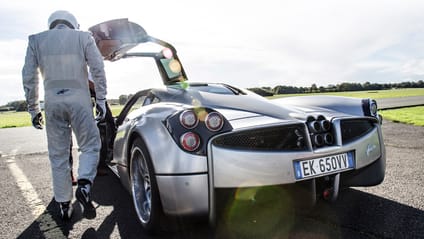
Back in 2003, Pagani felt that the Zonda was nearly done. He wanted to replace it with something completely different but that still pulled whatever clever trick it was that allowed the Zonda to blend nerdy science with passionate, automotive art. The Zonda didn't exactly come to a sudden halt though. While Pagani's imagination toyed with the Huayra, the company made the Zonda Roadster S, Zonda F, Zonda R, Zonda Cinque and Zonda Tricolore. Now, finally, and only when Pagani believed it was properly ready, the team has wheeled out the Huayra, named after a South American god of wind, on account of the consideration given to aerodynamics and stuff.
It's longer and wider and more powerful than the Zonda, using a specially designed AMG V12, making a huge 730bhp. But the headline figure is the torque: it has 738 of the buggers.
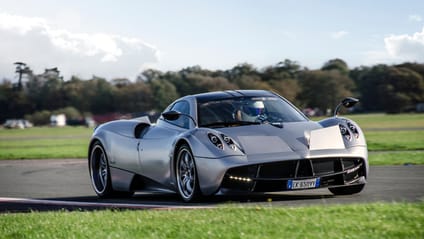
The key issue is that it's moved on from the Zonda. But that progress has not been at the cost of its identity. Some would have predicted that this young upstart supercar company, fizzing with youthful exuberance and excitement, making crazy-ass supercars literally just down the road from Ferrari and Lamborghini, would have come over all confident and corporate when its first car was such a monumental hit. Its second might have been more sensible, tamed like an Audi-influenced Lambo. But no, really, just no. The thing is still crazy.
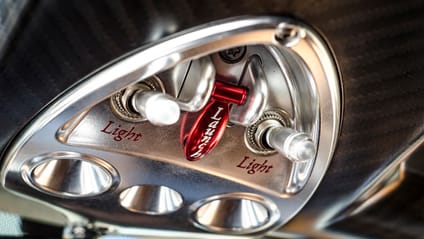
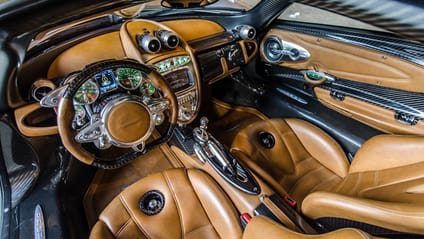
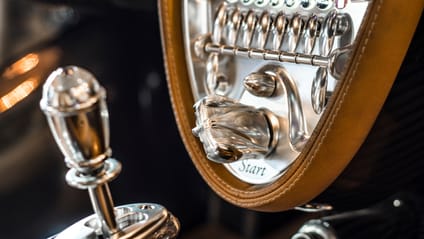
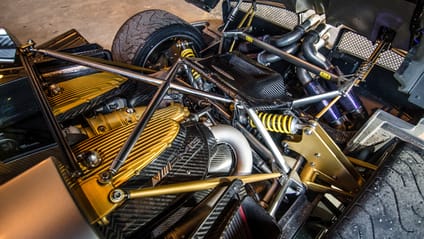
The interior is a fantasy of leather and sculptural chrome; if Captain Nemo had got together with a very high class S'n'M Madame to design an operating theatre for the Nautilus, it would look like this. This isn't bling in this cockpit, it's kinky art. And art spills out all over the Huayra; the body, still cab forward, straining to have at it, is smoother and more rounded than the Zonda's, with aerodynamic flaps tucked away at the corners, ready to move out and work with the active suspension to keep the car stable through corners. It's the first car in the world to be made entirely from carbotanium: a composite material blending carbon fibre and titanium strands. The resulting car is lighter than one made from carbon fibre, stiffer than one made from carbon fibre, but unlike one made from carbon fibre, it doesn't shatter if you crash. But I can never quite get away from the thought that Pagani chose the stuff mostly because of the name ‘carbotanium'. It just sounds incredibly futuristic, and futuristic is always good.
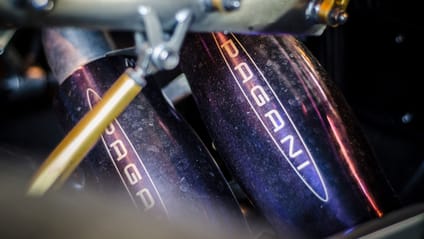
The engine was specially designed for the Huayra by AMG, whose engines have powered all of Pagani's cars. Much work was done to keep the power delivery linear, without lag from the twin-turbo V12, and the resulting thrust is shocking at a primal, instinctive level. On our track, the traction-control light came on a couple of times, letting me know that it was keeping the rear wheels from spinning and I was going in a straight line. In sixth.
It has a better power-to-weight ratio than a Bugatti Veyron, but it's all being served up to the rear wheels only. And I love that about it. It's a reminder that despite the price, the lavish materials and the active aero, this is still a fanciful, beautiful, crazy piece of art.
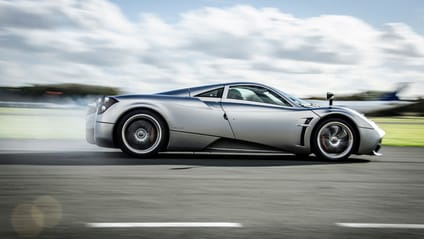
I can only ever come back to the same point about the Huayra. It's driven by the passion of one man. In order to realise his dream, he has surrounded himself with the best designers and partners he can. But nevertheless, it's something that has dropped out of his head and onto a poster on our bedroom walls, if not actually, in most cases, into our garages. What he's done is present us with his living, breathing unicorn and that makes it, to me anyway, a very, very special car indeed.
Get all the latest news, reviews and exclusives, direct to your inbox.