


25
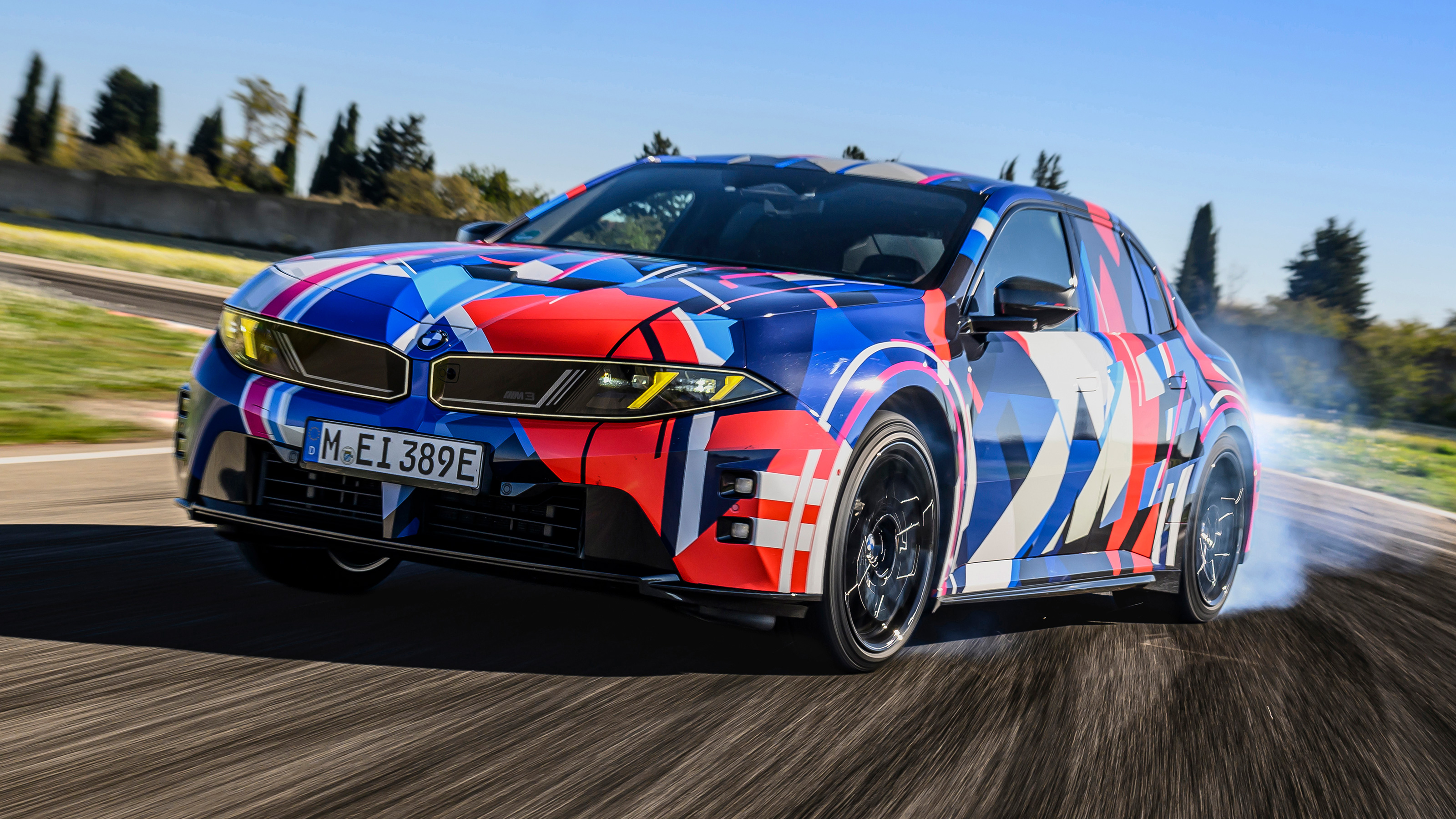
It really is. The M3 is going electric – and we’ve had an early go in it on track at BMW’s Miramas testing facility in southern France.
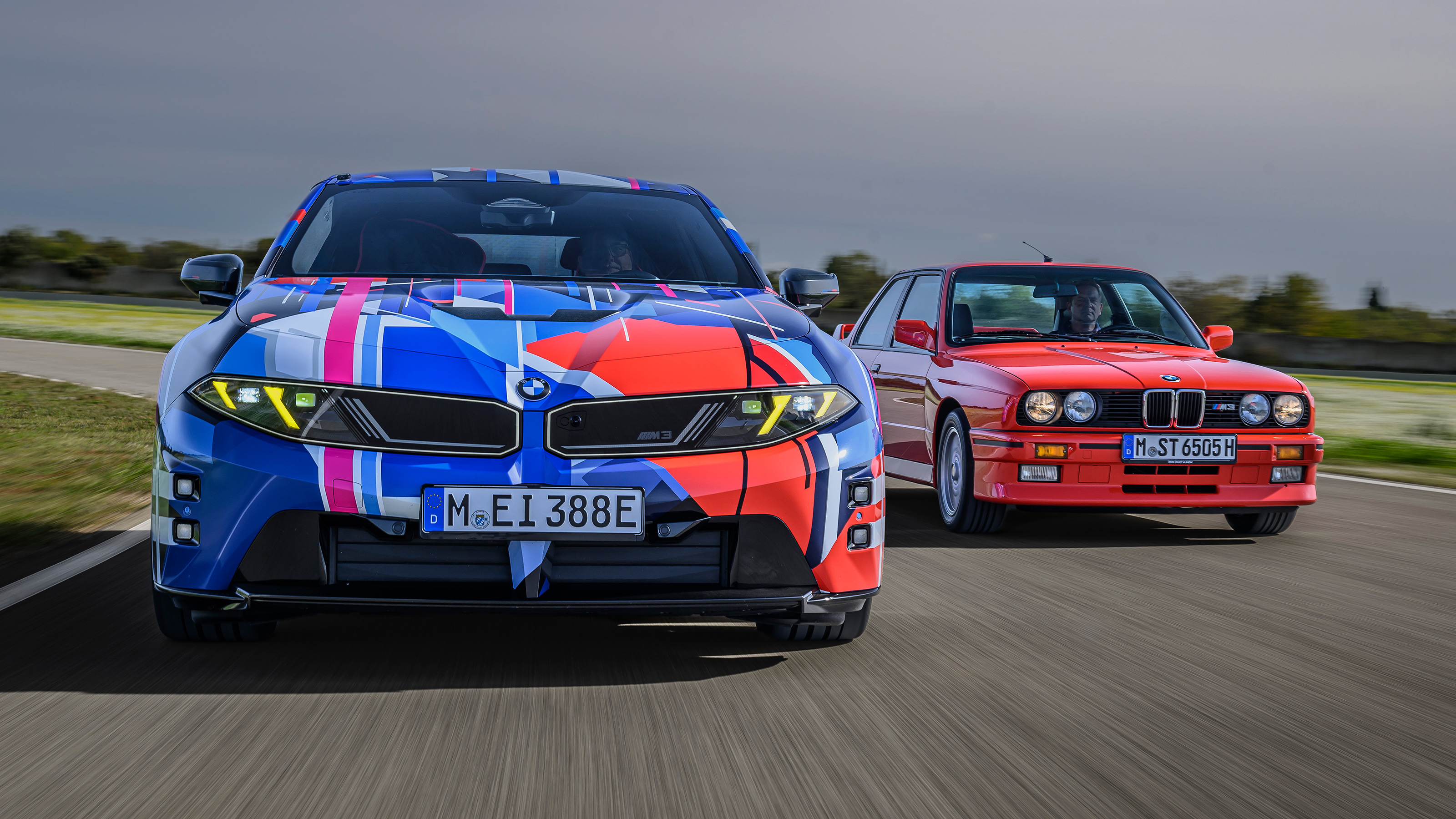
Fear not, my futurephobic friend. BMW has preempted your reservations, hence why a combustion powered M3 is coming too. But it’s the EV that launches first and that’s telling. As is the fact BMW has pointedly not badged it the iM3 – this is simply the new, seventh gen M3.
Moreover, while Bimmer has hedged its bets by building two cars, the M division big cheeses in attendance for our test drive certainly didn’t straddle the fence when asked about the pecking order. It was unequivocal: the EV is the best M3 possible today, far superior in terms of performance and dynamic capability.
Point is, don’t write this thing off prematurely. BMW hasn’t done this because it felt it had to. This is not a sensible side dish to the petrol powered main. The electric M3 exists because M division’s brightest minds decided battery power was the optimal medium for achieving their goals. And they know a thing or two about stuff.
BMW isn’t ready to give precise figures yet, so these are all approximate for now. The battery is a roughly 100kWh NMC unit (presumably the 108kWh pack found in the long range i3) with upgraded cooling and a revised cell chemistry for reduced resistance. Four electric motors combine for a power figure in the region of 840bhp and around 885lb ft of torque. 0-62mph is dealt with in “under three seconds”, although having experienced the launch control, I reckon it might be closer to two. Breakfast just about stayed down.
Not just fast, the fastest and most powerful M3 ever made. But you’re right, that’s barely news and certainly isn’t the most impressive thing about the car – that would be the remarkable way it corners.
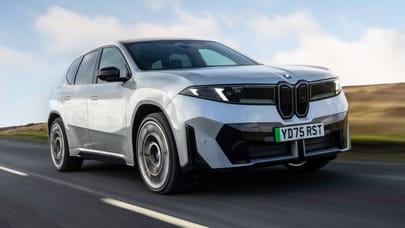
Quick refresher: in other cars, the drivetrain and various electronic assists – traction control, stability control, ABS, e-LSD etc – are operated by multiple ECUs communicating with one another incredibly quickly, but with unavoidable delay. In Neue Klasse cars, a single superbrain called the ‘Heart of Joy’ presides over all, seamlessly and simultaneously utilising the various tools at its disposal to help you progress safely, smoothly and quickly. In a BMW iX3 the result is striking, but here it’s staggering. And that’s because the quad motor M3 has an additional, very shiny tool in its toolbox: four wheel torque vectoring.
It’s a difficult sensation to describe. Driving the M3, things just… go well for you. It’s like being supernaturally lucky. Arrive at a corner far too hot, turn the wheel, and the car – seeing that the foolish meat creature operating it is going to miss the apex and possibly the entire corner – intervenes. It deploys its suite of driving assists and sends the perfect amount of power and braking to each of its four wheels in order to deliver precisely the amount of turn-in you’ve unreasonably requested.
Driving the M3, things just… go well for you. It’s like being supernaturally lucky
There’s no admonishing judder from the traction control, nor does the intervention seem to remotely slow your progress. Next thing you know, you’re firing out the other side of the corner, marvelling at the brilliance of your own driving.
Get all the latest news, reviews and exclusives, direct to your inbox.
And that’s the best thing about the M3’s helping hand: it’s subtle. Flattering, even. A system like this could – and in other cars often does – be overly intrusive, or make it feel like you’re playing a racing game in easy mode; that the car is doing all the real work and you’re merely a passenger. Neither is the case here. The M3 responds completely naturally to your inputs, always finding a way to do as you’ve asked without ever letting on that it’s working so hard to spare your blushes.
If all this talk of e-assists is off-putting, remember: all modern performance cars have this tech. If they didn’t, there would have been a Ferrari customer extinction event around the time the F12 launched. This is nothing new, the M3 is unique only in how seamlessly it blends these systems into your driving, and the extraordinary cornering characteristics enabled by its four wheel torque vectoring.
Turn it all off and prepare to get seriously sideways. The M3 delivers the bulk of its almost 840bhp to the rear axle and its engineers assure us that, during development, they “considered those who like to drift”. Bring spare tyres and brown trousers.
Less than you might think, especially compared to Merc’s AMG GT 4-door EV. That gets rear wheel steer, active suspension and active aero with ground effect. BMW’s contender does without any of the above, a testament to the freakish ability of that Heart of Joy and quad motor combo.
Happily, you do get fake engine and gearbox settings. Strange to think all this started with a Hyundai crossover – now it’s difficult to imagine a new performance EV offered without some version of the tech we fell in love with in the Ioniq 5 N.
The M3’s interpretation is interesting. For one, the soundtrack isn’t trying to faithfully emulate a combustion engine, nor is it Hans Zimmer sitting on a synth like in previous BMWs. This new noise is somewhere between pod racer and flatulent Decepticon, a digital, vulgar, otherworldly sound. It won’t be to everyone’s taste and it’s noticeably loud, even in the medium setting (the highest setting is designed to be audible with a helmet on), but we enjoyed it during our brief drive. It’s unique and befits the car’s thuggish, futuristic appearance.
In manual mode, the shiftable ‘stages’ add an extra layer of engagement, although the execution felt a touch muted on first impression, with downshifts not as pleasingly punchy as those of the Merc or Hyundai. The synthetic gears also have oddly long ratios, meaning you have to be getting a serious move on to reach the redline.
I reckon we could’ve lapped Miramas without ever changing out of third and posted a respectable lap time, which somewhat defeats the point given this feature is primarily about making EVs more engaging at normal speeds. Still, we’re talking about software here: it could be tweaked with a line of code before the start of production, if BMW so chose.
All the ones you’d hope and expect of a new M car. Suspension and brakes are all new, totally unrelated to those of the i3. Carbon ceramics are offered, but don’t bother: the car relies so heavily on its regenerative brakes that after 10 hot laps, our discs were sitting at a balmy 35 degrees Celsius. For context, the M4 GT3 lead car’s disks were north of 300. The M3 actually recovers so much of its expended charge that on track, every fourth lap is free.
Elsewhere, much stiffening has been added. Areas identified as being unacceptably floppy, like the A pillars, have received additional bracing, while under the floor two aluminium plates positioned in front and behind the battery connect the pack (already a structural element) to both the body and axle to bolster chassis rigidity.
The M3 actually recovers so much of its expended charge that on track, every fourth lap is free
The new M3 also does without any carbon fibre whatsoever, instead debuting a new flax-based natural fibre that offers the equivalent lightness and strength, but whose manufacture results in significantly less CO2.
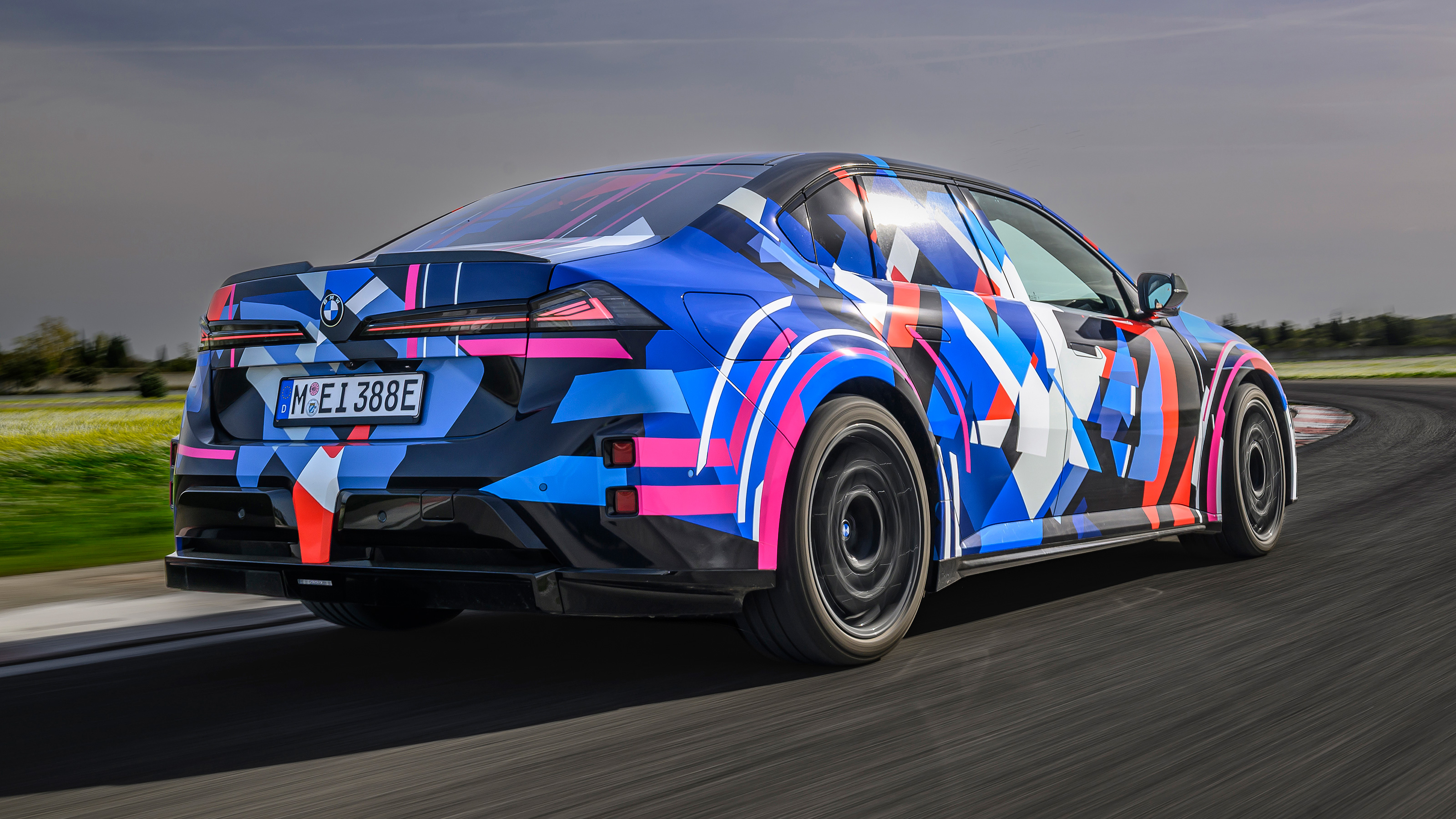
What it looks like undisguised both inside and out, although its bodywork looked fabulously stubby, swollen and menacing through the light camouflage. The ride is another big question mark as it’s impossible to assess on a buttery smooth circuit. Given the doubtless significant weight figure yet impressive body control, we’re a tad nervous it might be a bit of a bone shaker on pockmarked British roads, but we’ll soon find out.
Fair enough. And if the piston M3 proves to be significantly slower but far more involving, I’d be inclined to agree – better doesn’t always mean better when it comes to driver’s cars. Still, based on this fleeting first impression, the M3 EV sets a seriously high bar. It exploits the inherent advantages of its powertrain in dazzling new ways and serves as yet another reminder that we’re just scratching the surface of what electric performance cars are capable of. It’s not just rapid, it’s genuinely thrilling.
Get all the latest news, reviews and exclusives, direct to your inbox.
