



25
It’s slightly more conventional compared to its Atto 3 bigger brother (remember those guitar string speaker straps?) and Dolphin (with its wave like dashboard), but feels mostly well built, thanks to good fit 'n' finish. Your kids might not like it as much, though.
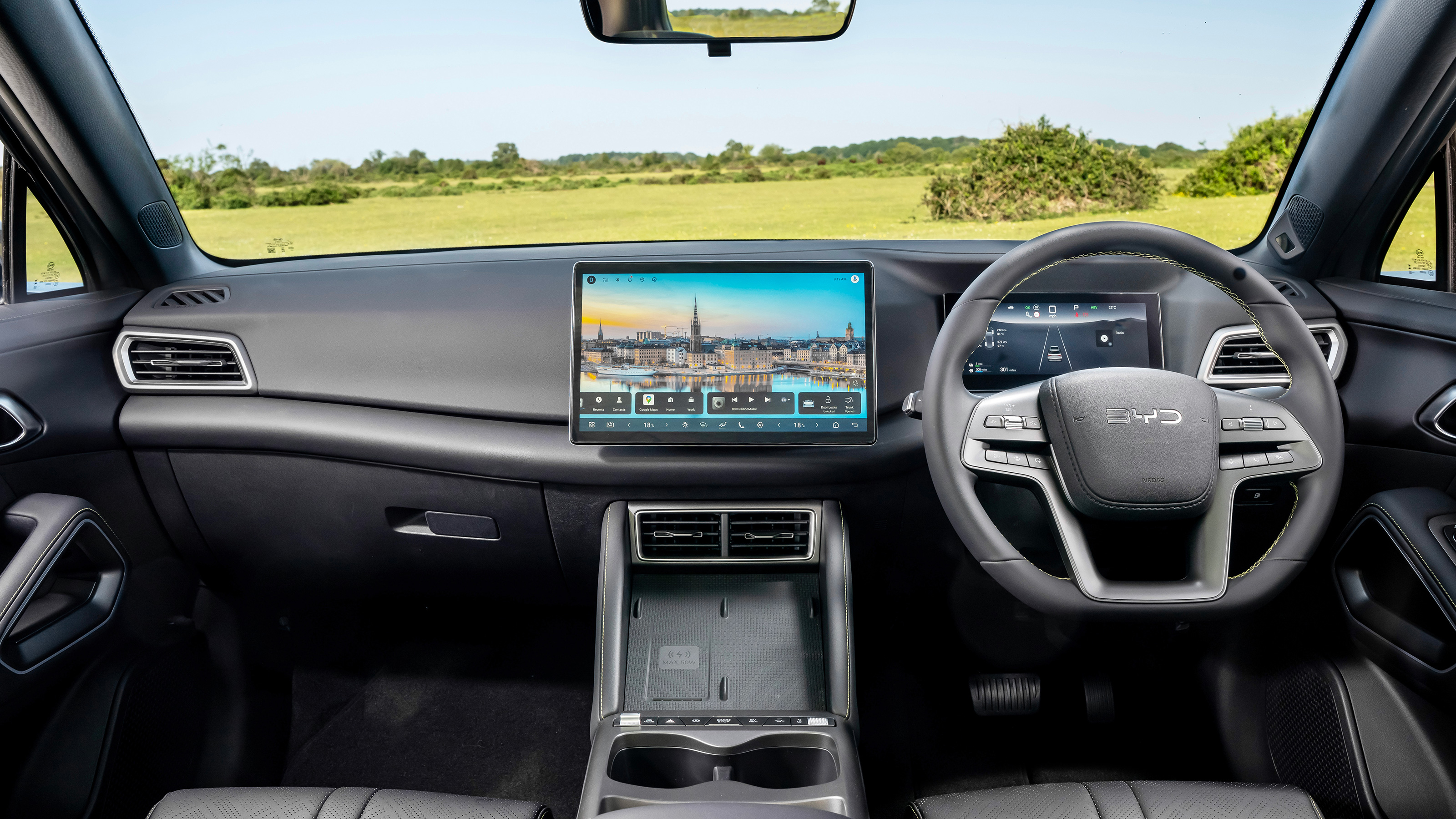
Most versions get a heated flat bottomed steering wheel with proper buttons and scrolls, and an electric driver's seat. Very comfortable front seats, in fact, bucket-like in their design but with plenty of padding.
The base version of the DM-i gets cloth. In other versions there's plenty of ‘vegan leather'. You get a split-level centre console complete with two cupholders and a wireless phone charger whatever version you go for, as well as a flat floor throughout the cabin.
Sorry. Directly in front of the driver sits an 8.8-inch digital instrument panel. All very digital though; no analogue dials here. And its space is badly used, so many of the symbols and the speedo itself are too small. There’s little imagination here, although dig a little deeper and in the plug-in hybrid you’ll actually find an acceleration timer. Out of place, much? Still, you can call up a 3D map for the inbuilt navigation.
In the middle, the Atto 2’s party piece at launch was its 12.8-inch rotating touchscreen. However, BYD found that buyers rotated their screens precisely once and then left it in landscape forever more. So that’s now being phased out on all BYDs.
Anyway, on the infotainment’s homepage you get a selection of widgets which you can customise a little, while down the bottom you get a few shortcut buttons to menus, climate controls and so on. As ever it takes a bit of figuring out, and navigating the menus isn't as easy as it should be.
And again, the space is badly used. You can't get a tiled layout showing say music track and map on half the screen each. So the default layout is mostly a giant photo. Probably AI-generated. At least you can choose between a sunset, mountains, or icebergs. Or hey, upload a background of your own.
We’d have liked more physical buttons. The centre console does at least have a few – drive modes, hazards, start/stop, regen level, demisters and volume – which all prove very handy. But BYD will say you should be using its voice control system, which you can use to operate the climate control or even open and close the windows. Unfortunately, it’s completely terrible as is often the way with these things.
There are also a couple of hidden Easter eggs for the screen: swiping up and down with three fingers adjusts the cabin temperature, while swiping from side to side changes the ventilation fan speed. Swipe down from the top with one screen and you pull up some shortcuts to turn off the Lane Assist and Speed Limit Warning. Although unfortunately this doesn’t actually remove all of the bongs.
Interestingly, the Atto 2 DM-i is the first BYD product to feature Google built-in for things like navigation and apps. Expect the EVs to get the same in an over the air update at some point soon. It’s a good system that we’ve seen in things like the Renault 5 and various Polestars. But the Google/BYD system doesn't use the satnav's information on altitude and speed to predict range – which it does in those other brands.
You’ll probably just use Apple CarPlay or Android Auto anyway. They connect quickly and without fuss.
Plentiful. We’ve already touched on the comfort up top, but rear room is pretty good too, with plenty of foot space under the front seat and no centre tunnel to cramp the middle passenger. That’s helped by its ‘cell-to-body’ construction, meaning that the top cover of the battery pack is the passenger floor. There’s also loads of headroom thanks to the panoramic roof.
Further back, the boot in the electric models measures 400 litres in Boost or 450 litres in Comfort trim. That positions it pretty much bang in the middle of its rivals. Fold the seats flat and you’re looking at 1,340 litres and 1,370 litres respectively. And when we say flat we mean flat, thanks to the, er, flat floor.
Interestingly, the plug-in hybrid powertrain doesn’t take up too much space either, so you get 425 litres of boot space whatever trim level you go for. That expands to 1,335 with the rear seats folded.
Get all the latest news, reviews and exclusives, direct to your inbox.
