



25
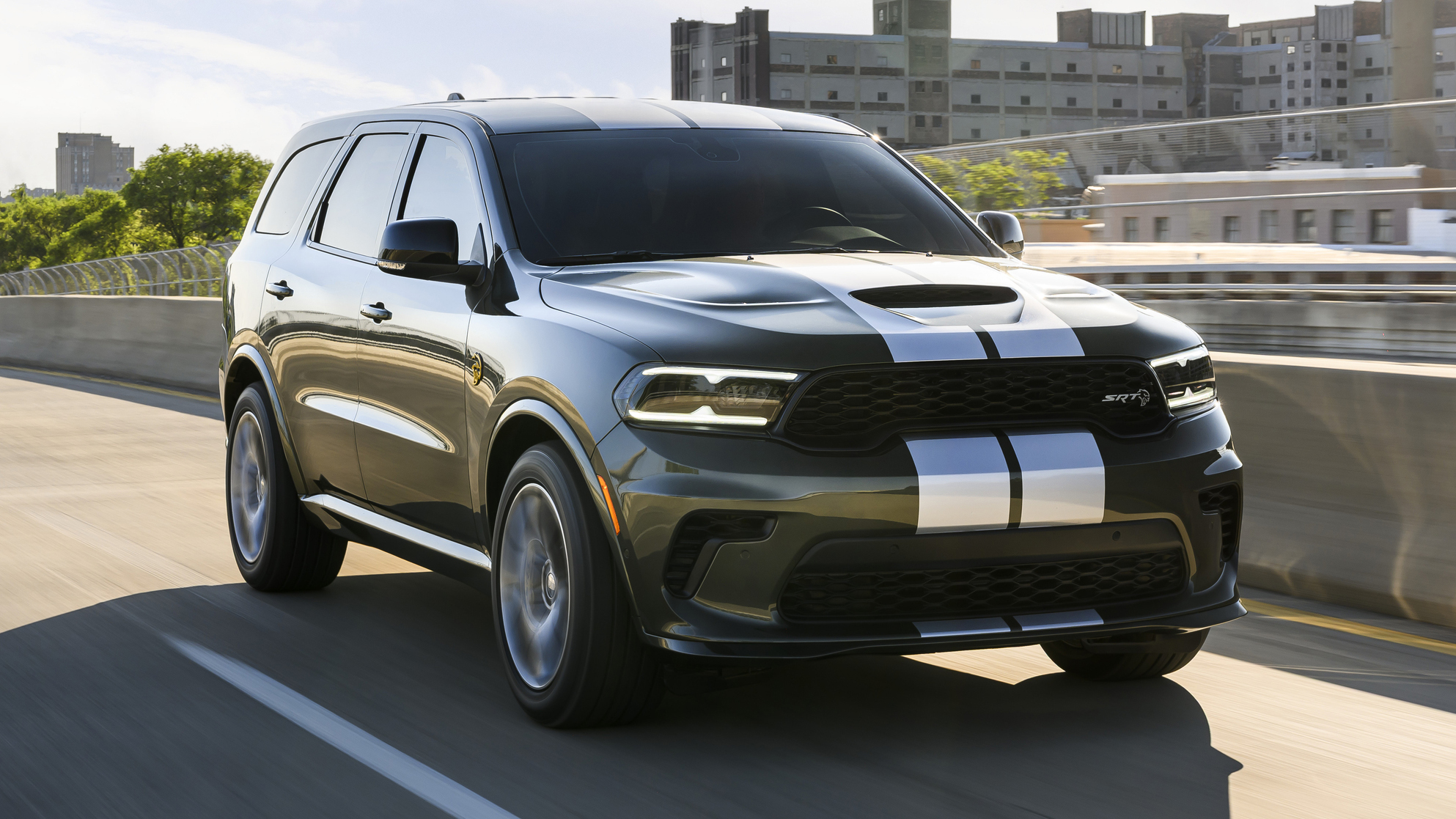
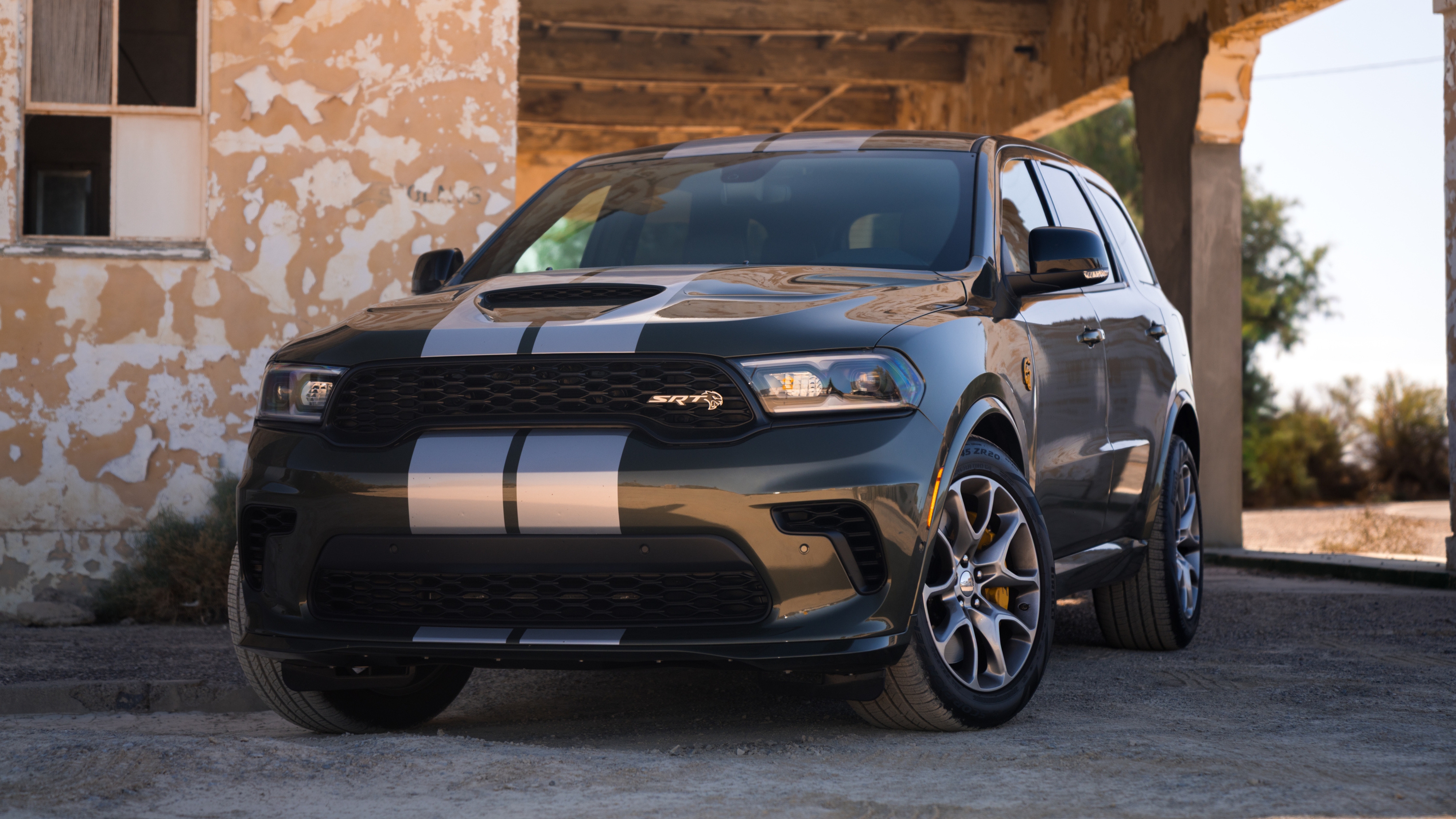
It is, in fact, an automobile, but like bootleg hooch, it’ll melt your eyebrows off. This is the Durango SRT Hellcat, a dated three-row SUV with a massive V8 that belches out 710 horsepower just for yucks. For the record, it absolutely delivers.
Indeed. We’re right in the smack of the dab of Dodge’s '**** it' era, which means V8s for everybody that wants them. Great news for horsepower junkies with gas money to burn, and now everyone in all 50 US states can rev their engines in Hellcat harmony after previously stating it wouldn’t be available in the 17 regions following CARB (California Air Resources Board) emission regulations.
On its best behavior, the Durango Hellcat nets a whopping 13 combined MPG, and there’s rarely an instance that you’ll be driving it that way.
Dodge has walked back so many changes in just the past couple of years, it’s hard to keep track, but the short answer is the Durango Hellcat was meant to be a limited run in the same way the Rolling Stones were meant to have a farewell tour. Turns out, if enough people keep showing up with stacks of cash, there’s little reason to stop what you’re doing.
We’ve got the 6.2-liter supercharged Hemi V8, the power unit for all the ‘Hellcat’ Dodge vehicles, including the Charger and Challenger. These were the cream of the crop, surpassed only by the Challenger Demon in terms of factory-delivered power. Dodge’s sporty muscle cars have had their own journey while the Durango has persisted quietly in the background. Well, not quietly, per se, but you get our meaning.
The engine screws up 710hp and 645lb ft of torque sent to all four wheels by way of an eight-speed automatic transmission. It’s fitted with a transfer case that allows it to split the torque between both axles according to its drive modes. Even in auto, the Durango Hellcat has a rear bias, with a 40/60 split, and only snow and tow modes divide it evenly. Sport and track are happy to throw 65 to 70 per cent of the power to the back, respectively.
“Ornery” is the word that immediately comes to mind. Jacked up on a sporty suspension with Bilstein dampers, the Durango Hellcat stands tall and prepared to take a beating by the turf at speed, similar to the Baja-ready Ford F-150 Raptor R, a vehicle that seems almost sensible by comparison.
Even in its most docile settings, the Hemi’s supercharger whines enthusiastically at the slightest throttle input. In sport or track mode, the Dodge SUV sprints down the road like a slobbery dog chasing a thrown stick, and with as much grace. This is not an elegant piece of machinery, it’s ‘hold my (proverbial) beer’ in car form.
At full clip down a back road, the Durango Hellcat bucks like a rodeo horse, constantly threatening to go off the trail, though mainly because it’s so encouraging to push it. The throttle response is sharp and while it’s a handful, there’s rarely the sense that you’re losing control, so long as you don’t send it sideways into the air over a berm.
Fairly spacious, as one would imagine. In the Hellcat, the third row is optional, but you’re still afforded 17.2 cu ft of cargo space, though without it, there’s 43.3 cu ft, that opens up to a substantial 85.1 cu ft if you utilize all the room behind the first row.
Get all the latest news, reviews and exclusives, direct to your inbox.
Beyond that, it’s about as dated as the exterior. Sure, it’s seen a few glow-ups to modernize it, but it’s certainly showing its age, particularly when beside a fresh batch of Charger Sixpacks and their swish new cockpits. Behind the wheel is a half-analog-half digital gauge cluster, beset by a 10in touchscreen housing all the usual menus, nav functions and entertainment options. It’s kind of a mess, but there’s loads of info and settings to dabble with, particularly when it comes to fine-tuning the different dynamics of the SUV.
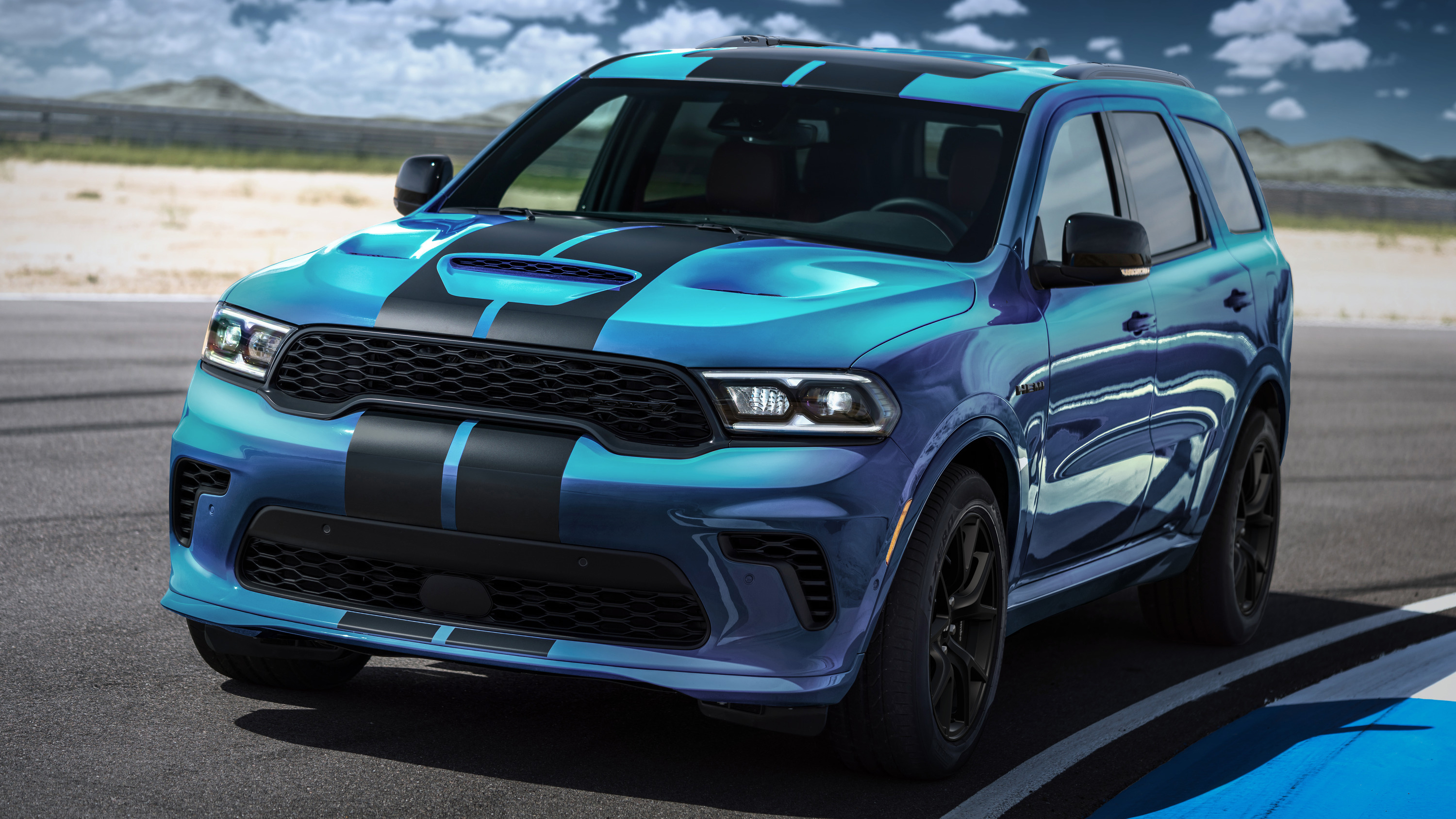
If the Durango’s interior or its exterior isn’t really tickling your fancy, the Jailbreak trim level unlocks a wild amount of customization combinations for an additional fee. This allows buyers to choose from a wide array of exterior paint, corresponding racing stripes, interior seat and badge colors among a too-long list of other things customers can select to make their Durango Hellcat their own.
The Dodge Durango is a competent SUV with enough inherent attitude, it comes as no surprise that an SRT Hellcat version was dreamed up, let alone pushed into production. It’s a big, burly three-row people mover with enough utility to make it invaluable to an entire homestead, stuffing a wildly overpowered motor under the hood doesn’t change that. What does change is it’s now an unruly smile machine destined to be the darling of any rural backroad chicanery. Big, ugly and comically impractical, the Durango SRT Hellcat can only be described as “a hoot”.
At time of writing the Durango Hellcat is currently for sale, though like the McRib, it may go away just to come back again when we need it the most. Either way it starts at $80,590, with the Jailbreak trim coming in at $81,585.
Get all the latest news, reviews and exclusives, direct to your inbox.
