



25
Jeep Wrangler Rubicon
1995cc
268.2bhp
I recently fitted a tow bar to the back of the Wrangler. This was a bold move, given my towing experience is zilch. But since UK towing rules changed a few years ago – allowing drivers who weren’t born in the era of paper licences and Ceefax to tow trailers up to 3,500kg without an extra test – I thought now is the time to have a go. Because curiosity, mild delusion and too much late-night reading about billionaire survival strategies will do that to a person.
See, there’s a quiet pattern emerging among the ultra-wealthy. Hedge fund managers, tech founders, industrialists – the sort of people who measure risk for a living – have been buying land in New Zealand and remote corners of North America. They’re carving bunkers into hillsides, installing private power generation, water filtration, satellite communications and food stores that would embarrass a small supermarket. Not because they think a meteor is imminent, but because they’ve watched how fragile modern systems really are. And it’s quite easy for the world to go pop.
We’ve had rehearsals. Texas lost power for days in sub-zero temperatures. A ransomware attack on a US fuel pipeline emptied petrol stations in under a week. Banking outages in Spain left people unable to access cash because everything now assumes the internet is always working. Even in the UK, brief fuel shortages caused queues within hours. Modern life runs on invisible threads – electricity, data, digital money. Snap one and the rest unravel quickly. No power means no internet. No internet means no banking. Independence vanishes. And what’s stopping countries attacking these parts as a new way of warfare?
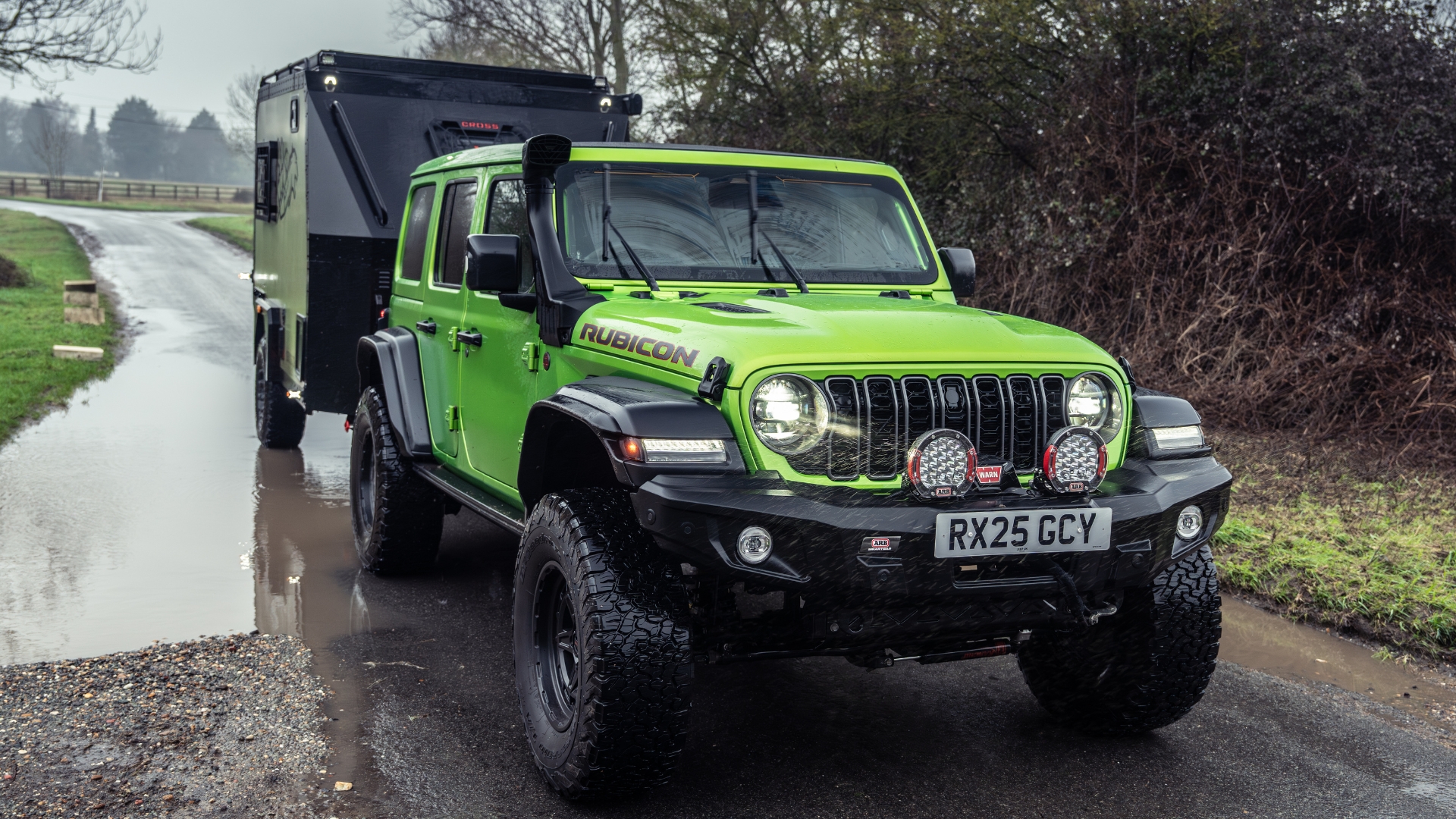
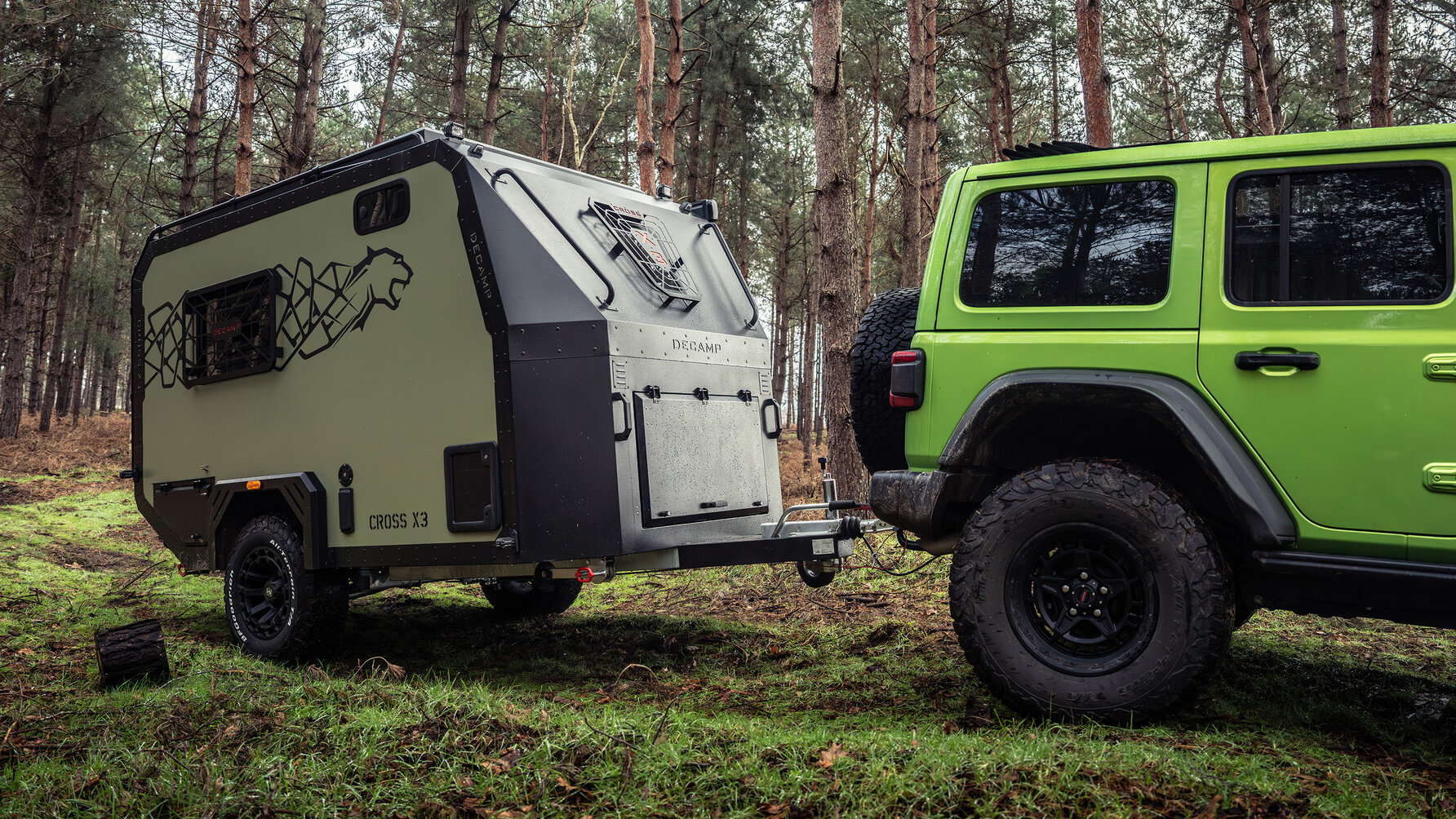
Unfortunately, I don’t have a bunker to escape off-grid to. So I opted for the more terrestrial approach – a Jeep, a tow bar, and something designed to keep going when everything else stops: the Decamp X3. At £50k as tested, it’s an all-terrain caravan that looks less like leisure equipment and more like something for a minor military campaign.
The plan – if you could call it that – was to spend three days and two nights off-grid. In February. When Britain is dark, wet and vindictive. I’d go from London to Essex to collect the caravan, spend a night in Sussex woodland, then head north to Norfolk and back to complete a 350-mile loop. A gentle apocalypse rehearsal. Cleanse the brain. Disconnect from the grid.
The departure from London was uneventful until it wasn’t. Rain lashed down, standing water pooled across lanes, and somewhere near Stansted airport I encountered aviation fuel on a roundabout. The result was an entirely unplanned drift that briefly recalibrated both my steering input and my sphincter. The BFGoodrich KO2s have been faultless all winter, providing a lot of traction and confidence, but this made me wobble. The sobering thought wasn’t just grip – it was knowing that shortly I’d be asking this Jeep to control another tonne and a bit of aluminium ambition behind it.
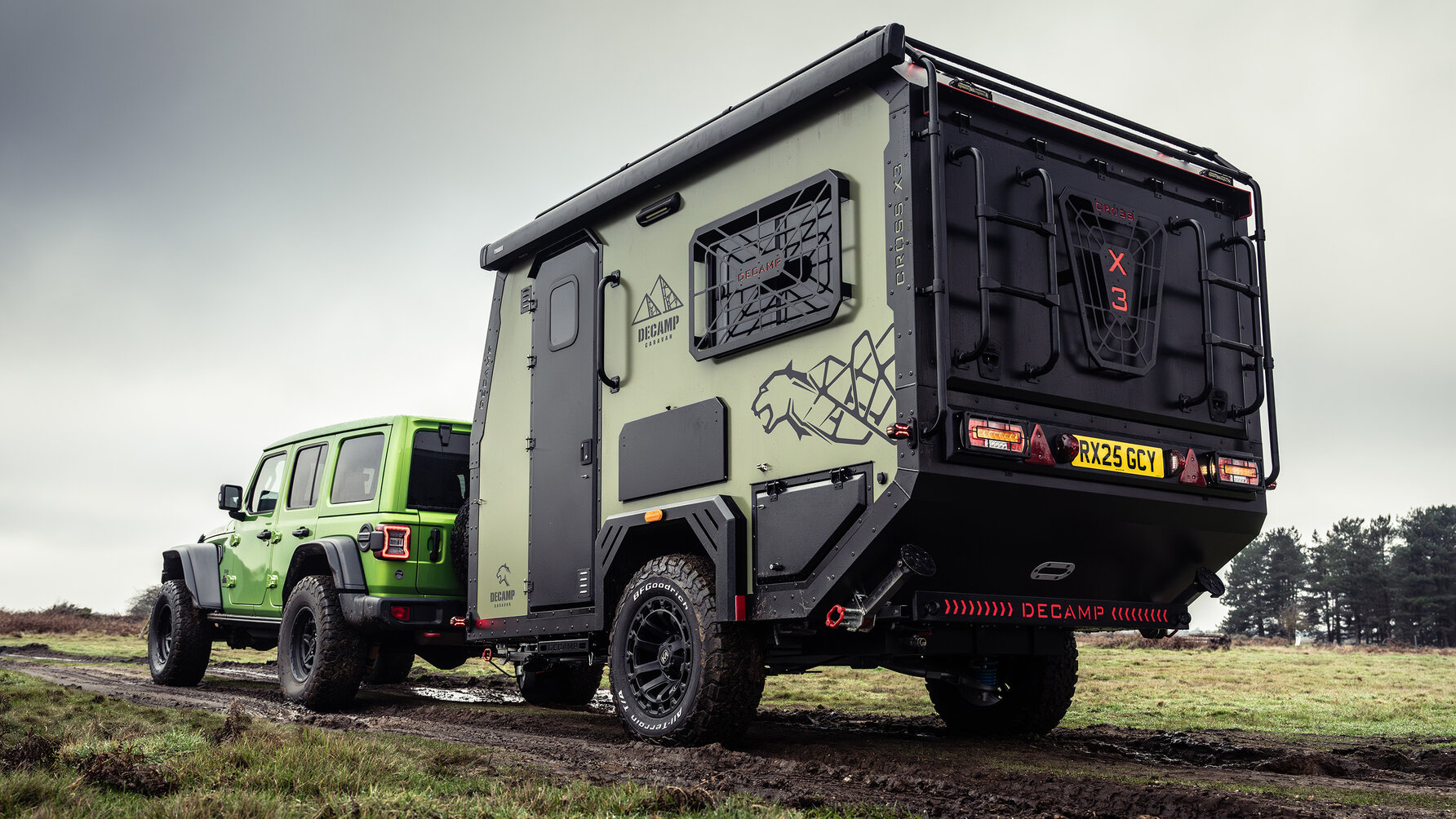
At Braintree, I saw the Decamp properly for the first time. It’s bigger than Instagram suggests. At 4.5 metres long it fits in a standard parking bay, yet visually it’s dense and purposeful. Camo-coloured, boxy, unapologetic. No fibreglass swoops. No beige despair. It has the aesthetic of equipment rather than ornament.
Numbers first. The Wrangler’s kerb weight sits north of two tonnes, and its braked towing limit is 2,495kg. The Decamp X3 weighs roughly 1,300kg empty, with Knott independent suspension rated to 1,800kg and a hitch limited to 1,600kg. Legally, comfortably inside limits.
Hitched up, the Jeep changes character. The rear axle squats slightly, the nose lightens, and the 2.0-litre turbocharged petrol four-cylinder – producing 272bhp and 295lb ft – has to work. On paper that torque figure looks ample, but it arrives higher in the rev range than a diesel’s would. You notice it pulling out of junctions and climbing gradients, where low-down shove matters most. The eight-speed automatic does its best to smooth the effort, and at motorway speeds the entire rig becomes strangely normal. But return to B-roads and you’re aware that your bed, cooker and toilet are now actively pushing you forward. It’s controlled, but always under tension. Thanks to my earlier near-pirouette, I selected four-wheel drive on particularly greasy/wet roads to calm torque delivery. Not textbook usage, perhaps, but it steadied the whole outfit.
I arrived at Holistic Woods in Sussex and – surprise – it was deserted. Rain hammered the windscreen as I made the unwise decision to explore a woodland track in the dark. Ruts deepened. Branches snapped under tyres. Reversing became implausible. With no phone signal and a heavy caravan behind me, low range engaged purely to maintain steady momentum. The Jeep didn’t struggle – ground clearance and articulation are its natural habitat – but the tow bar’s breakover angle demanded caution. Alone, in the rain, failure felt expensive. So I stopped before I had to fail at a three-point turn and declared survival sufficient for one night.
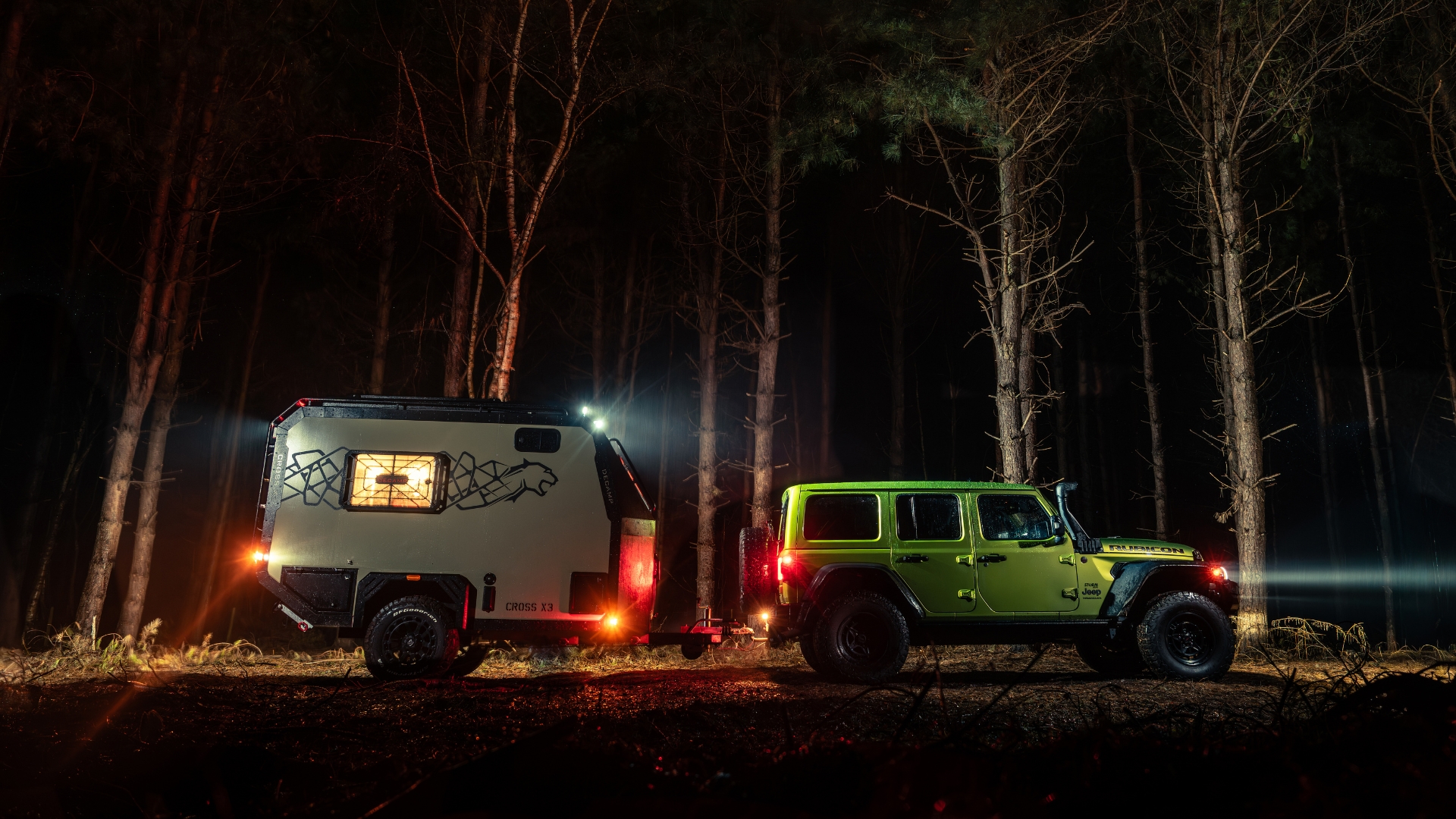
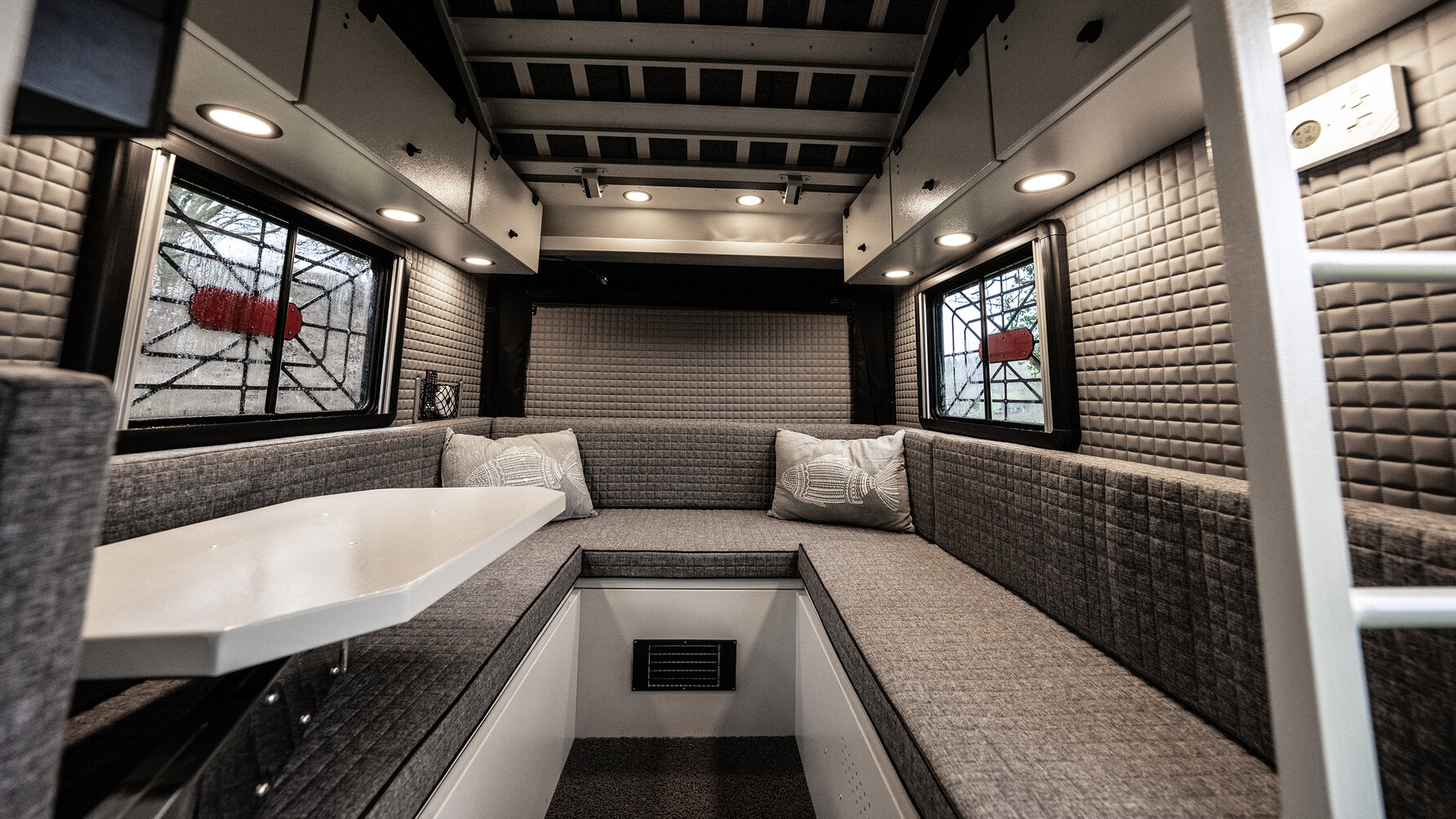
This is where the Decamp proves its worth. Instead of mud-wrestling a tent, I stepped into a lit, insulated cabin and fired up the diesel heater. The X3 is built around marine-grade thinking – chunky switches, simple systems, nothing delicate. A galvanised chassis, aluminium frame, 40mm insulation, moisture-resistant poplar plywood interior. It feels less like camping and more like inhabiting a bomb-proof North Sea trawler.
People over 6ft can stand in it comfortably, but you can pop the top for even more headroom. Inside, four adults can sit comfortably before the area converts into a vast 208 x 187cm bed. The pop-up roof houses an additional ceiling bed. There’s a proper kitchen – two-burner hob, sink, drawers, fridge – and an actual bathroom with indoor shower and optional cassette toilet. An outdoor shower hangs at the rear for mud, dogs or existential cleansing. Base price is £34,648. With winter-proofing, energy systems and heating, mine totalled £50,440. Expensive, yes. But this isn’t decorative. It’s infrastructure on wheels.
Morning revealed frost and an inconvenient lesson in battery chemistry. Overnight temperatures had dropped to -2 degrees. Lithium and cold are not friends. Despite twin 100Ah gel batteries, solar panels and inverter, the system faltered – compounded by the fact the batteries weren’t fully charged at collection. I attempted to use the Wrangler’s 240V socket as an improvised petrol generator – thwarted by a non-UK plug. Eventually I borrowed a Honda generator and let sunlight and internal combustion restore order.
Heading north up the coast, I discovered towing becomes intuitive quickly. What remains novel is the attention this rig provides. At a supermarket stop, strangers asked for photos. No one photographs ordinary caravans. Supercars are ten a penny on Instagram. Armageddon rigs are not.
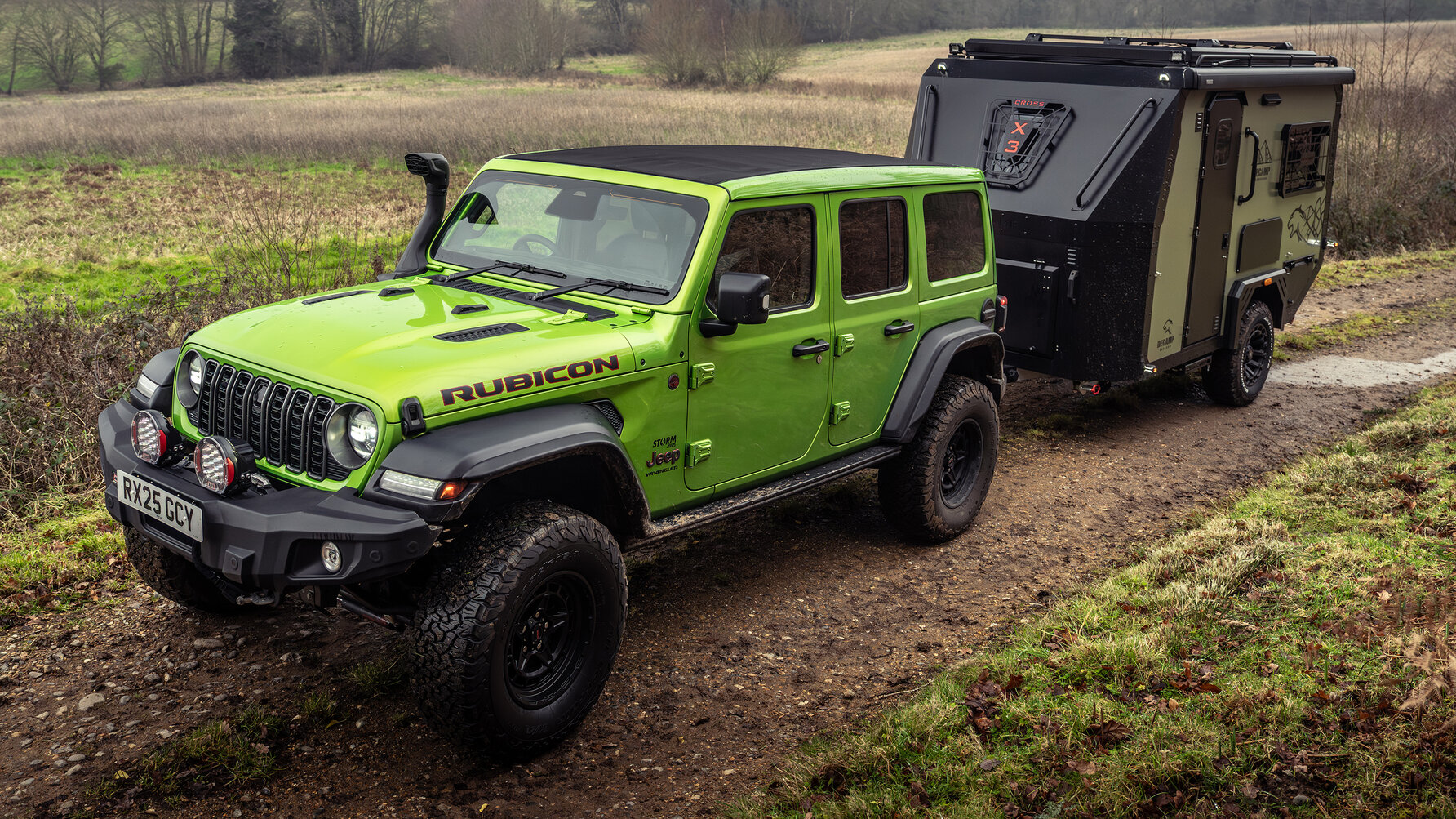
The Jeep’s lift kit and headlights, however, earned me less affection. The loaded rear tilted beams upwards into oncoming traffic. I was flashed repeatedly. When I flashed back – which activates the auxiliary bumper lights – I ended the debate decisively. I could smell people’s eyes burning as they drove past.
That evening, I had to once again commit to a muddy track I couldn’t reverse from to get to my destination. Darkness and wet grass hid the lake I knew lay ahead. So fear once again dictated my resting place. By now, though, routine was established: park, heater on, roof up. Done. But then a knock on the door. A local couple, drawn by the lighting array slicing across the valley wondered what the hell was going on as no one camps in February. They’d assumed alien activity. Instead they found a man stirring pasta in a frozen field. After questions, laughter and inspection, they left contemplating similar off-grid purchases.
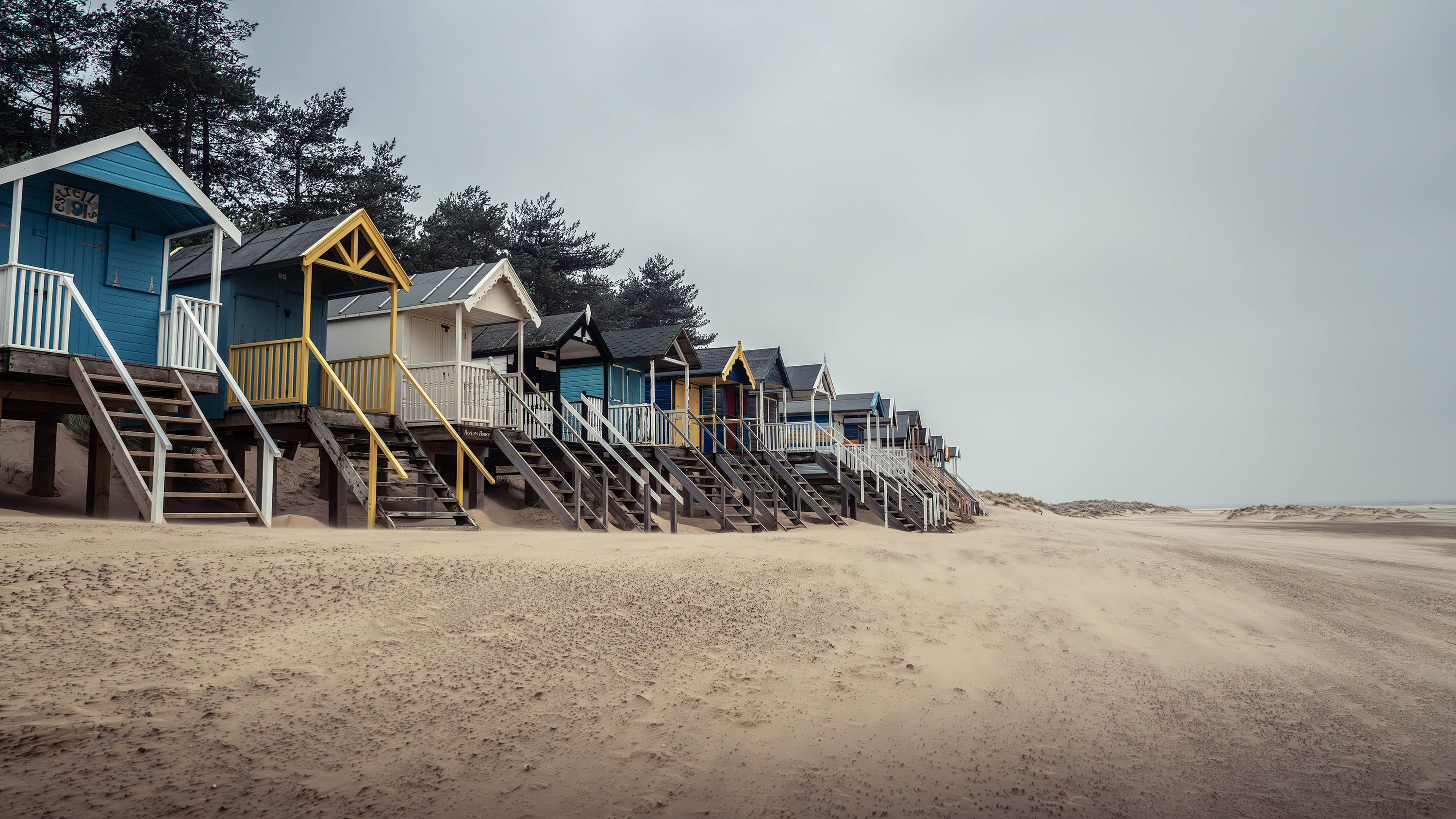
The next morning, I lifted the party piece rear hatch to reveal a still, pale landscape. Two days in, the pace of thought had slowed. No signal. No schedule. Walk. Coffee. Air. Holkham Bay lay empty and vast, white sands stretching into a washed-out horizon. Norfolk looked like the world had ended. And I was fine with that.
On the return leg, I calculated the damage towing had done to my already woeful MPG: 12.8. Yikes. Saying that, the Jeep strained at times but never felt overwhelmed. It remained composed off-road, entirely in character dragging something built to leave tarmac behind. If fuel were cheaper, I’d already be heading further afield. Because if the cautious billionaires are right – if civilisation is going to end – I won’t be queuing for a bunker. I’ll be pointing a Jeep and Decamp X3 towards tree lines and empty coastlines. Home, heat and hope – all hitched firmly to the back.
Get all the latest news, reviews and exclusives, direct to your inbox.
