Report 6


Time to see if Ram's latest has the muscle to win a tussle with Ford’s Raptor R
It's hot enough to make your sweat start sweating. It’s a heat that makes your eyes swim in dusty sockets and legs unsteady like a kick to the back of the knees, heat that feels like a hot pillow pressed lightly across your face. Sweat prickles instantly, pores yawning, and after a few minutes a T-shirt will have salt marks like the high tides of your circulatory system.
That’s 47.8°C in Johnson Valley, California, home of the legendary King of the Hammers off road race – one of the most mechanically unsympathetic competitions in any motorsport sphere – the place where competitors throw themselves up and down rocky cliffs on purpose. They bet their safety and racing credentials on some of the toughest mechanicals known to automotive. And they do it for hours. We’ve come here to test six-figure production trucks. This may have been a mistake.
Except for the fact that these are production trucks in a technical sense; Ford’s original 411bhp Raptor started the Baja-style supertruck – halfway between a Trophy Truck Pre-Runner and a normal pickup – back in 2010, and it’s been improving ever since.
Photography: Drew Phillips
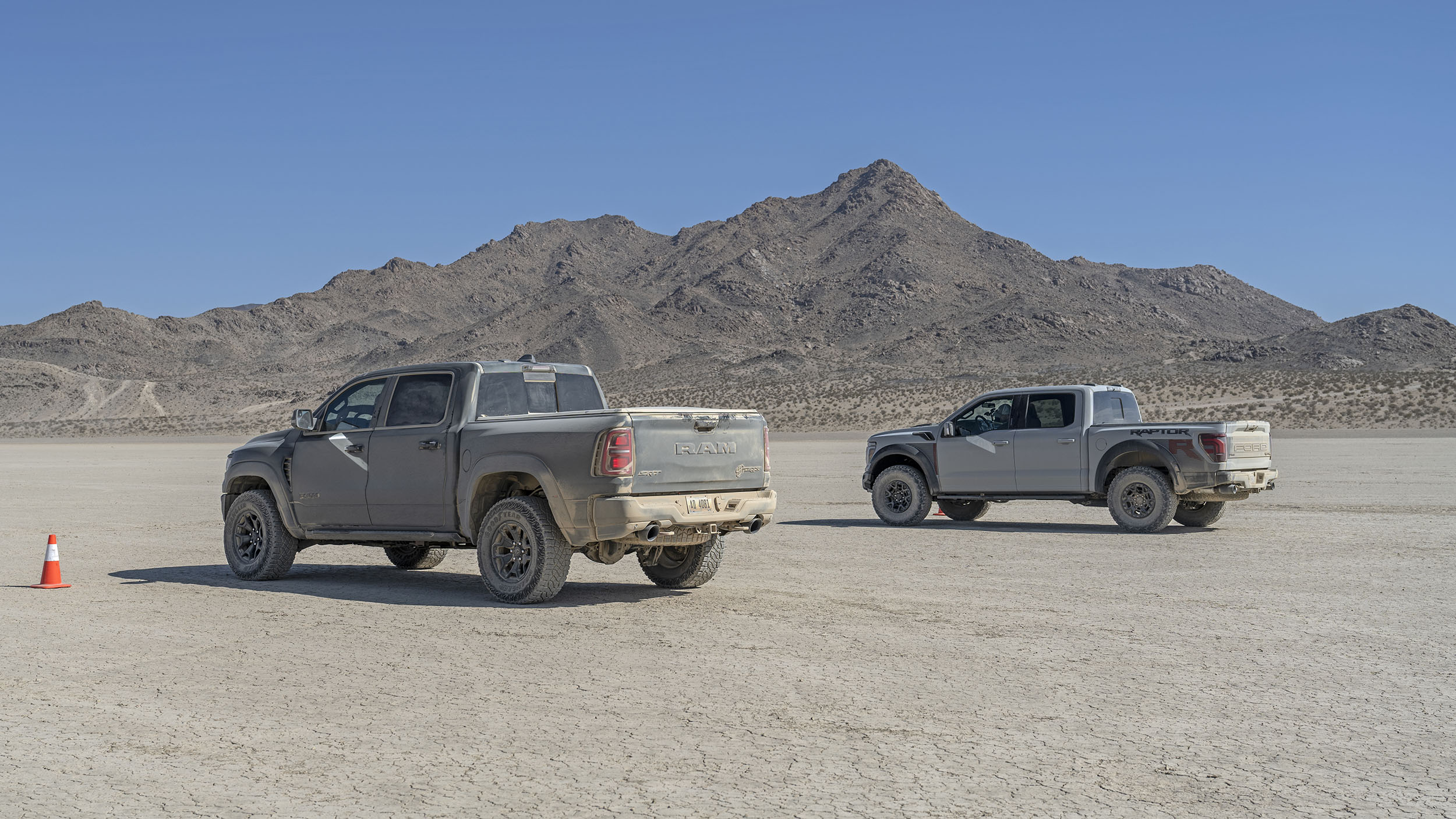
The Raptor got more powerful in each iteration. Ram responded with the 702bhp TRX in 2020, but that car went off sale in 2024 for a slight break as the company moved away from Hemi V8s. The Raptor became the 720bhp Raptor R, and when Ram decided to bring back the TRX this year, this time with the topline ‘SRT’ performance badge, it dropped the 777bhp V8 Hellcat motor into it, improved everything and went Raptor hunting once again. It’s been a tit for tat exercise in corporate one-upmanship.
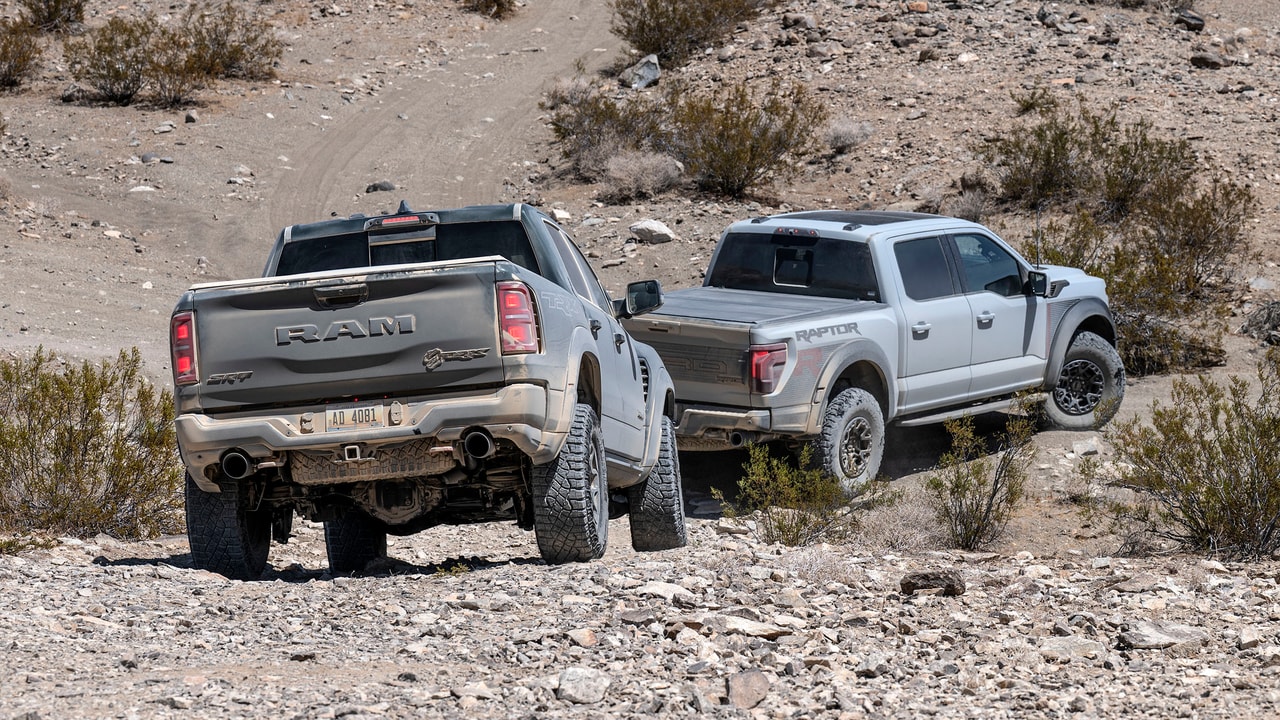
And so, we’ve brought both together for the ultimate showdown: supertrucks versus Johnson Valley. For the next three days, we’re going to see if these things really can match the marketing, or whether it’s all just off road bluster. And we will not be kind.
First, we must commute. And in the freeway and twisty mountain road portion of the challenge, we discover that... these pickups aren’t actually dynamic on a road. There’s loads of power from both, feisty amounts of torque and amusing amounts of body roll, but the juddery recoil of ladder frames, soft suspension and big tyres mean they’re blobby and imprecise. Like trying to steer a near three-tonne vehicle via the medium of a waterbed.
Tyre howl is the first indication of a loss of grip, and then you’re in mighty understeer territory, unless you’re confident enough to play with the modes, at which point you can provoke oversteer, comfortably occupy all the available roadspace and scare yourself to death. Allegedly.
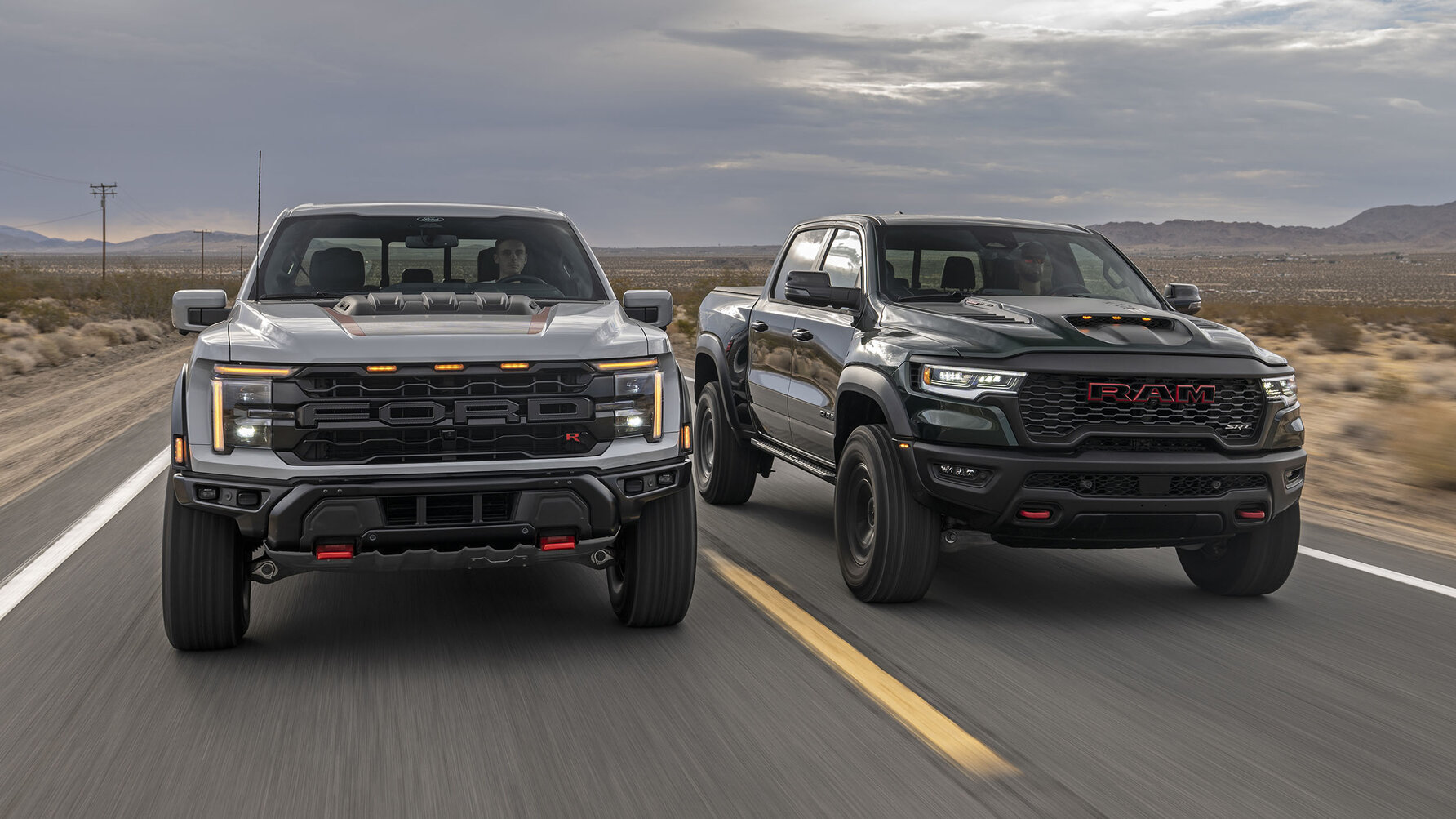
Slow steering on both doesn’t help – they go where you point them, but it’s a conversation rather than a command. The Ram is better, shod on 35in tyres versus the Raptor R’s 37s with a bit more positivity, but it’s shades of less bad rather than talent; both sets of brakes on the cars caught fire after a relatively short section of mountain, which probably tells you all you need to know.
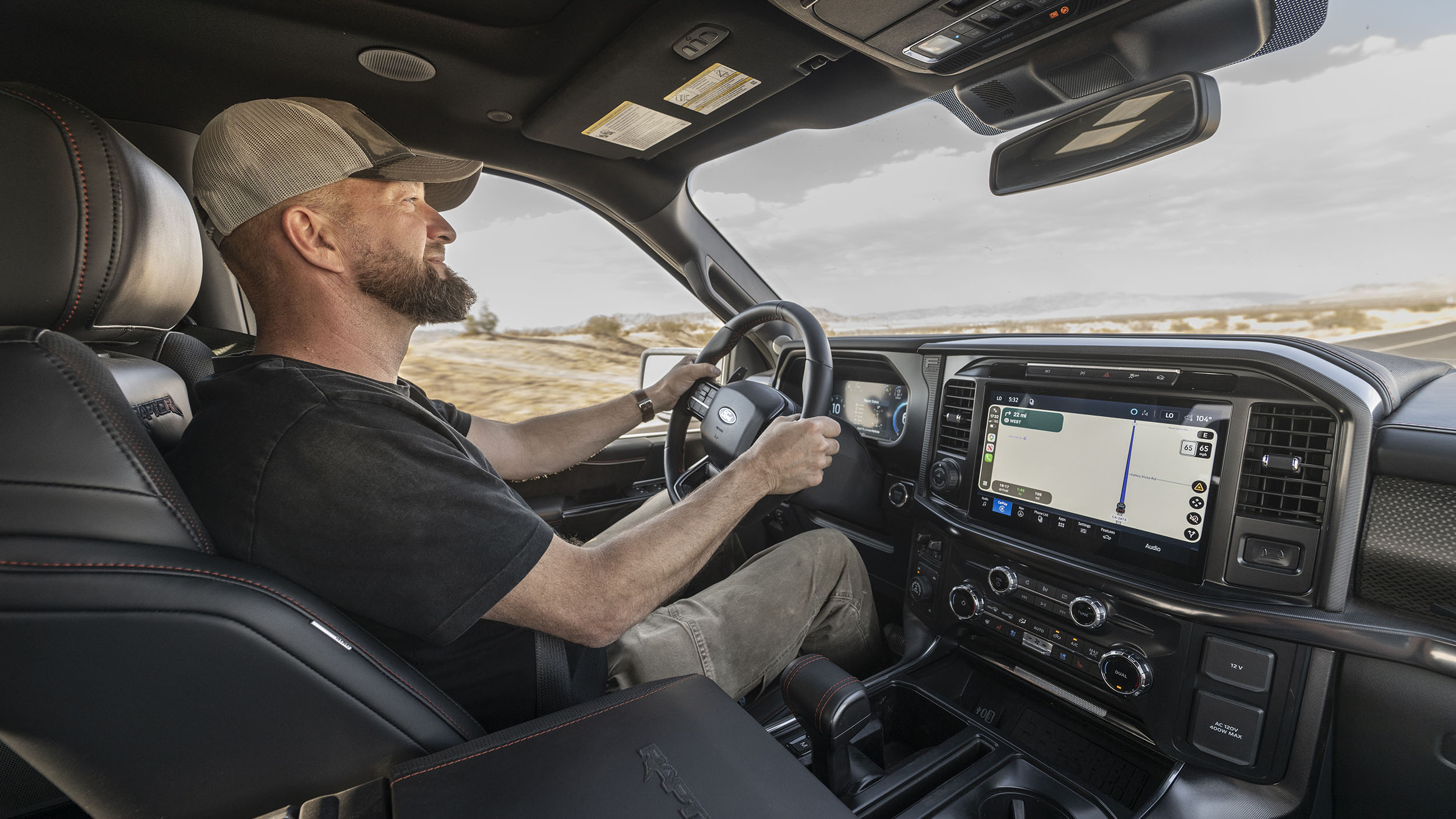
On the plus side, the interiors of both are surprisingly well appointed and comfy on a straight line cruise. The Ford feels more dated but easier to understand, the Ram more techy, better appointed and filled with kit. In fact, both feature all the ADAS, connectivity and shiny bits you get in most luxury cars – both are as aspirational as an RS or M in the European market.
They’re also loved in the USA; people wave and want to chat, but these things are definitely biased, and it’s not toward canyon carving on tarmac.
Finally, we’re off road and both trucks start to make a bit more sense. We’re at the base of the KotH ‘Chocolate Thunder’ dry creek that runs down the mountain with space to play, and there’s a sense that both trucks are much more suited to the surroundings, surrounded by spiky, if low, jagged hills. It’s brutally beautiful here with a library – an entire history of rock – that ends up as just the underbite in the jaws of the sky.
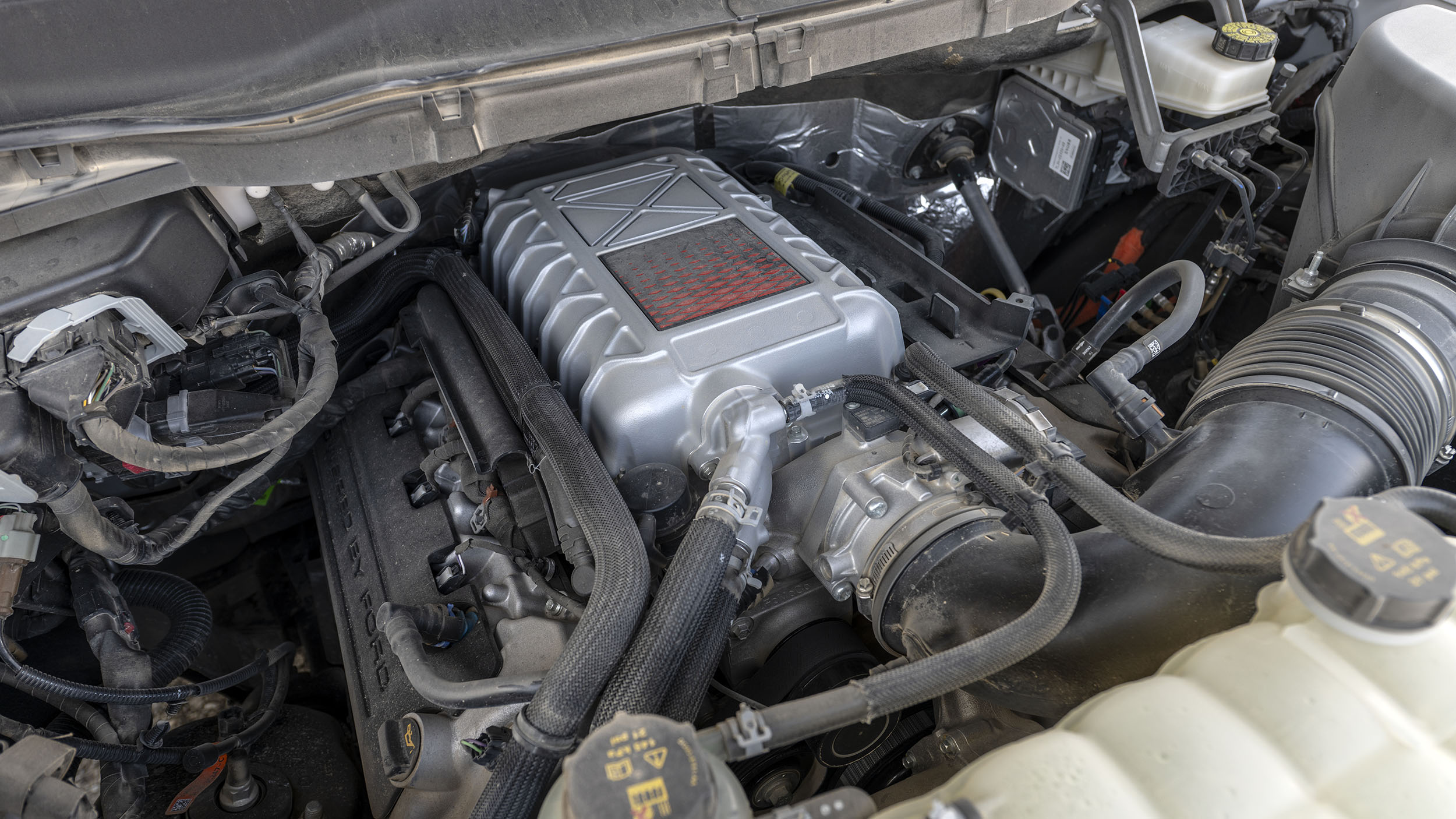
Here’s where the sweating really starts, and the sound of big capacity is the order of the day. The Ford comes equipped with the 5.2-litre supercharged ‘Carnivore’ V8, itself a development of the ‘Predator’ from the Mustang GT500, so cross-crank, rather than the flat-plane in the GT350’s ‘Voodoo’ V8. That’s 720bhp and 640bhp in a truck that weighs 272kg less than the Ram, and proof that the USA is just better at naming things.
But the TRX gets 777bhp from the 6.2-litre similarly supercharged ‘Hellcat’, with 680lb ft of torque, which makes them both capable of the 0–60mph sprint in 3.5 seconds, apparently. That statement requires a pause – these are trucks bigger than most British villages capable of accelerating as fast as an unspicy Porsche 911.
Get all the latest news, reviews and exclusives, direct to your inbox.
Install TG’s US correspondent Alex in the other car and set both in Baja mode (the off road only settings for fast desert attack) for the first couple of runs, roll up on the brakes, and launch. Interesting here: the Raptor positively leaps off the line and gains half a car, with the TRX taking slightly more time to get moving, a gap it maintains right up until the finish line and 110mph. That’s just a couple of mph shy of the Raptor R’s top speed and eight shy of the TRX’s top end.
And so it remains – in six out of eight runs, the Raptor wins by half a car-ish. Utilising the Ram’s launch control function doesn’t get it any closer, and even waiting for the Ram to launch can’t give it the advantage. So the Raptor might be a little less powerful, but that weight advantage and, one assumes, more competitive gearing, makes the difference. On dirt, at least.
‘Agility’ probably isn’t the first thing that springs to mind when you consider cars with bonnets five feet high and suspension made of domesticated trampolines, but if you can’t turn, you can’t win. Ram first, in Baja mode. So that’s rear-biased four-wheel drive and no traction control, and it’s... really useful. Brilliant, even.
The back axle swings wide on command accompanied by the lazy yelp of the supercharger, and just as you think it’s all gone a bit wrong, the front axle leans in to help. Big, expressive drifts that never seem to end, decent weight transition when changing direction. It’s got confidence, and lots of it.
But the TRX SRT feels a bit dense. Heavy. It’s capable and fun, but it retains the feeling of a very big truck dealing with a situation rather than revelling in it. It looks after you, mind – it’s the one you want to be in if you need a helping hand.
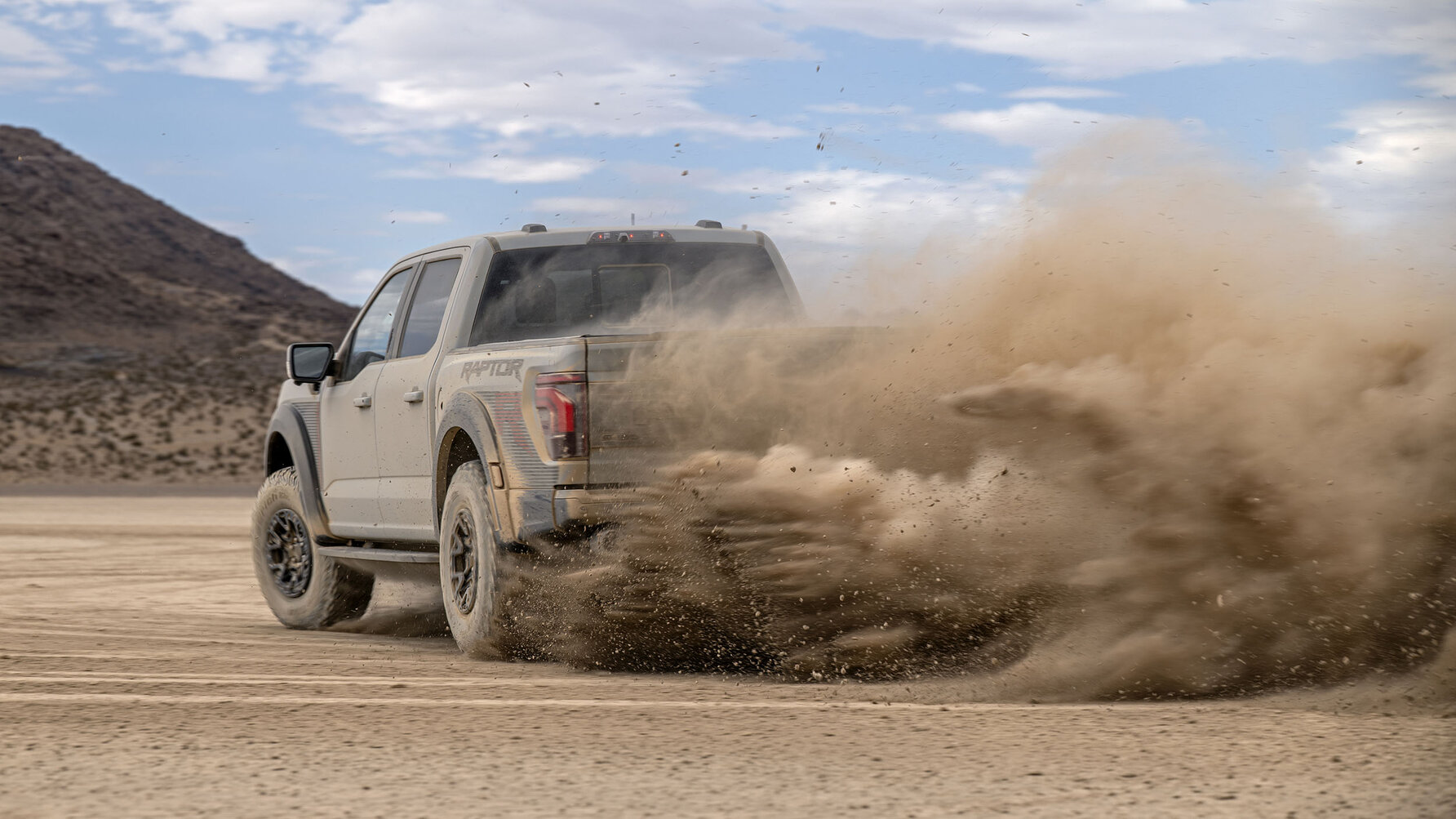
The Ford is less deliberate, but also more chaotic. There’s a much more definite rear bias, and that’s without putting the car into rear-wheel drive mode, which is a recipe for localised tornado making, and it’s harder to control, and more likely to bite the hand that feeds. But there’s a better connection to what’s going on with the steering and traction that makes it feel more connected. Basically, it’s harder to get right, but has more finesse on the limit.
At this juncture it’s wise to note that at certain points I completely lost track of where I was on the course and disappeared in my own dust cloud. Though I probably should have asked where the course was actually supposed to go in the first place.
Nothing too extreme here, more the kind of lumpy trail off roading that an owner would be likely to attempt if out in the boonies solo. Both cars get locking rear diffs and low ranges, both an IMAX worth of cameras, which are a necessity when your bonnet is this tall and you’re cresting a ridge. Honestly, the size of these things makes them a little cumbersome to thread through a donkey track.
Still, Johnson Valley is also plus sized, so we attack many trails during the course of two days and find both trucks more than capable. There are modes and trail assist functions for both, various helpers to play with, and the Ford even gets a button that will drag an inside rear wheel for tighter off road turns. Not quite a tank turn, but definitely something useful when you need to get around a sharp radius on a cliff edge, or avoid vegetation and the like.
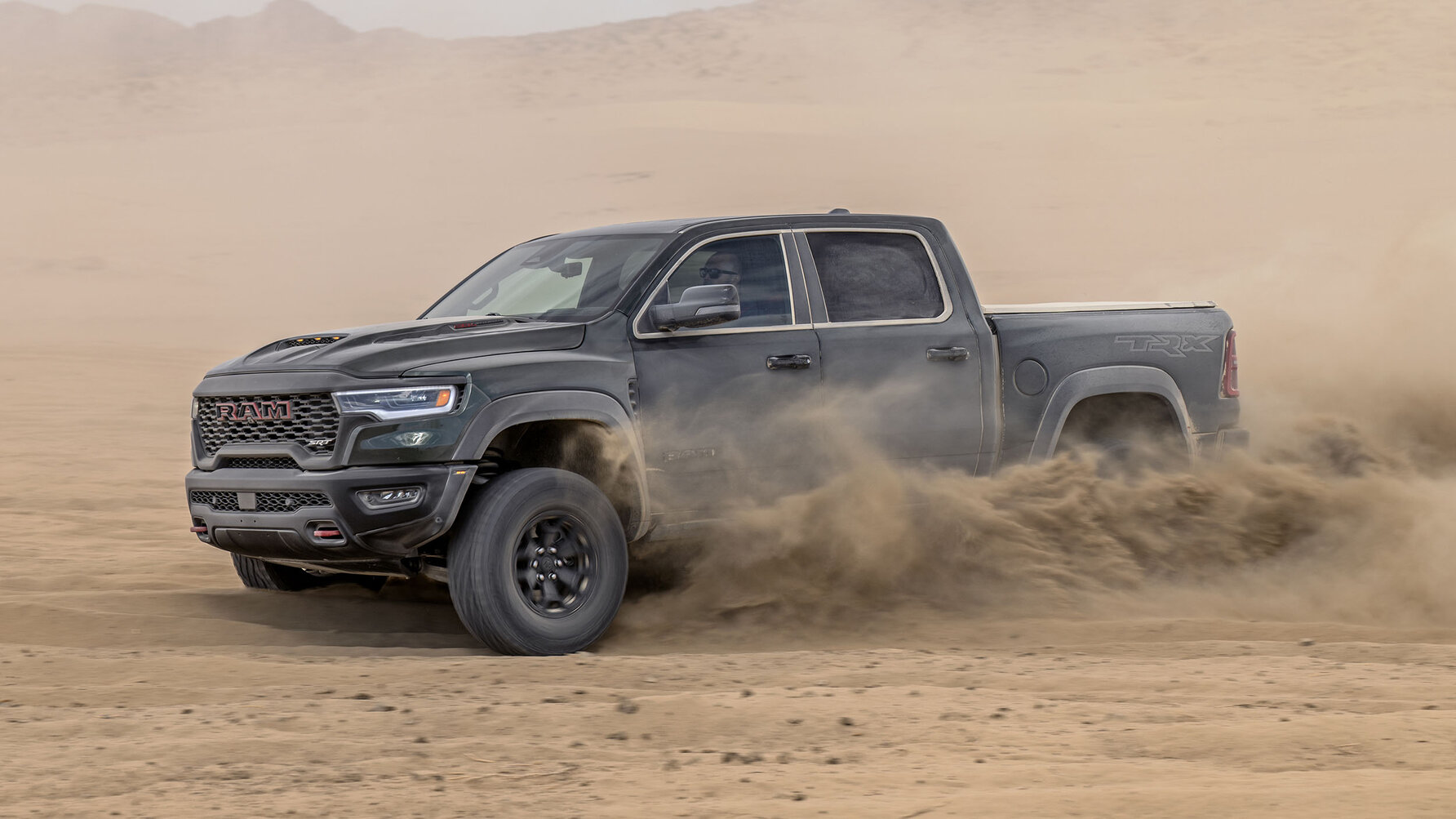
Both get the same amount of suspension travel – 13 inches at the front and 14 at the rear – and neither struggled with anything we aimed them at, although both would slightly drag their tails if the grades got too steep from the flat sections. The Ram didn’t seem to suffer on the 35s either, though again, we weren’t exactly pushing the absolute limits of what they can do, because no one really wanted to be left with a broken truck and subsequently skin like a sultana.
Moving from one area to another, we also attacked some dunes – again, both have a mode specifically for the terrain, one that allows for more wheel speed and general lack of stability control or traction intervention. And again, both were fantastic, and spectacular, on the deeper sand. It has to be said though that the Raptor seemed more comfortable pulling away in the deep stuff, with the Ram sinking fast if throttle was deployed with a bit too much vim from a standstill and the car wasn’t pointed on the downhill. Small things, but noticeable.
The dictionary definition of ‘whoops’ (or whoop-de-dos, if we’re being romantic) is ‘a continuous series of evenly spaced, rhythmic dirt bumps’. The kind that Trophy Trucks skim through at 120mph with their cabs level and 36 inches of suspension travel and big tyres clattering away underneath them like dribbled basketballs. Get this wrong – and I did – and it’s like the weak forces that hold all your cells together are being rudely dismantled.
It feels like you’re coming apart at the seams. In both trucks, 20mph whoops have you riding every facet, and it’s all a bit seasick. Up the ante and 40mph is better, but you’ll find the odd hit that’s out of sync, and you’ll set up a bouncing fishtail that requires focus not to overcorrect; get too out of shape and you’ll dig in and roll. Which means it takes a bit of commitment to run the course at 65mph. But then, revelation.
The Ram is, frankly, mightily impressive. Set in the right mode and the rebound control from the Bilstein E2 ‘Blackhawk’ sucks up the punch and gets the tyre back down where it needs to be. There’s a finesse that the TRX didn’t feel like it might have, and it encourages you to go faster. Scarily faster. At which point the limits become clear; the TRX is heavy, which seems to help up to a point, but it’s less keen on changing direction once it’s set on a course.
Nothing too scary, but you have to slow down to get a comfortable direction change. It’ll also very slightly run out of travel if you get increasing amplitude on a series of consecutive hits – basically, it’ll eventually start to bounce. Which is... disconcerting.
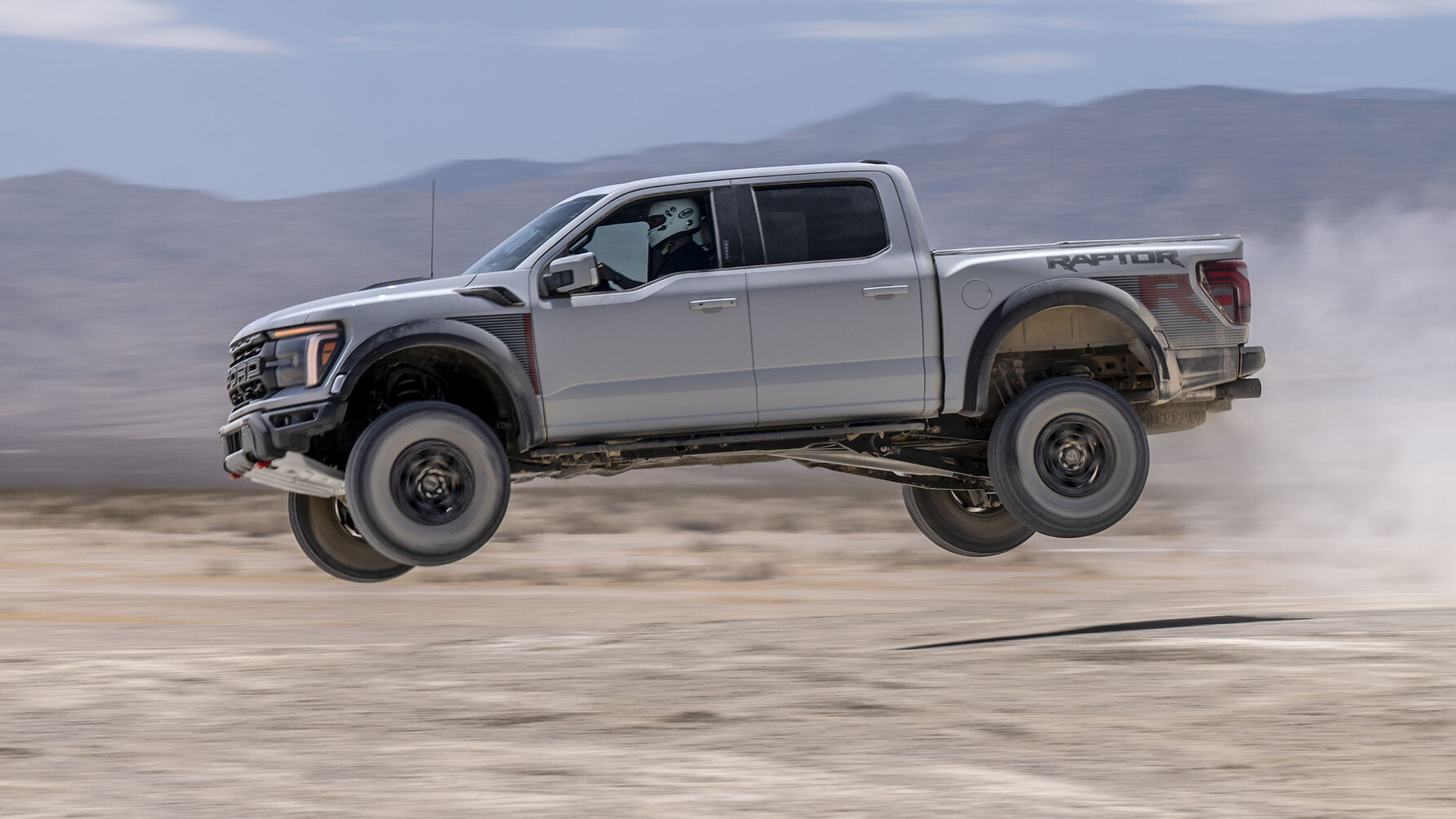
Again, the Ford Raptor R initially feels worse than the Ram. It’s more skittery, definitely looser, feels like it’s going to humble you. But once you up the speed and aggression, it really does come into its own. There’s a feeling that the Raptor is more balanced front-to-back, and even though it actually jumps some sections that the Ram drives through, the Fox Racing dual live-valve dampers seem to work best when pressed.
Both are impressive, but the Raptor feels like it’s got more in the tank – with the Ram being easier to drive fast through these tricky sections, but the Raptor delivering more at the extreme end of the cycle.
The inevitable on terrain like this is that if you’re moving fast, eventually you will become airborne, and slowing down for potential jumps loses time. So both of these trucks are inevitably pictured with all four wheels off the ground. Hence a little airtime; a long flat jump rather than an up ’n’ over kicker, testing the landing rather than the huck. Start slow at 30-ish mph and both suck up the jump without fuss, shrugging their suspension and getting a couple of inches off the floor. Both are rock solid. Up the ante to 55–60mph and we’re looking at a couple of feet and some distance.
Raptor first, and there’s the feeling as you approach the crest and ascend to weightlessness that you’ve overooked it and there’s going to be a big bang when you land, complete with spatchcocked front suspension. Nothing of the sort; land in the Raptor R and it just absorbs and keeps going.
Interestingly, on the video (see TG’s YouTube channel), the Raptor does actually pop back up from the front, something you can’t feel from the inside, and the dash tray liner flies out, but generally it feels like it could do this all day. Again, the faster the Raptor R was thrown at the jump, the better it got, flying straighter and more level every time.
The Ram has more investment in the science of flight, and it shows. There are wheel speed sensors, suspension ride height monitors, and g-force accelerometers at each wheel adding up to the Ram’s ‘jump detection system’. Once the truck senses liftoff – a process of milliseconds – the TRX will cut the throttle and adjust the damping, open the diff to prevent driveline shock upon landing and manage torque. So you can attack the obstacle at full throttle and not have to worry.
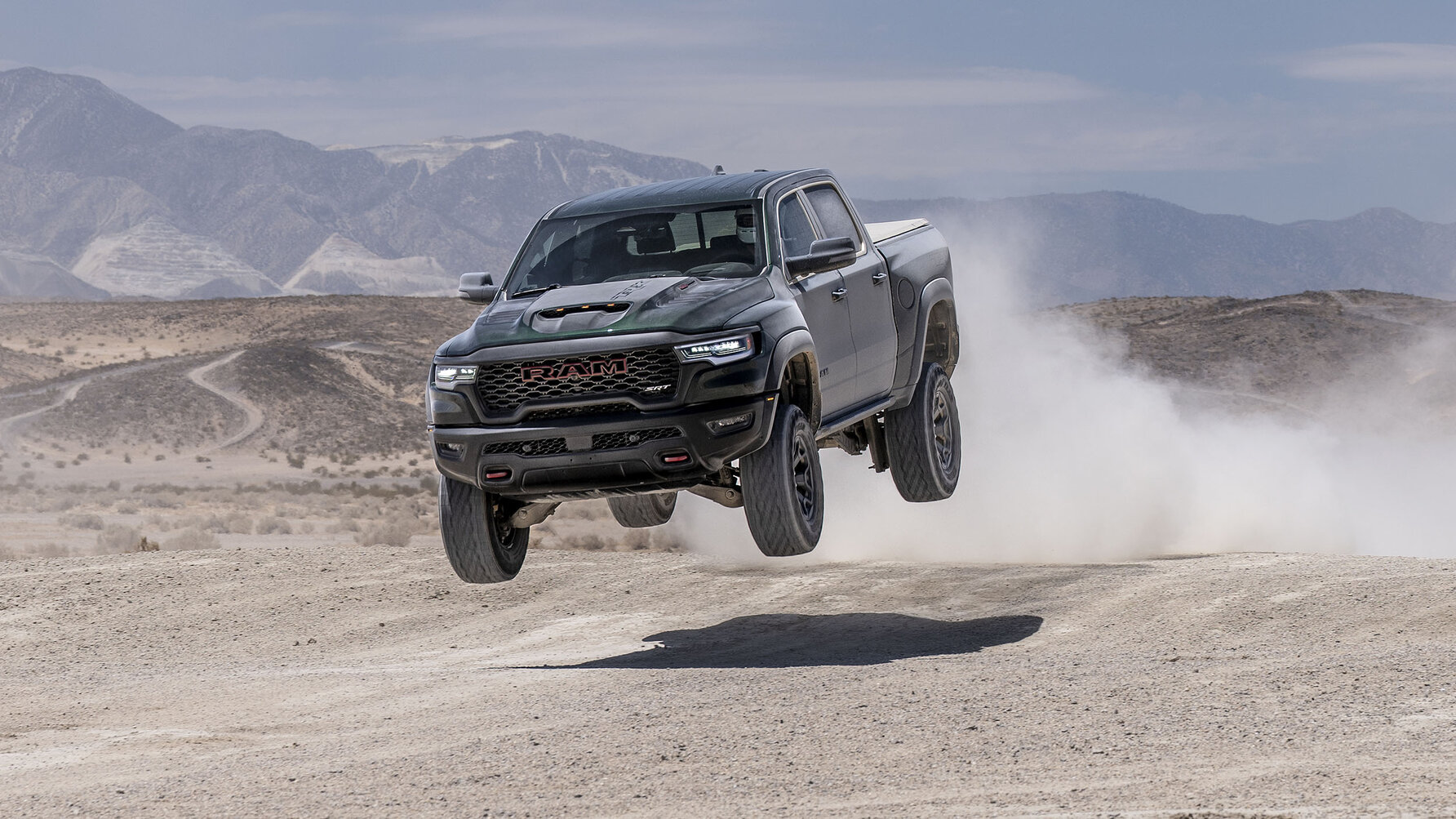
Learning how to use it and forcing yourself not to lift is surprisingly difficult, but once you learn the Ram’s ways, it’s utterly effective. Landings are just as effective as the Raptor – albeit with a notably more nose-down finish. And yes, we tried both several times and from slightly different angles to make sure. Both remained mighty.
The TRX SRT is more stable, comforting and a bit easier to use, but will find a limit. The Raptor R is more likely to scare you, but also seems happier the faster you go – so it comes down to driving style and personal risk assessment.
These trucks are both huge, silly, monstrous fun. The Superman to a regular pickup’s Clark Kent. But they are also specific. The world may see them as slightly anachronistic, but the USA is a different kind of playground. Infrastructure is bigger, petrol is cheaper and there are actually places – like Johnson Valley – where you can use these things as they are intended. It’s where they come alive.
These two are also a prime example of what happens when competition improves the breed. Put them side by side and they have deliberate one potato, two potato engineering going on – and that’s great for consumers.
So. Some conclusion. The Raptor R feels older, is less powerful, less ostentatious. The Ram TRX SRT is filled with surprising technology and comes with all the tricks – including that monster engine. They both do what they say they can do – and then some. But the Raptor feels like it’s been dialled in for maximum attack off road, plus a little chaos. It’s harder to get right, but more adjustable at the limit.
The TRX allows you to reach higher, faster, but will eventually curb your enthusiasm slightly on the rough stuff, is better on road. So it comes down to which kind of supertruck you prefer, and how you want to drive it. For me, and by a sliver, I would prefer a car I had to learn to get the best from off road, and go a little faster. So I’d take the Ford.
The TRX makes for a better compromise on road, and feels like the interior matches that quality, plus, it’s cheaper by $15k. So if you’re not constantly hitting the whoops, the Ram would be the better choice. But whichever one you picked, I guarantee you wouldn’t be disappointed.
Get all the latest news, reviews and exclusives, direct to your inbox.