


First LookTop Gear
Welcome to the most ambitious Rolls-Royce ever built: the astonishing Project Nightingale
The first of RR's 'Coachbuild Collection' is a 5.76m-long fully-electric two-door convertible. So Rolls
Rolls-Royce reckons this is its most “ambitious work” to date. After 120 years in the game, and with one of the most splendiferous back catalogues in the automotive world, that’s a serious flex.
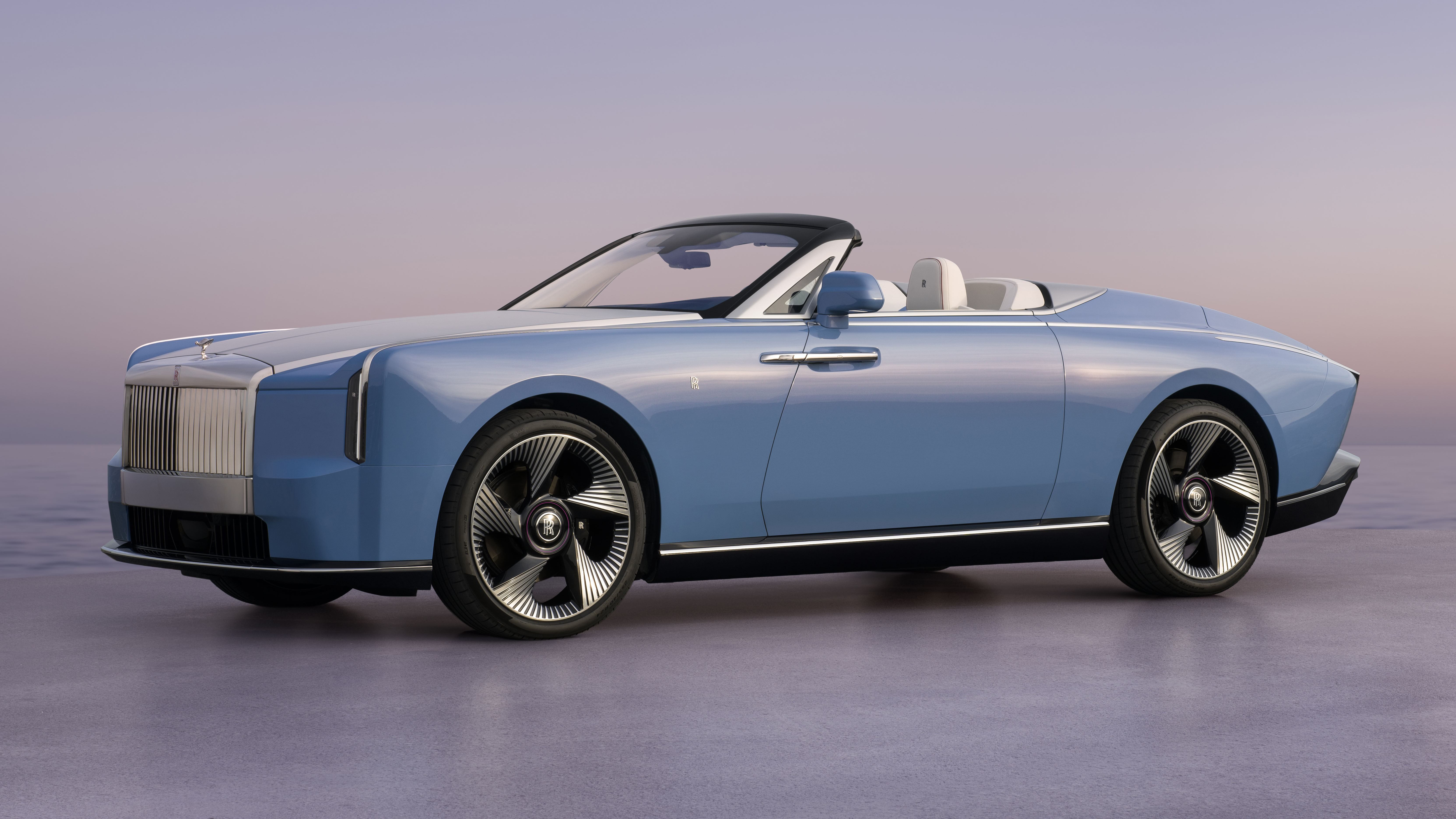
Project Nightingale is long – 5.76m stem to stern – and has frankly enormous presence in the flesh. It also ushers in a few firsts. It’s both fully electric and a two-seater convertible, but also inaugurates the company’s recently announced Coachbuild Collection. This is for those occasions when a regular Rolls-Royce, even a Black Badge or private commission, aren’t quite up to the mark. Only 100 will be made, and as is the way at this stratospheric end of what we must call ‘the market’, they’re all spoken for. Sorry about that.
Advertisement - Page continues below
“One hundred cars felt like the right number,” Rolls-Royce CEO Chris Brownridge tells TopGear.com during a super-early preview. “We could easily have done more based on the feedback we have, but scarcity is important and if we change our position on that we lose our credibility at the top of our model pyramid. It showcases what Rolls-Royce can do, builds future demand, and stimulates creative thinking about client commissions.”
He continues: “We have five private offices around the world and Nightingale will drive demand even harder. That’s why we’re extending the factory at Goodwood, to provide more space to do more complicated projects. It’s not just about creating a motor car, it’s about creating a part of the Rolls-Royce history.”
Rolls is remaining discreet about the tech details for now, but the new car uses the same modular aluminium spaceframe that underpins the rest of the line-up. Beneath that glamorously Stentorian body lies a fully electric powertrain, although it will be a substantially updated iteration of the current Spectre set-up. Expect more performance, efficiency and range, although none of these is a major priority for the people who will end up with a Nightingale. Not when you likely have an Airbus ACH160 or Gulfstream G700 on standby and, you know, staff. The focus here, says Rolls, is on “beauty… both observed and lived". And the name? It references ‘Le Rossignol’, a house on Henry Royce’s winter estate on the French Riviera.
The majority of cars will be going to existing customers, but Nightingale is also aiming to draw newcomers into the fold. Rolls-Royce is an elite club and the owners like to network with each other – and the company. It might also help shore up demand for the Spectre, whose sales have dipped noticeably now that the early adopters have all been sated. “We’re the only luxury brand where any client can talk to me at any time,” Brownridge says. “And our clients can have direct access to a member of the design team. Being close to our family members is critical to our success.”
Advertisement - Page continues below
Many of the most memorable Rolls-Royces were coachbuilt, sometimes as one-offs, often in low volumes. That’s how the real-life Great Gatsbys liked it, back in the Jazz Age. In terms of design, Streamline Moderne is a more apposite reference here, a Thirties design movement that influenced art and architecture, as well as cars, ships, trains and aviation. Grand proportions, absolute surface discipline and a clarity of line are the hallmarks of Rolls-Royce, according to director of design, Domagoj Dukec. “For me, this landmark motor car feels both inevitable and completely unexpected,” he says, “and it will shape everything that follows.”
"It needs to be a brand shaper for our future portfolio," he adds. "But it’s not just the shape, it’s the experience that supports it. It’s a very small group that works on coachbuilt, with a different engineering team and different processes. The design team should be as creative as possible, they shouldn’t even know all of the constraints because that will only limit them. We let them really explore things."
With different cooling requirements compared to its combustion siblings, the Nightingale is definitely pushing some limits. Slim, vertical headlights accentuate the width, and ask some basic questions about the extent to which a car has ‘eyes’. Polished stainless steel strips start at the bottom of the lights and bisect that epic body all the way to the tail. The famous Rolls Pantheon grille anchors the front end as always, with a structured plinth beneath it that’s strongly geometric. The Spirit of Ecstasy sits at the top, in her usual position, defying vertigo and incoming high velocity insects.
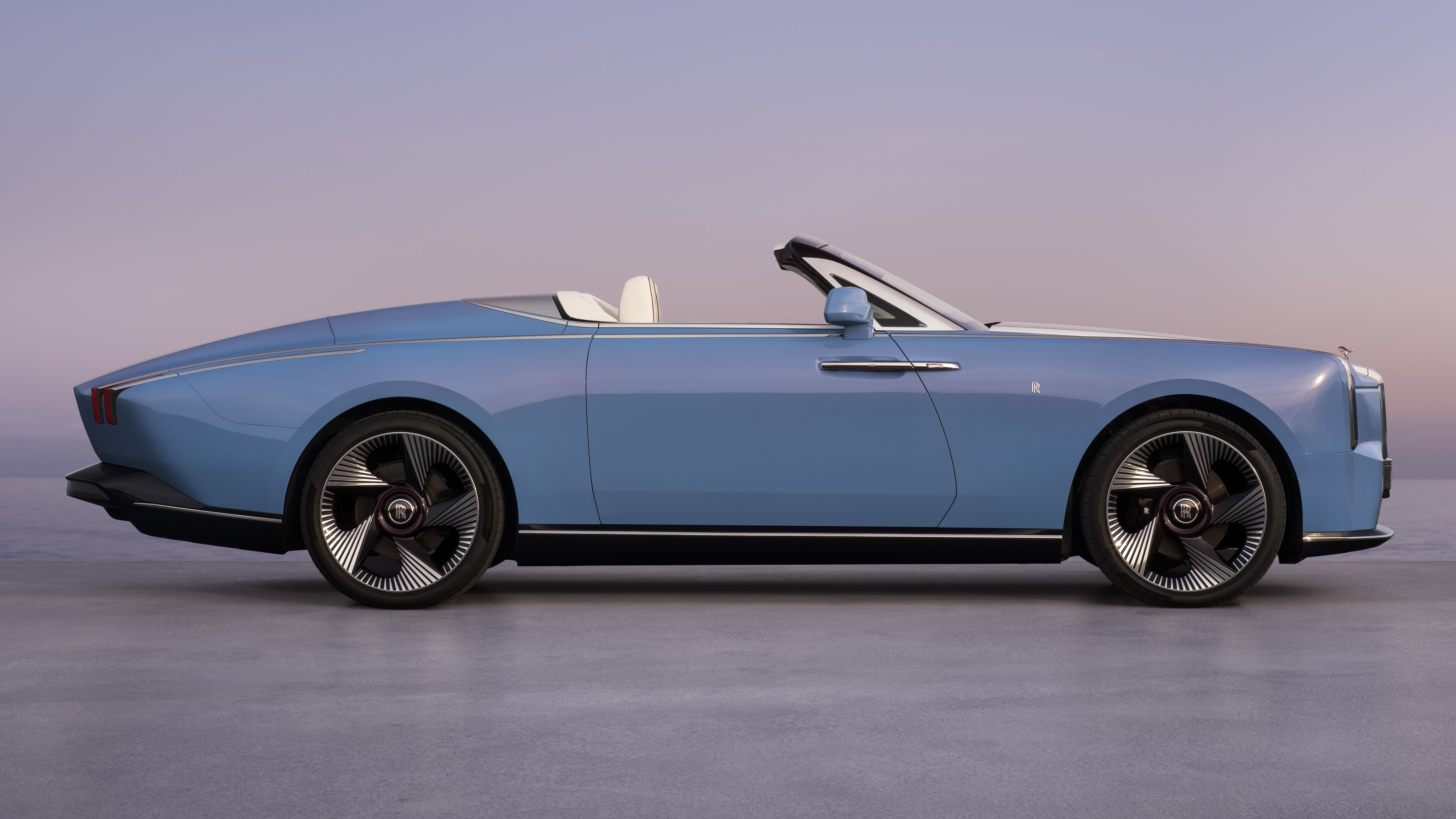
Equally striking is the Nightingale’s epic fuselage – when a car is this long it can have one of those – and the ‘negative sculpture’ on the lower part of the body. It takes considerable confidence to build something with this much sheet metal and not festoon it with intakes, graphics or other elements designed to distract the eye. Monolithic is the word. There are prominent door handles, though, and a ‘double R’ monogram appears on each front wing.
Top Gear
Newsletter
Get all the latest news, reviews and exclusives, direct to your inbox.
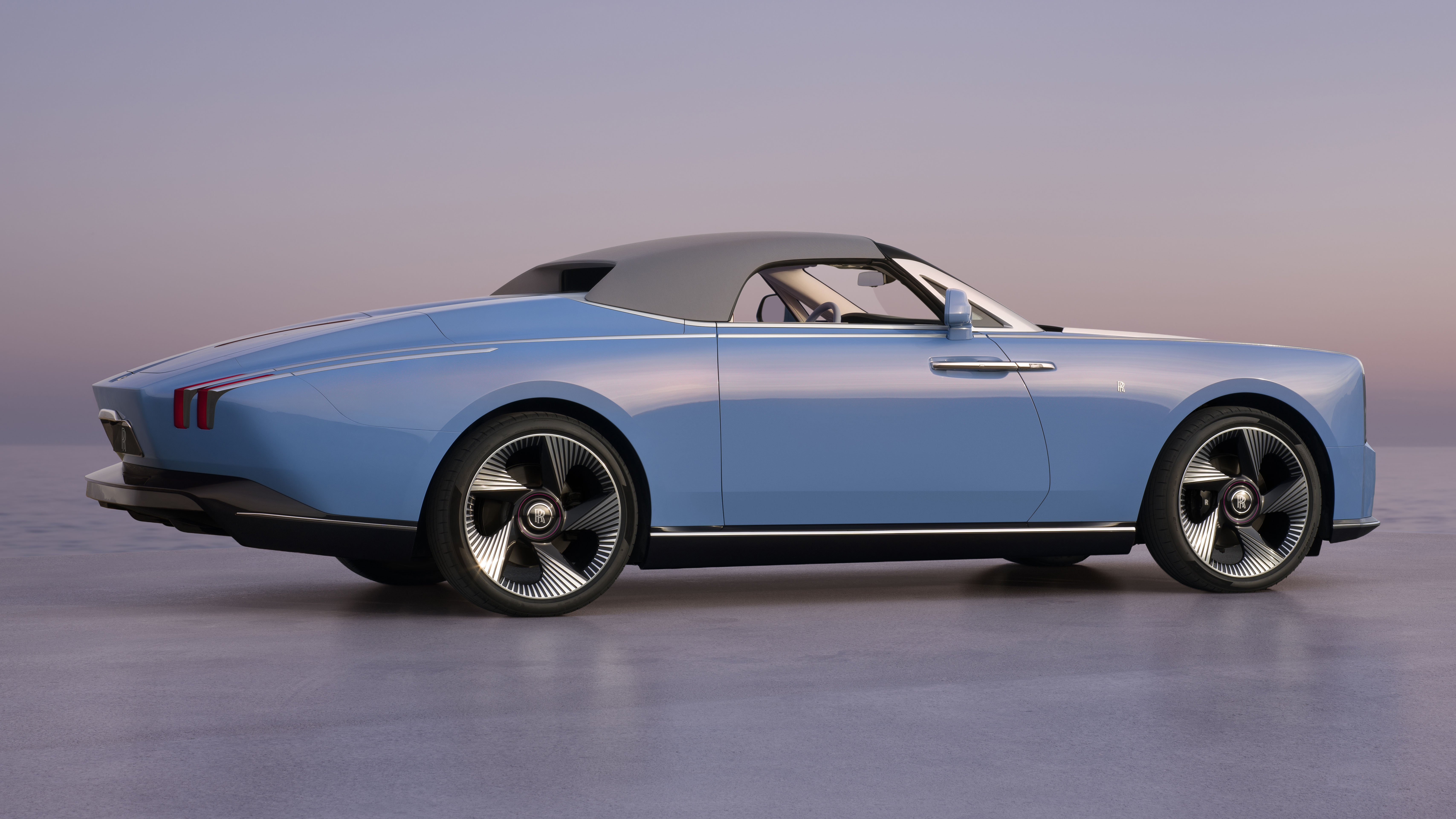
The wheels are the biggest yet seen on a factory Rolls-Royce, at 24in, with a swirling look modelled on a yacht’s propeller and machined stripes that suggest motion even when static. The tapered rear end has an imperious sweep, and owners can enjoy what Rolls dubs the ‘piano boot’, which opens sideways on a cantilever like the lid of a grand piano. Beneath that is the ‘Aero Afterdeck’, a transom diffuser that brings the whole thing to a suitably implacable full stop without any old-school exhaust outlets ruining the flow.
Less is more here, although the Nightingale is still self-evidently a maximalist motor car. Dukec compares the coachbuild design process to the one that usually results in a concept car. “It’s similar to that path, although this isn’t a concept car because it’s fully driveable and has to work on the street,” he notes. “The tail is longer, and the front is higher than the rear, like a boat. It’s not about speed so much, and that actually influences every detail on the car. Because people want to promenade in such a spectacular looking machine.”
“Being timeless means ignoring fashion,” he continues. “You can’t react to what everyone else thinks is cool right now. Rolls-Royce also has to have a certain value in terms of craftsmanship. It doesn’t really matter what kind of engine it has.”
The roof incorporates a sound-deadening material that mixes fabric, cashmere and composites, preserving the serenity that makes the Spectre such a remarkable driving experience. Inside, the dashboard structure is another quasi-architectural aspect, and the interior is enlivened by some quintessentially Rolls-Royce inspo. Not for these guys trifling ambient lighting; instead you get something called ‘starlight breeze’, which uses 10,500 individual elements to create a pattern that mimics the soundwaves of an actual nightingale’s song. We wonder what Tyler, the Creator would make of that.
There are other exceedingly high-end touches: as the rear-hinged coach door opens, the central arm-rest slides back to reveal the rotary controller, elements of which are glass-blasted to give it the feel of an achingly expensive piece of jewellery. Same goes for the driver selector and other items inside. Including the cup-holders, which are made of polished aluminium. To paraphrase Prince, the Nightingale is mainly a physical thing, and to hell with the touchscreen tyranny.
“Digitalisation is a great thing, but it’s poor if it’s not executed in the right way,” Dukec says, as we debate the role of hi-tech in a car with the atmosphere and intent of a Rolls-Royce. “AI is not bad in itself, it depends what you do with it. It’s a tool, and it needs the right intellectual leadership. After all, we wouldn’t have built skyscrapers without tools.”
I ask him if BMW’s panoramic iDrive will appear in a future Rolls. ‘No. It’s not appropriate. Our clients have different ideas about cars than everyday drivers.”
The Nightingale’s price is unconfirmed, but while it tips its hat at 2021’s Boat Tail (three were made, at a rumoured £25m apiece) and 2024’s Arcadia Droptail, it’ll be… well, affordable isn’t the word, but you know what we mean.“The pricing reflects the effort that goes into making it,” Brownridge says matter-of-factly.
As for all those geo-political headwinds, Rolls-Royce is apparently robust enough to withstand the turbulence. “We’re nicely hedged in our business, but our business model and our production facility is completely demand driven and flexible. Demand for more complex commissions is continually growing, as is the ultra high net worth audience. We respect our heritage but also need to innovate.”
Coachbuilding, you could argue, is looking back to go forwards. Rolls-Royce knows that stuff inside out, and how resolutely it reinforces the bottom line. A no-brainer, then. But it’s resisting the temptation to expand into other superficially lucrative realms, as pretty much every other high end car maker has done.
“Rolls-Royce describes itself as a ‘house of luxury’, not a car company. I thought that sounded quite aloof when I joined them,” Brownridge recalls. “But the reality is that a customer buys a Rolls-Royce because they want a luxury experience and an exquisitely engineered motor car – particularly so with a coachbuilt car. We are only interested in creating value, and the focus is always on our cars.”
So the House of Luxury is unlikely to be building an actual house any time soon. This new high flying bird will just have to do.