



GamingTop Gear
Racing games need to “adapt and change” says Star Wars: Galactic Racer developer
The upcoming racer set in the Star Wars universe could bring about a paradigm shift. Here’s the man heading up the project...
“ We love racing,” Fuse Games founder Matt Webster tells TG in quiet corner of the studio’s Guildford headquarters. “But we've largely been on a car collection progression system for a decade or two.”
He’s right, you know. On both counts: as a veteran figure at Criterion before cutting loose to create a new studio, Webster’s long list of credits on Burnout and Need For Speed titles more than demonstrates that love for racing games. And racing games have been stubbornly clinging onto the Gran Turismo blueprint for too long now.
Advertisement - Page continues below
You know the one: get car, race car, earn money, buy better car, repeat. That’s just one of the dusty old principles Star Wars: Galactic Racer is about to modernise.
“We want to push that forward,” Webster says. “And what we realised is that a roguelike structure is built for infinite replayability. For us, racing thrives on that replayability.”
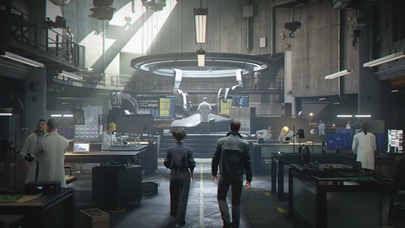


The career mode doesn’t bury you under menu tiles of events and simply ask you to race your way through them. It really is like a roguelike: when you start a championship, the sequence of races and events between you and the end is randomly generated.
It might include testing dangerous prototypes in time trials, elimination races, powerful rewards, or fail states that end your whole run. As we noted after going hands-on with it, it’s great.
Advertisement - Page continues below
As you race more, you become better attuned to your vehicle’s handling, better acquainted with the tracks, and you know how and when to use your boost. “ So let's have a progression system that's in tune with that,” says Webster. “There’s an element of randomness to reward drops.”
He asks if we wrecked out of our first tour. We did. (Too cocky with the boost, too devil-may-care about our championship tokens.)
“ So the second time you enter, that's all fresh. There's a completely different mix of choices for you to make. And then that pool of parts that's available to you continues to grow, and those parts are synergistic with one another.”
That means you can lean into one particular attribute of your vehicle – super-silky handling, or massively powerful boosters. Even elements that appear at first like a weakness can be turned into a strength: generally it’s a good idea to keep your temperatures down so that your engines don’t blow up, but that’s turned upside down if you pick up a component that makes you faster at higher temperature: " This part thrives on burning, so I actually wanna get hot."
Top Gear
Newsletter
Get all the latest news, reviews and exclusives, direct to your inbox.
And that gets you racing differently. Picking lines out in the sun, rather than ducking into caves to bring your temps down. And while there’s real consequence to losing races, crashing, or dropping out of championships, you carry over some bits too that make the next run even more laden with possibilities and experimentation.
“"When you wreck out, that vehicle is scrapped, but you keep your credits and tuning points. So the next time you start that run, you're starting from a more elevated position," explains Webster. "You might have a moment where these parts come together in a build that you never expected, and then you get that ‘broken build’ moment."
It’s all those thoughtful little design decisions that make this game so exciting, and so fresh to play. Which was, Webster reveals, the whole point of founding a new studio.
“We wanted to build on everything that we'd learnt and that had been successful, and try to apply it all at once. To see if we could do something with the scope and scale of our ambition, but to do it in some different ways.
“The industry's changing and how you go about making games needs to adjust and adapt to reflect those changing times.”
Part of that adaptation is the scale of the studio, and the way the team works. Webster tells us Fuse Games is about 70 people – an amazing number to hear after you’ve played a game that feels this lavish and grand in scale – and works with multiple partners to achieve that triple-A production standard.
That way of working, versus the old method of tooling up by hiring hundreds of developers and then firing them after a product ships, has obvious benefits. For Fuse, it means being able to make a game that feels like an epic, with a team small enough for its creators to really author it.
“[The studio’s objective] was to bring everything that we'd done to pass in a healthy, sustainable way, and to try and push the genre forward from a racing game perspective.
“We’ve made a lot of racing games. We’ve been fortunate to stand in front of a few good ones in my time. But we recognize that the genre needs to adapt and change.”