





25
For a facelifted car – even one with no carryover body panels and a new name – to get this wholesale a new cabin tells you something: Ferrari knew the Roma’s cockpit was a screw-up. Better to start again. Better yet, better to go back in time…
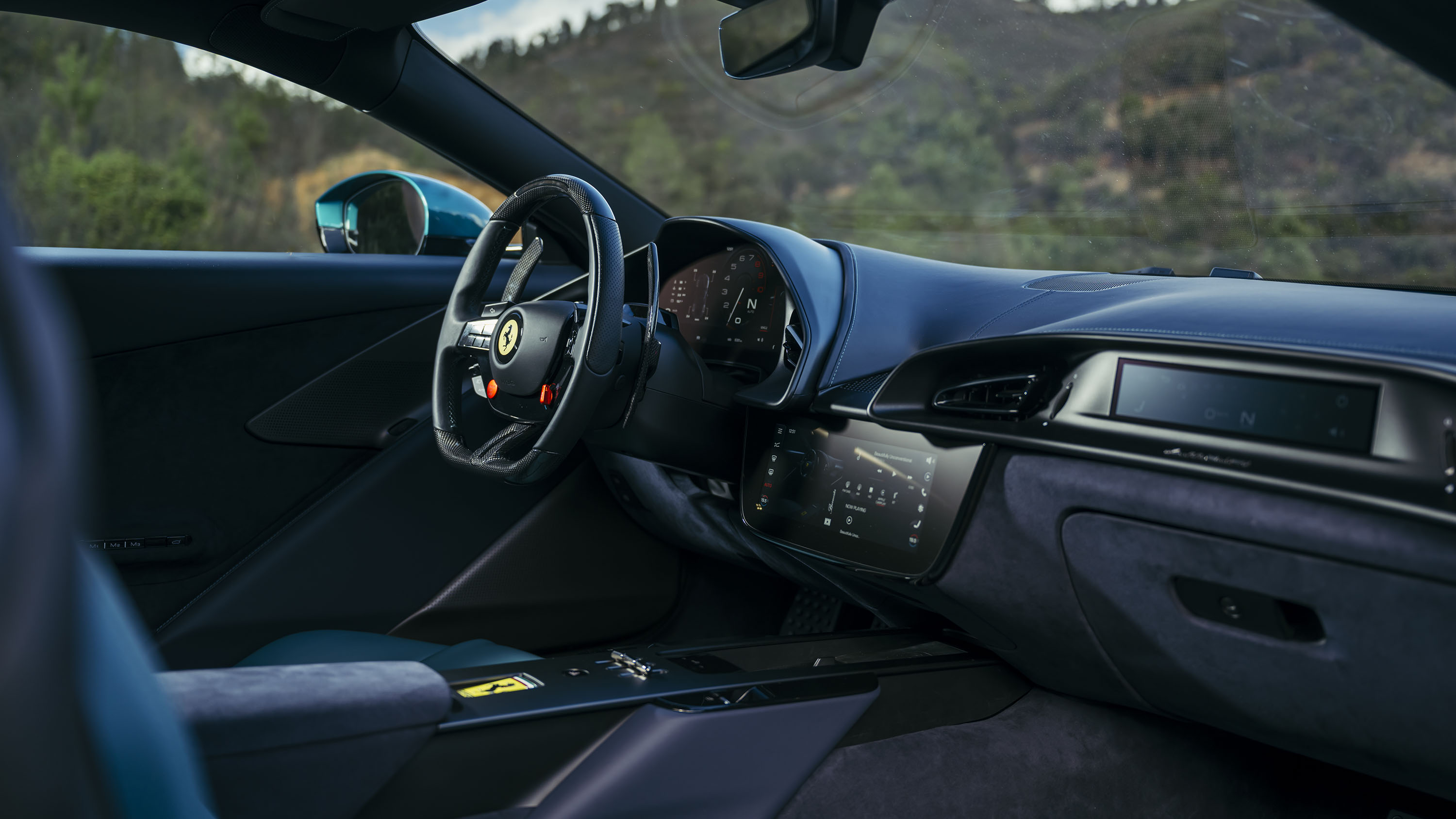
Buttons arrive back on the steering wheel in place of the hateful capacitive controls which have blighted all Ferraris since the SF90. Good riddance – the clicky buttons are so much easier to use, especially on such a busy, fast-moving wheel.
What’s more, there’s a dedicated button to switch the overactive ADAS nonsense off – right and proper that a Ferrari should be the easiest car in the world to neuter interfering nannies. Well done Maranello.
Then there’s the central redesign. In the Roma you got a Temu iPad balanced atop the centre stack. It was painfully laggy, with fiddly menus and thick bezels. That’s been binned, and the whole cabin opened out so the contrived ‘twin cockpit’ layout is less space-invasive. The passenger still gets their own letterbox screen and pair of air vents, but the architecture is less oppressive.
The new 10.25-inch touchscreen is far crisper and snappier to your touch, though the menus are a fiddle. This is made worse by how low down the screen lies in the car.
Ferrari’s design team explains they don’t like interiors which feel ‘dominated’ by screens, and in a Ferrari your eye should fall on leather, metal and carbon before pixels. Sure, but when there are no physical heater controls, no button for the nose-lift, and activating the heated seats is a four-tap process, it would be handy not to have to drop eyes below knee-level.
Ferrari has lazily carried over the capacitive touch-panel controls from the Roma for the mirrors, lights and start-stop system. Adjusting the mirrors is fiddly as a result – and it would be a crime to kerb those stunning milled wheels. And watch out for the sharp corners to the air vents as you duck inside. Doesn’t half hurt if you catch your knee on one.
Categorically not. Ferrari perhaps doesn’t get the praise due for its cabin quality like Bentley or Rolls-Royce does because it’s a performance car maker, not a luxury brand. But the materials and finish on show these days really is stellar, from the soft waxy hides to the glossy carbon jewellery and the Amalfi’s exquisite aluminium central fillet which runs front to back and houses the key like a miniature work of art.
Visibility is excellent in all directions – it’s much less like peering out of a tank turret than the Aston Vantage and now the bonnet has lost its cringeworthy power bulge there’s no longer a blind-spot hiding potholes straight ahead.
Oddment stowage is less good. The minimalist door bins are tiny and awkwardly shaped, the glovebox merely adequate and there’s only one cupholder. Place a tall bottle or flask there and it’ll block the low-lying touchscreen. The wireless charging pad also struggles to contain a smartphone when you’re driving like an Italian, but luckily you’ll discover secure stowage and charging under the central armrest.
Ferrari doesn’t even bill the Amalfi as a ‘2+2’ which is usually code for ‘forget about rear legroom. Officially it’s a ‘2+’ which is code for ‘the back seats are so impossibly cramped and upright they’re only worthwhile for extra luggage space.’
The boot is 273 litres – about the same space as an AMG GT, but twice as much as you get in the nose of a Porsche 911. You can fold the rear backrests down to swallow longer items.
Get all the latest news, reviews and exclusives, direct to your inbox.
