



25
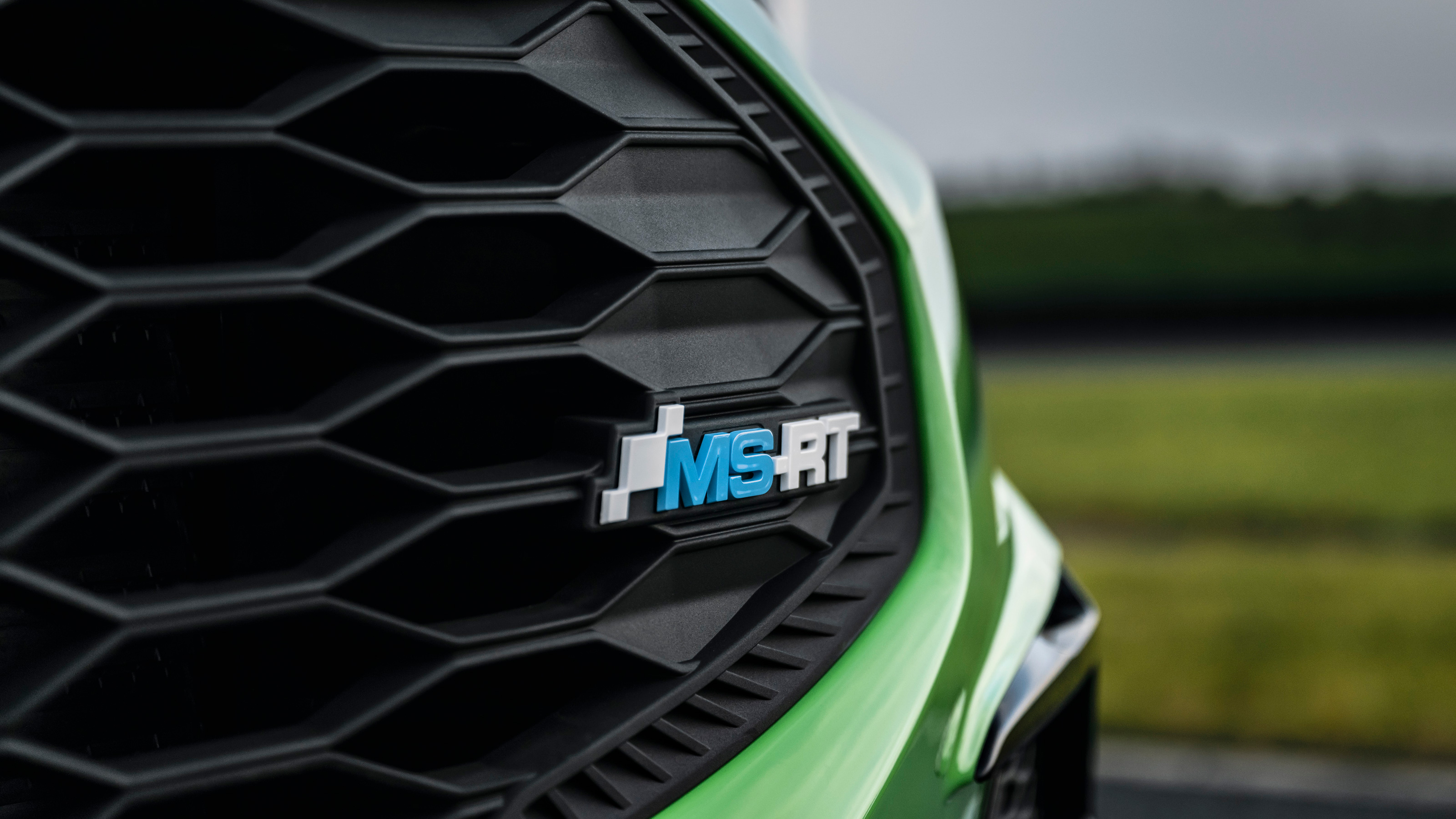
Sure is. It’s the Ford Transit Custom MS-RT, the motorsport-flavoured version of Britain’s favourite tool carrier. Or a baby Supervan, depending on your disposition. MS-RT stands for M-Sport Road Technology, the road-going offshoot connected to M-Sport – the people who know a thing or two about making Fords look angry, grip hard and jump over things in forests as part of the World Rally Championship.
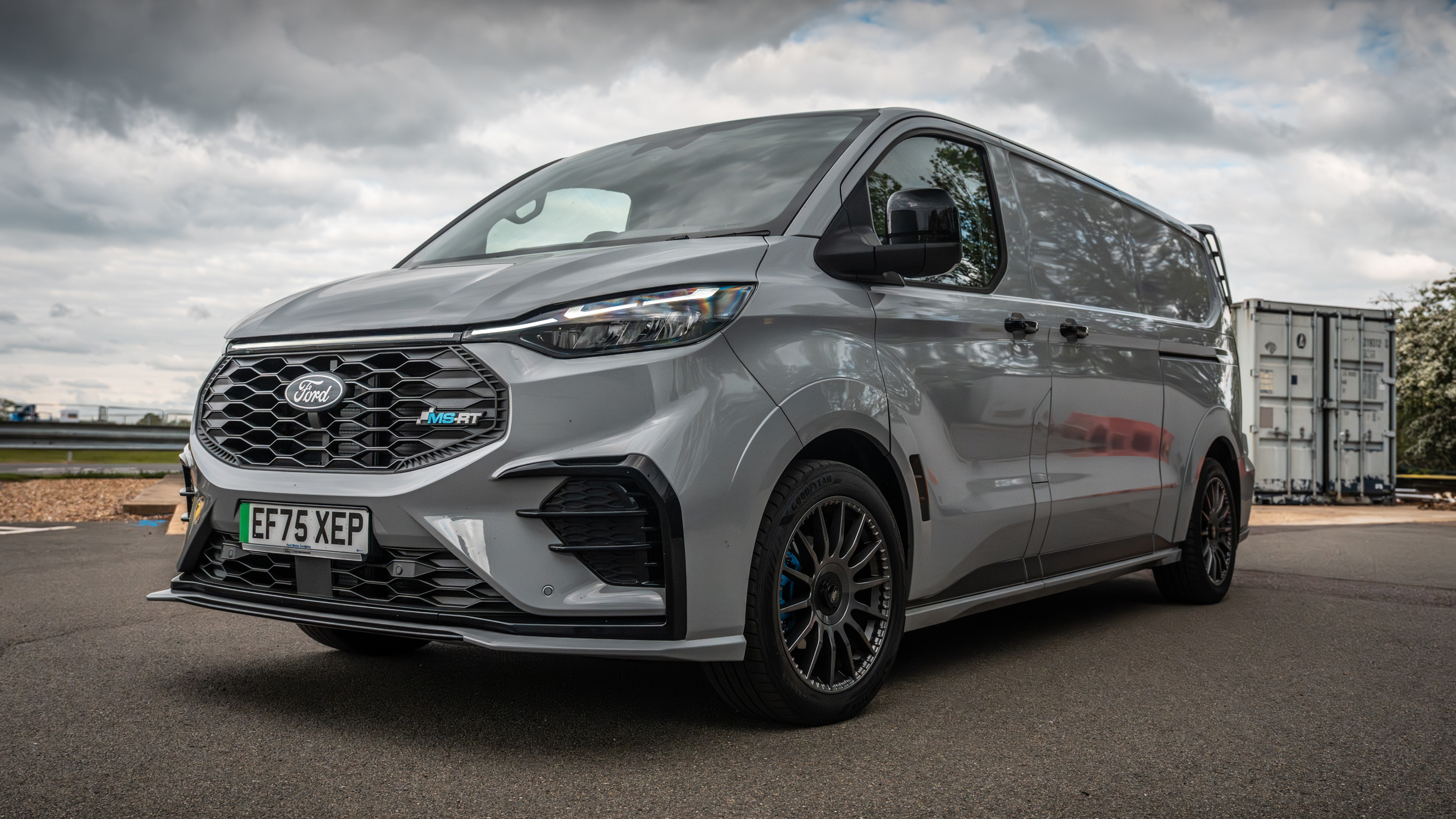
A Transit Custom with broader shoulders, lower-looking bodywork, 19-inch wheels, blue brake callipers, spoilers, diffusers, arches, sills and enough rally visuals to make your local courier feel like a works driver. Only this one is electric.
Yes, and that is the odd little contradiction at the heart of it. The E-Transit Custom MS-RT is the most powerful Transit Custom yet. The electric version gets a 210kW motor – that’s 282bhp – driving the rear wheels. Yes, you read that right. Rear-wheel drive. Like a supercar. Not a van.
There are other powertrains available: a 2.0-litre EcoBlue diesel with either 148bhp, a manual gearbox and front-wheel drive, or 168bhp, an automatic gearbox and optional all-wheel drive. There is also a 229bhp plug-in hybrid with a 2.5-litre petrol engine and an 11.8kWh battery.
But the all-electric version is the headline act, partly because of the power, partly because of the rear-drive layout, and partly because there is something beautifully absurd about a zero-emissions van dressed like it has taken the wrong turn off a track day.
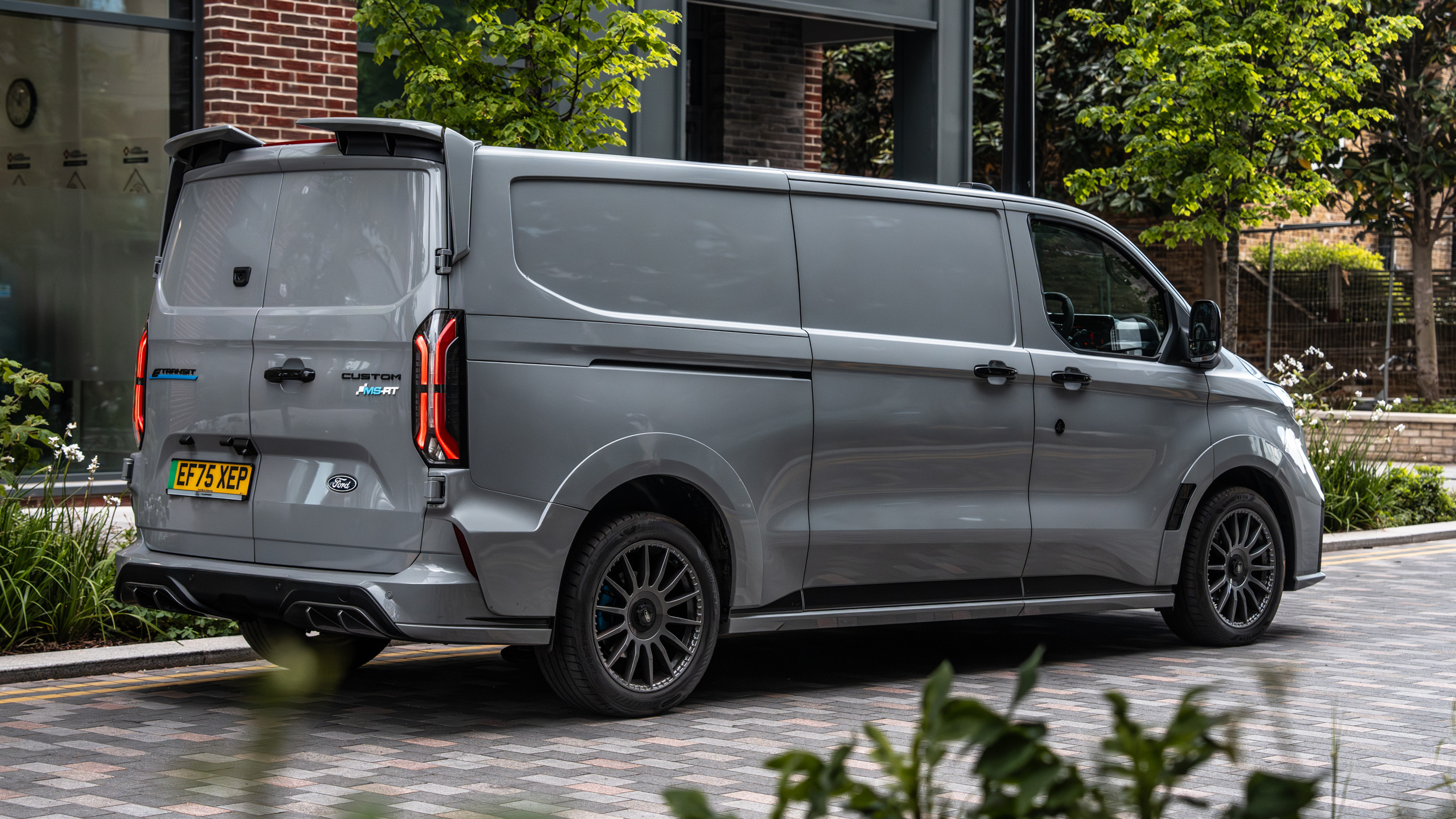
Visually, quite a lot. The MS-RT gets an aggressive new front bumper with an integrated spoiler, wide body arch extensions, sports side sills, black mirror caps and door handles, a redesigned rear bumper with a diffuser and a motorsport-inspired rear spoiler – great for those aero-inspired looks, less good if you have to work in tight multistorey car parks.
The electric version also gets a full-width LED light bar across the nose, which gives it a useful point of difference from the diesel and plug-in hybrid models.
Under those arches sit exclusive 19-inch anthracite alloy wheels wearing commercial-rated 235/45 R19 Goodyear Eagle Sport tyres. The wheels are half an inch wider than the ones on the Transit Custom Sport and save just over 1kg per corner in unsprung mass. Track width is up by more than 50mm compared with the standard van.
A bit of both, naturally. This is not a GT3 car. Nobody is going to be trail-braking into the loading bay at Spa with three plasterboards and a shedload of flat-pack furniture in the back.
But the rear spoiler has been developed using computer simulations to optimise airflow, and the whole MS-RT bodykit is designed to lower and widen the visual stance. The front bumper, sills, rear bumper and diffuser all work together to make the thing look more planted, and it is bloody effective.
Get all the latest news, reviews and exclusives, direct to your inbox.
In London, I followed a Ferrari 296 and still seemed to get more attention. That is not science, but it is very funny and shows the Transit is the real people’s champ.
Refreshingly, it is also available in lots of lairy colours including Fast Blue, Yellow Green, Sunset Orange, Ultramarine Blue and Turini Purple.
Sportier than any van strictly needs to be, which is rather the point. You get semi-bucket hand-crafted EcoLeather and suede seats with proper side bolsters, MS-RT logos and blue stitching. There is a heated sports steering wheel with a blue 12 o’clock marker, MS-RT branded inlays and yet more blue stitching.
Van versions can be had with two or three seats up front, while the Double Cab-in-Van gets five seats, with matching upholstery in the rear. So your passengers can also enjoy the curious sensation of being in something that feels part site vehicle, part touring car support wagon.
There is sensible kit too: SYNC 4, dual-zone electronic climate control, a digital rear-view camera, front and rear parking sensors, cruise control, Intelligent Speed Limiter and Reverse Brake Assist. Useful, because a wide-arched van with expensive-looking wheels is precisely the sort of thing you do not want to reverse casually into a bollard at Travis Perkins.
Yes, and this matters. The Transit Custom MS-RT offers up to 6.8 cubic metres of load space and up to 1,124kg maximum net payload, depending on configuration. The electric version can tow up to 2.3 tonnes, which is the same as the plug-in hybrid, while the diesel models can tow up to 2.5 tonnes. Body styles include Panel Van and Double Cab-in-Van, in L1 and L2 lengths, with the H1 roof only.
A van that looks cool but cannot work is not a van. It is a very expensive cupboard
So underneath all the swollen arches and motorsport froth, it is still doing proper Transit things. Which is important, because a van that looks cool but cannot work is not a van. It is a very expensive cupboard.
Ford quotes up to 173 miles of electric driving range for the E-Transit Custom MS-RT. But that is the official figure. In cold weather, at motorway speeds and fully laden, expect that to drop. If you have all three of those conditions, you are looking at closer to 120 miles of range. Which isn’t great, especially if time charging is not time working/making money.
Charging is handled by an 11kW AC onboard charger, while DC rapid charging is available at up to 125kW. In other words, it should fit neatly into the life of a business that can charge overnight, depot-charge or plan its day properly.
But a near-300bhp rear-drive Transit with sticky-looking tyres will tempt people into silliness. Do that, and you will watch the range drop.
Yes. In fact, it is one of the most surprising things I’ve driven in a long time. It does not feel good for a van. It just feels great in the world of motoring.
Which, really, it should. Ford sells Transits in the sort of numbers that make accountants misty-eyed, so it does not mess about with the basics. But the electric MS-RT adds something else: nearly 300bhp, rear-wheel drive and the low centre of gravity that comes from having the 71kWh battery pack slung underneath you.
The result is deeply strange. It has hot hatch acceleration, proper grip and far better balance than any sensible person expects from something with sliding doors and twin onboard power sockets. Ford won’t give official performance figures, but the 0-60mph time feels properly punchy from our highly scientific bum accelerometer.
I’m lucky enough to have spent time with the genuine 2,000bhp Supervan, and this has a faint echo of that madness. The whirr from the motor, the instant shove, the lack of noise apart from growing wind rush – it all feels bizarrely familiar. This is the baby version, and it is hilarious.
Do not expect smoky powerslides out of Screwfix. It is still a commercial vehicle, still carrying weight, height and responsibility. But rear-wheel drive gives the E-Transit Custom MS-RT a pleasing sense of balance and traction, especially with the wider track, independent rear suspension and those Goodyear tyres.
The front end feels less burdened than it would in a powerful front-drive van, and the steering has a cleaner, less scrabbly sense of direction. It is still a Transit, not a Focus RS with a payload rating, but there is genuine polish here.
When you are not clogging it around, the electric torque suits commercial vehicles beautifully. There is no waiting, no gearbox dithering, no diesel clatter, just a clean shove from standstill and a pleasingly smooth surge once you are rolling.
There are selectable drive modes too. You get the full 210kW in Sport, 160kW in Normal and 100kW in Eco. Leave it in Eco and it behaves like a proper working vehicle. Put it in Sport and it becomes faintly ridiculous.
No, not ruined. Firmed up, certainly. You are aware this is the sporty-looking one, especially over poor surfaces, drain covers and the sort of urban rubbish British roads like to throw at vans all day.
But the latest Transit Custom platform is a good starting point, and the independent rear suspension helps. It feels tied down rather than crashy. There is body control, a proper sense of grip and less of the top-heavy wobble you might expect from something this upright.
The clever bit is that it still feels usable. That matters. Van drivers do not spend their lives on perfect roads, and no amount of blue stitching can compensate for being beaten up by your own suspension before 9am.
The bucket seat does leave you sitting slightly taller and closer to the wheel than some taller people may like, but it does have double armrests, which means it is good on a cruise. Well, until you need to make it to your next charger, which is always coming sooner than you think.
And here, inevitably, is where the fun stops. The all-electric E-Transit Custom MS-RT currently sits at around £60,500 excluding VAT. That is a lot of money for a van, however swollen its arches, however blue its brake callipers and however amusingly it fires itself away from the lights.
This is the big negative. Not a small caveat, not a bit of awkward small print, but the proper problem at the heart of the thing. Because a working van has to earn its keep, and at this price the MS-RT is asking a lot. Even after you've factored in the £5k discount. And especially when the electric version’s quoted range can look far less heroic in the real world.
Yes, for the right business, with depot charging, urban routes and a friendly tax position, it might make sense. But private indulgence and commercial logic are not the same thing. The MS-RT is brilliant, funny, useful and genuinely good to drive. It is also very expensive.
Depends on the job. For urban and regional work, regular depot charging and drivers who want the smoothest, punchiest version, the electric MS-RT makes the most sense. It is the quickest, most interesting and most coherent with the idea of a modern performance van. It may also help with your tax bill.
The plug-in hybrid looks useful if you need some electric-only running but still want petrol flexibility, while the diesels remain the traditional choice for long-distance, heavy-duty use and maximum towing.
But emotionally? The electric one adds something new. It is the version where the MS-RT costume feels least like theatre and most like a promise.
The E-Transit Custom MS-RT is a deeply unlikely thing: a commercial vehicle with attitude, genuine usefulness and enough electric shove to make the styling feel earned.
This is a Transit that has been to the gym, bought the loud trainers and discovered instant torque
It is not subtle, and it is not pretending to be. This is a Transit that has been to the gym, bought the loud trainers and discovered instant torque. Beneath the wide arches and blue callipers, though, it is still a practical, capable van with decent load space, strong towing ability and a cabin that makes working life feel a bit less grey.
The problem is not the silliness. The silliness is the point. The problem is the price, and the fact that the real-world range may not be enough for everyone who looks at the badge, the bodykit and the bill. A brilliant silly idea, then. Just not an easy one to justify.
Get all the latest news, reviews and exclusives, direct to your inbox.
