



25
OK, a quick summary. Founded way back in 2009 by RJ Scaringe, it managed to push through Covid and the chip crisis to launch the all-electric R1T pickup and R1S SUV to considerable acclaim in 2021, the most powerful iteration of which now delivers 1,025bhp from its quad-motor set up.
Such is its software expertise that in 2024, VW Group announced an intention to invest in Rivian and embarked on a joint venture worth a reported $5.8bn. The financial markets went nuts at this news, but Rivian’s stock price continues to fluctuate. The arrival of the R2 should steady the ship.
Because it’s a heartland car, both in the US but perhaps more importantly also in Europe. Yep, Rivian is on its way across the pond, though it has a network to set up and other hurdles to surmount. VW’s regulatory expertise will help. It’s also currently building a new factory.
The R2 aims to deliver the same experience as the R1 but at half the price to get more people on-board. “Adventure forever”, on road and off, is the Rivian deal. RJ Scaringe talks of “brand tonality” and admires Apple in terms of how it has built an entire eco-system around its products; Rivian makes its own tents, flash lights and portable kitchens.
The R2 itself is useful without being utilitarian. It’s made of durable, sustainable materials, it’s cleverly designed, with big wheels and tyres, and has impressive if not class-leading approach and departure angles for committed off-roading. TG.com is in California to try a pre-production vehicle – in dual motor Performance guise.
The R2 is smaller and narrower than its big brother, and weighs 2,250kg. It has a unitary body rather than the ladder frame the R1 uses, so it’s 22 per cent stiffer and has a lower centre of gravity. The structure uses longitudinal die cast sections, and the battery pack is a structural member so it provides stiffness as well as playing a role in crash absorption. The battery is arranged differently and it’s more compact, but has similar energy volume to the previous set-up.
As this is a pre-prod drive, Rivian is keeping its powder dry on that. But core to the R2 is an EPA range of 300 miles, so it’s safe to assume the battery will be in the region of 90kWh. But don’t hold us to that, OK? It uses a 450 volt architecture, and has V2L capability.
The changes to the platform are designed to simplify the manufacturing process, building out on ideas already in play on the R1. Rather than 17 separate ECUs, there are now seven. The R2’s drivetrain features something that Rivian calls the ‘tree house’, which bundles the ECUs and battery management system into a single unit for multiple efficiencies, including a reduction in wiring (there’s a mile and a half less than before). The ‘tree house’ seals to the body but can be accessed from inside the cabin, so it doesn’t have to be dropped out during servicing. Another efficiency.
Charging from 10 to 80 per cent should be done in under 30 minutes, at up to 200kW. The drive unit is new and the motor is nicknamed Maximus. The AC bus bar is shorter which saves cost and reduces mass. There’s a single piece input gear and rotor shaft, rather than multiple parts bolted together. The R2 uses two permanent-magnet synchronous motors, with a continuously wound stator, for a total power output in this spec of 656bhp. A single-motor version is due to land in the first half of 2027. Prices will start at $45k in the US.
Hell yeah. Rivian is a software king, so when it talks about being ‘software defined’ it’s in a way that really works – unlike plenty of its rivals. There is true vertical integration here, and it’s all done in-house.
Get all the latest news, reviews and exclusives, direct to your inbox.
“We control the entire stack, from electrical hardware to software,” engineering chief, Max Koff, tells us. Which means that the car is packed with features that are constantly being upgraded and improved. In fact, owners love the cadence of updates, which happen every four to six weeks. There’s also a high degree of autonomous capability, which Rivian is convinced will play a major role in the future. And it’s ready for AI, too.
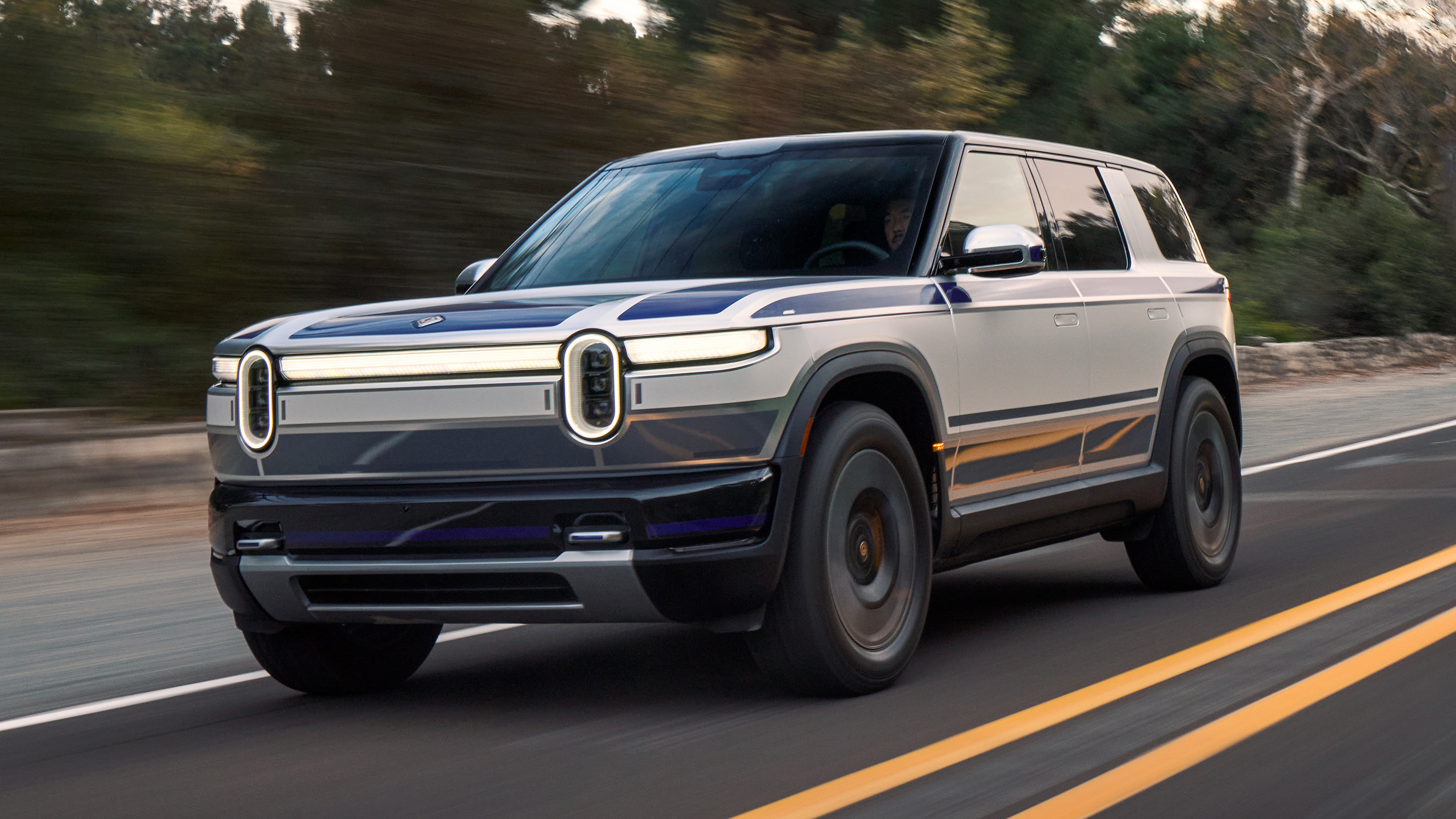
It’s immensely likeable. That might sound like an odd adjective to use, but it fits with the whole Rivian philosophy. The R2 measures 4.7m long and 1.7m tall, so it’s roughly Tesla Model Y/Polestar 3-sized. The signature headlights and light bar have evolved, and they’re a little smaller and wider. The badge in the front wing doubles as an indicator signal. In a design world dictated by aggressive, slim-line LEDs, the R2 looks refreshingly friendly.
It’s also unashamedly two-box in silhouette, which actually helps its stance and proportions, as well as bequeathing it with useful interior packaging. Its generous DLO also means that you can see out of it. Whatever cool it possesses flows from being fit for purpose.
As the R2 is coming to Europe it had to meet the EU’s pedestrian protection regulations. The lower line on the soft-close hood – sorry, bonnet – is there partly for that reason. Chief design officer Jeff Hammoud and his team decided to turn it into the main character line on the exterior. It also helps give the R2 class-leading frunk space.
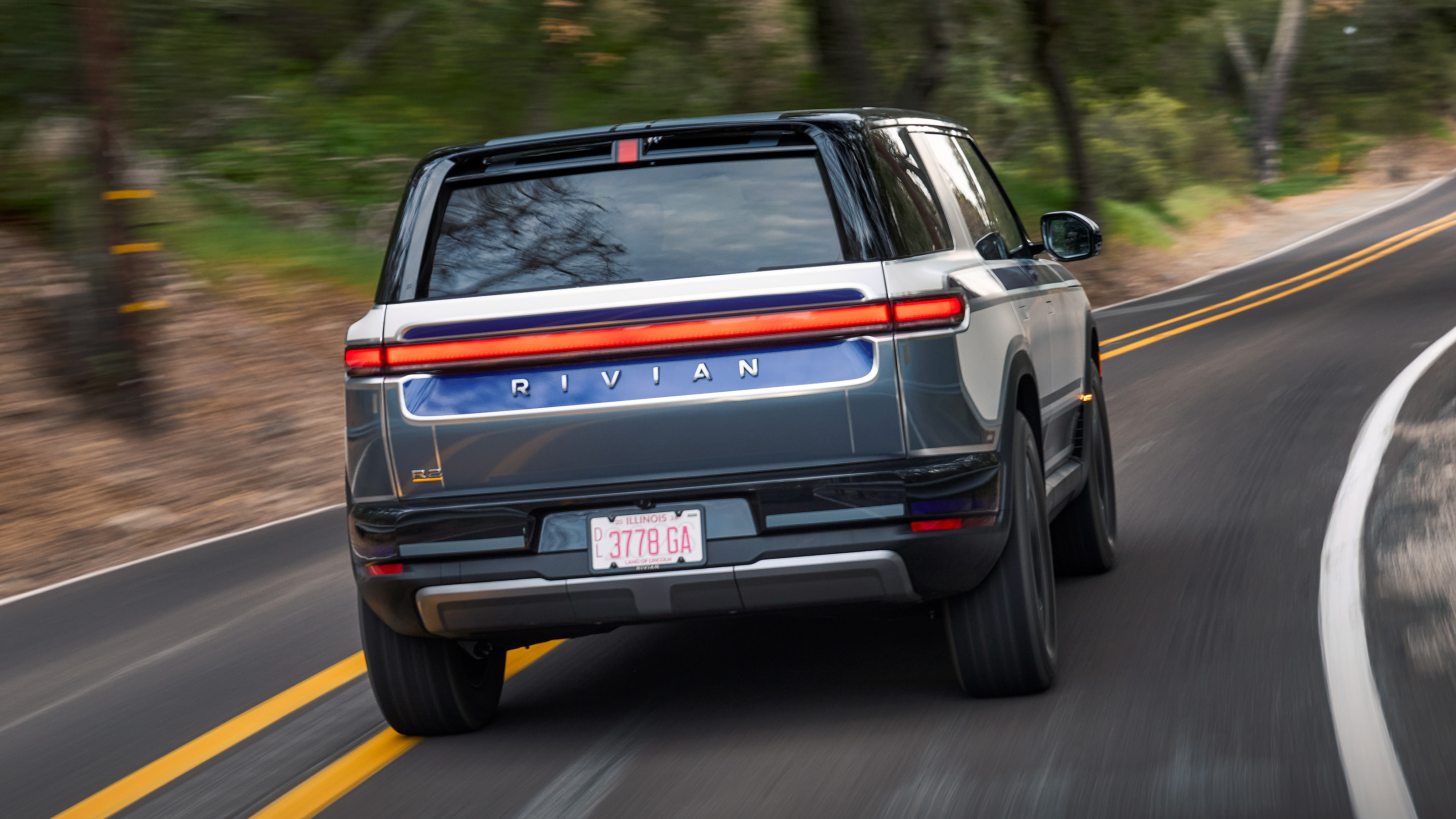
And you’ll note that there’s no rear wiper… except that there is. Rather than being fixed to the tail-gate exterior, it’s hidden within a recess that abuts the drop-down rear glass (good for sticking surf-boards out of, opened via a hidden button). It’s a useful example of Rivian’s uncompromising approach, although the wiper itself doesn’t actually clear that big an area. And we’d be a little concerned about leaves and such-like getting stuck in the recess over time.
It’s similar to the R1, but with (slightly) less premium materials and a reconfigured touchscreen. The main control bar is now vertical and positioned close to the driver. As ever with these things, it takes some getting used to, but as touchscreens go this is one of the best we’ve used.
The R2 also has massive storage space, as you’d expect, and two huge gloveboxes. There’s one big gripe: as with Polestar and Volvo, you have to dive into the screen to adjust the door mirrors and steering wheel. It’ll save your settings so an owner probably won’t have to worry too much. But it’s still annoying.
Cost, mainly. But it’s doubly irritating here because Rivian – which has very vocal online owner’s forums – has listened and introduced what it calls a ‘haptic halo wheel’, one on either side of the steering wheel. Owners wanted proper physical agency over the climate control – fan speed and temperature – and for audio volume.
You rotate the right wheel to access the climate setting, or nudge it across to alter drive modes, while the left one handles infotainment functions. The idea being that you can feel what’s going on without having to look at it. It’s a clever solution, particularly in that the wheel moves across as well as up and down, and the haptic is lovely.
But it’s still being fine-tuned, and frankly it doesn’t feel fully finished. Out on the road, we found it easier to use the touchscreen to adjust temp.
Quite possibly. Which brings us to the Rivian Assistant, an in-house developed voice assistant that uses large language models to take AI to the next level in the automotive context. In fact, who needs a haptic wheel? Simply say “I’m cold”, and the assistant will turn up the heat. Or tell you the history of that old building you’ve just driven past. Or manage your calendar…
Much of what you ask can be handled by the LLM in a nano-second, trickier things mean connecting with the Cloud. So that’ll be two or three seconds. The team is also developing an app which will allow you to monitor your dog remotely from your smartphone. A flesh and blood dog, not some canine avatar.
Let’s address some preconceptions. The Rivian R2 is an all-American SUV, and an electric one. For context, TG.com drove a Ford Bronco Badlands recently in Michigan, and while we thoroughly enjoyed it, we did so… in the spirit of the place. Americans call these things trucks for a reason. Because they are.
It’s fantastic. Smooth, linear, and refined, with impressive body control. The suspension uses coil springs and a passive anti-roll bar, but has semi-active dampers that adjust according to what drive mode has been selected – you can choose between All-purpose, Conserve, Sport or Snow.
Rivian’s engineers like lots of wheel travel vertically and longitudinally, so it deals with sudden intrusions very capably. “One and done,” as Max Koff puts it. But it’s stiffer than usual laterally, so there’s also good yaw response. The R2 is pleasingly rear-drive oriented, with 60/40 torque distribution front-to-rear, while the front axle is disconnected when the car’s in its default drive mode.
The upshot is a chunky electric SUV with an unexpectedly strong handling game. It has a different steering rack to the R1, and moves with a precision and naturalness you’d expect in something much more overtly sporting. And we were on all-terrain BF Goodrich rubber; it’ll be sharper still on regular tyres. It bodes well for the even more powerful version that’s in the pipeline.
TG.com had Rivian’s vehicle line manager, British expat and former JLR and Dyson engineer Rachel Jewkes, along for the ride, who confirmed that the R2’s electric power steering is still being fine tuned. Actually, its manners aren’t dissimilar to the Land Rover Defender’s, only with sharper response and superior NVH thanks to its EV-ness. There’s a terrific bandwidth here.
Zero to 60mph takes 3.6 seconds, which is a bit silly for a family SUV, but in reality the drivetrain is so beautifully calibrated that step-off isn’t hair-raising unless you really want it to be. And more impressive is the torque bias further up the scale, where it’s more useful for overtaking.
Not quite. The R2 uses brake by wire, for different response depending on drive mode. One-pedal drive is the preferred set-up for Rivian, as it is for most EV evangelists, and actually it really suits the R2. Certainly, on the roads of our southern Californian test route it worked well. We’d be less keen on a typical British back road, and if you reduce the level of regen, brake feel isn’t quite as resolute.
We also got to play a bit on a short but rather gnarly off-road track. Simply engage the relevant drive mode and get on with it; the R2’s torque vectoring lends itself to off-road agility and security, and there’s ample axle articulation. Rivian owners like rock crawling, and the R2 will do it.
There’s a temptation to be a little dazzled by start-ups, particularly ones with offices in Palo Alto. America’s venture capitalists certainly have a habit of being seduced. Rivian’s credibility is largely vested in its mastery of the software that’s completely re-framing the way we use cars. That’s the case here.
But the R2 also suggests that these guys are equally adept at engineering something that you might actually want to drive. Let its European adventure commence.
Get all the latest news, reviews and exclusives, direct to your inbox.
