



Car Review
Lucid Gravity (US) review
Advertisement
“The Lucid Gravity is a premium EV SUV with loads of potential, though it's too average to justify its hefty asking price”
Good stuff
Sharp looks, elegant interior, superb range
Bad stuff
Average handling, overwhelming interfaces, hefty price tag
Overview
What is it?
It’s the Lucid Gravity, the sophomore vehicle from plucky EV carmaker Lucid, which sprung from a battery-maker that decided to beat Tesla at its own game. You’ll have to turn to the business section of TopGear.com for a deeper analysis of how that’s going, but we can tell you here that its first foray into luxury EV dominance, the Air, is a phenomenal car to drive, imperfect as it is.
With the Air quickly establishing a high standard for what a Lucid is, we were curious to see how the Gravity, a utility vehicle with broader appeal, would perform. At last, the premium EV SUV that many people have been waiting for is indeed here, though it comes with more baggage than expected.
Advertisement - Page continues below
What are we working with?
The Lucid Gravity is an all-wheel drive, dual motor EV, with three trims dictating range and output, among other standout features. The Touring model is fitted with an 89kWh battery that’s good for up to 337 miles of range, dropping to a still decent 301 when opting for larger wheels and a third row. This version churns up a total power output of 560hp along with 811lb ft of torque.
Next up from that is the Grand Touring, which dials things up further with its larger 123kWh battery and increased power output. Able to whip up 828hp and 909lb ft of torque, this iteration can go from 0 to 60mph in just 3.4 seconds. More juice also means it’s capable of providing up to 450 miles of range, diminishing to 386 miles contingent on configuration.
At the top of the range is the new GT-S which replaces the launch-only Dream model. This delivers a staggering 1,070hp and can jump from 0 to 60mph in nearly three seconds flat. Naturally, the mileage takes a hit here, but this sportier Gravity can muster a still-mega 373 miles of range.
All models have a native NACS port and when connected to a 350kW DC fast charger, these can recoup 200 miles in around 15 minutes.
Advertisement - Page continues below
Sounds pretty good so far.
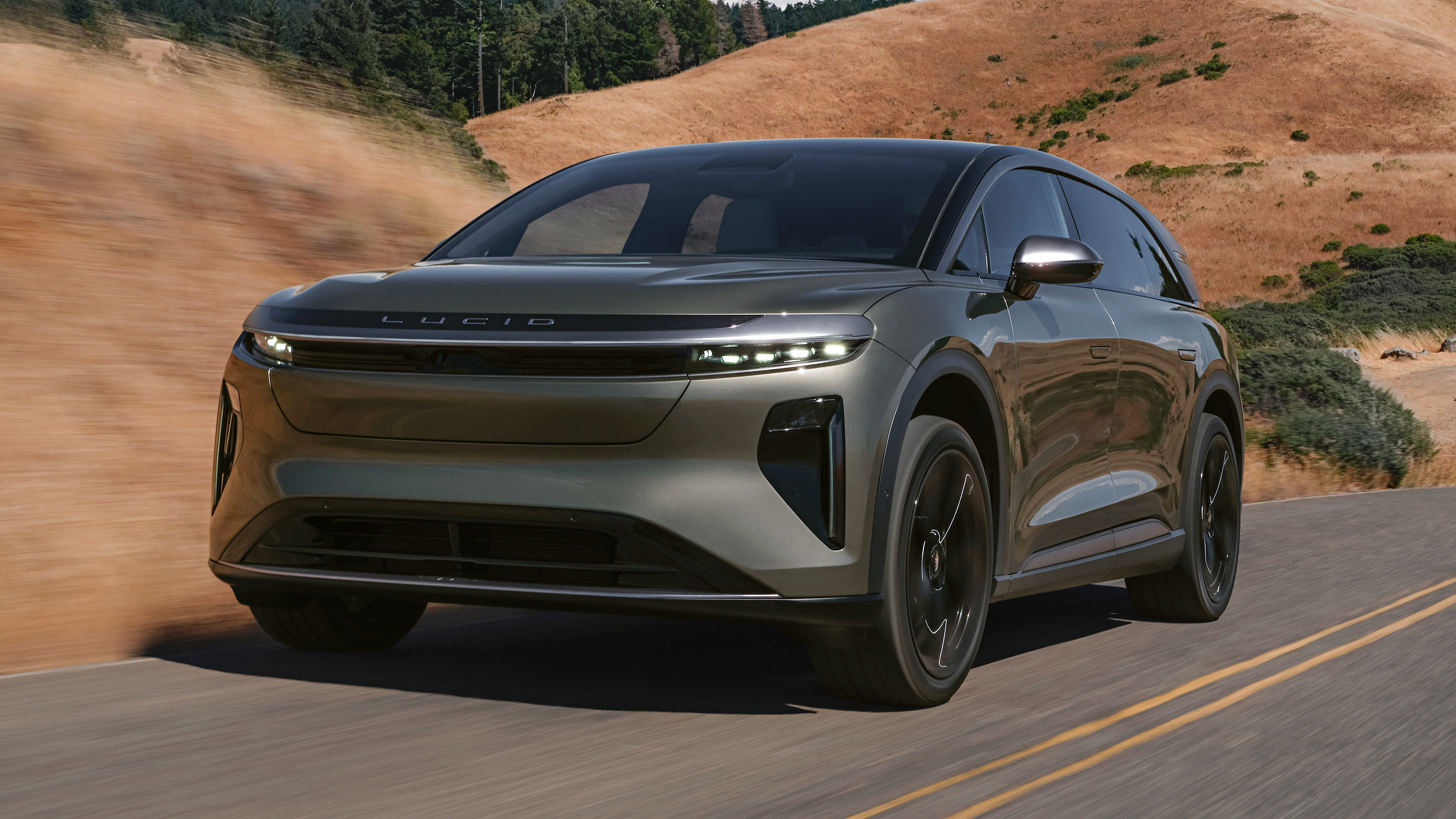
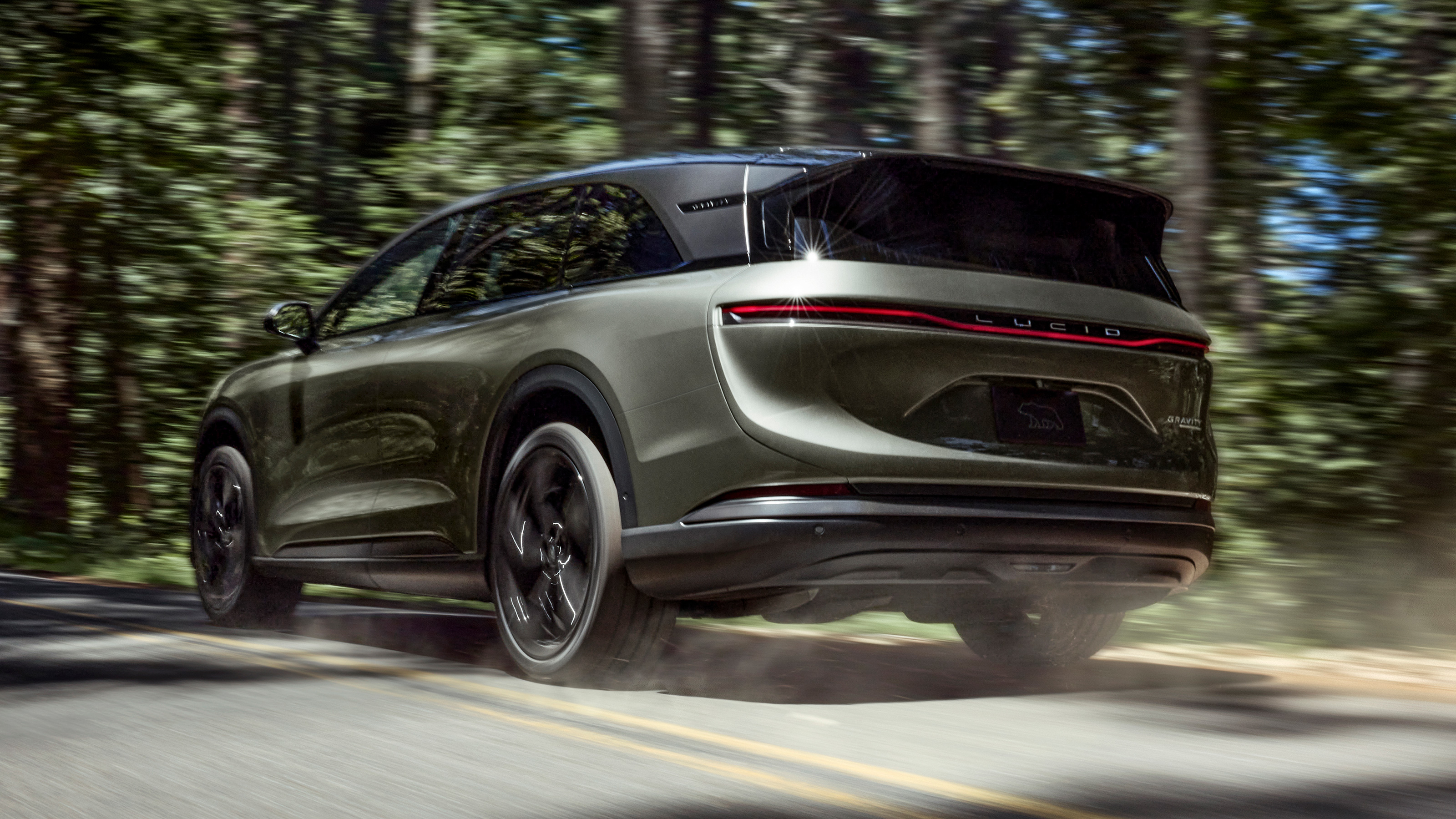
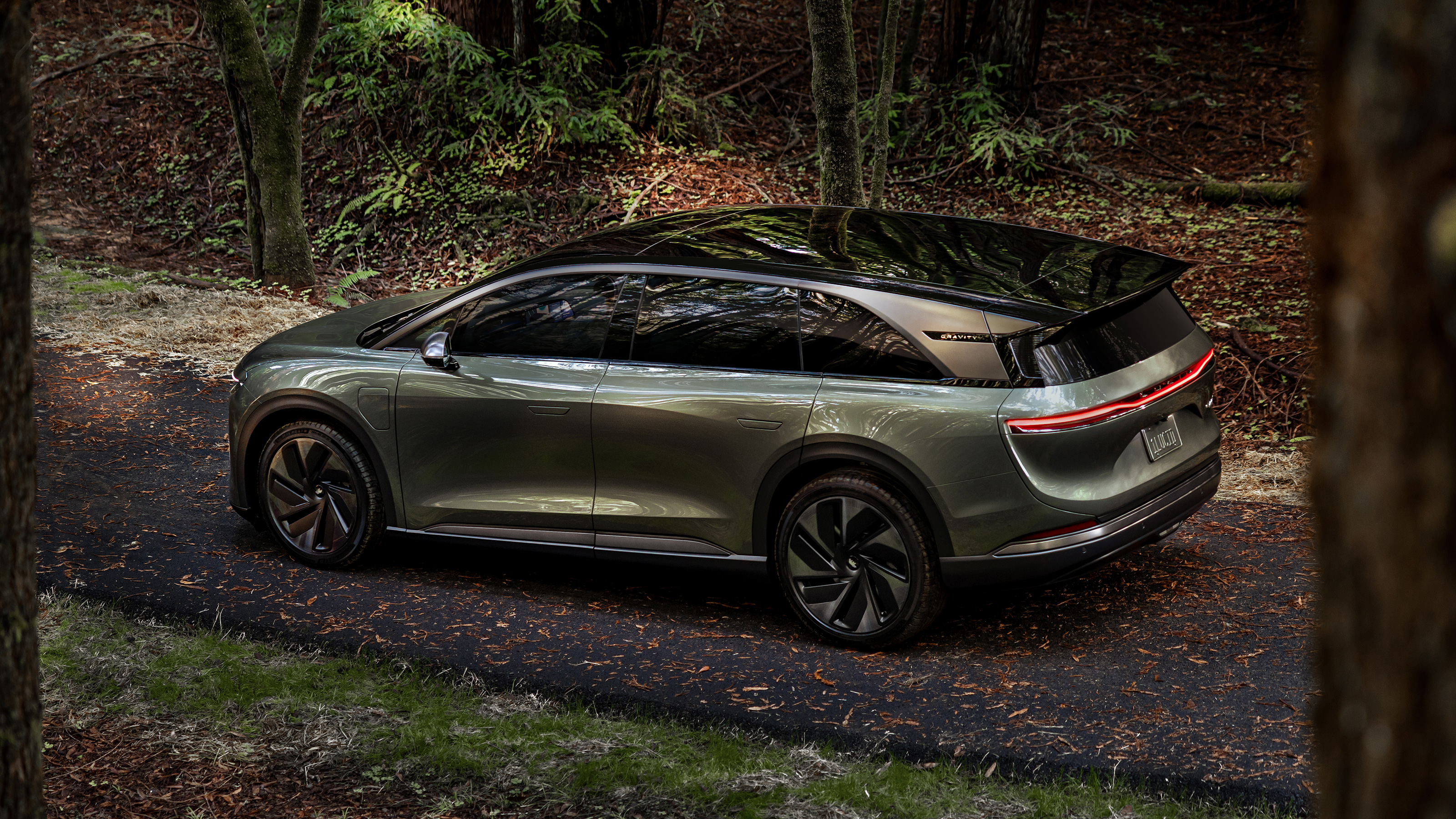
It makes a good first impression in person, too. The Gravity sports the Lucid signature Cylon-like-monobrow though with more substantial proportions backing it up. It has to be said that the Gravity cuts more of a minivan shape than it does an SUV, and that distinction only matters when it comes to certain expectations. SUVs are, broadly speaking, better at handling lousy-weather driving and some degree off-roading, but the Gravity is all street, no sleet.
Doubtless the drive modes can give peace of mind in the rain, just don’t expect this to be a rugged family knockabout. Something to keep in mind if you’re cross-shopping it against similar EVs like the more-versatile Rivian R2.
How does it drive?
Having the Air as a benchmark for driving dynamics is kind of unfair. The sedan’s combo of a well-tuned, mechanical suspension – as opposed to dynamic bags of air – and the dialed-in responsiveness of the electric motors makes for a spectacular, well-handling vehicle. It’s particularly noteworthy in the Air Sapphire, which needs it, frankly, if only to manage the sheer amount of power on tap.
And to that end, the lessons learned there are applied here, with a substantial independent suspension, adaptive dampers and so on. On the Gravity the difference is they’ve got air springs rather than coils.
How does that change things?
Significantly. You also have to keep in mind that this is a completely different car with a similar yet broader mission scope, so there’s… not concessions, but a shift in priorities, we’ll say. What’s gained is adaptive ride heights that are handy for clearing pesky curbs or slogging through the aforementioned weather, while also being able to also hunker down for a slipperier, sporty profile at speed, not to mention all the added comfort provided.
The trade-off is the loss of the amount of road feel that the Air was great at communicating. There’s still a good bit of feedback delivered here, though it’s fairly muted. If you thought that maybe the sportier GT-S would be different, it has the same setup, though it does throw in rear-wheel steering for added dynamics.
That’s sporty driving, though. What about normal-people driving?
Quite easy to handle and comfortable, if a little deliberately mundane. For commuting and errand-running, it ticks the boxes, which is what you likely want for most of the time behind the wheel. It almost has to drive like this, mind, since the Gravity is otherwise overwhelming in a very Lucid-specific kind of way.
Oh boy, dare we ask what’s it like inside?
Right away, your eyes are drawn to the panoramic windscreen that stretches across the top of the cockpit, jet-fighter style. Neat in terms of sightseeing, not particularly beneficial if you like driving in the, er, daytime. The tint at the top isn’t substantial enough to stop the sun from punching through on a cloudless day, nor will you get used to the constant scalp sizzle during the summer months.
Overall, it's still incredibly busy with its floating super-screen across the dash and supplemental console tablet. So many functions are locked in touch-screen hell, you’re forced to turn your eyes away from driving more often than what’s marginally acceptable.
That might be little comfort to your rear passengers, but they at least benefit from their own panoramic roof, ample head and leg room, and 21.3 cu ft (603 liters) of cargo space, third row or otherwise. If more space is needed, the second row lays well flat when folded. Though they’re over-engineered for the task, if you ask us.
What's the verdict?
“It’s a sharp-looking elegant car throughout, with crisp steering and a planted stance”
As its name suggests, the Lucid Gravity is a heavy, well grounded premium EV that brings all of what have become signature Lucid qualities over to the SUV market, for better and for worse. It’s a sharp-looking elegant car throughout, with crisp steering and a planted stance. Though not as playful as initially hoped, the Gravity has the hardware necessary to keep up with sporty contemporaries.
What sours the package is Lucid’s penchant for complicating once simple functions, from simple cockpit inputs to shuffling the seats around. More often than not they distract from what’s good here, which is tragic given the car underneath has the potential – and the range – to outpace the competition.
The Rivals