


Big Reads
'Gym-honed and hard as nails': can the new 630bhp Audi RS5 mask its 2.3-tonne weight?
Time to get some *drift winkels* on to find out
Three years of German at school and all I can remember is, “Enschuldigung, meine spiegelei ist nicht dahr.” Excuse me, my fried egg isn’t there. But here’s a new term: drift winkel. New for me, new for Audi (unless you cast your mind back 45 years to Michèle Mouton in a Group B Quattro). It means ‘drift angle’, and the new RS5 has such a trick rear axle that it can get serious winkels on.
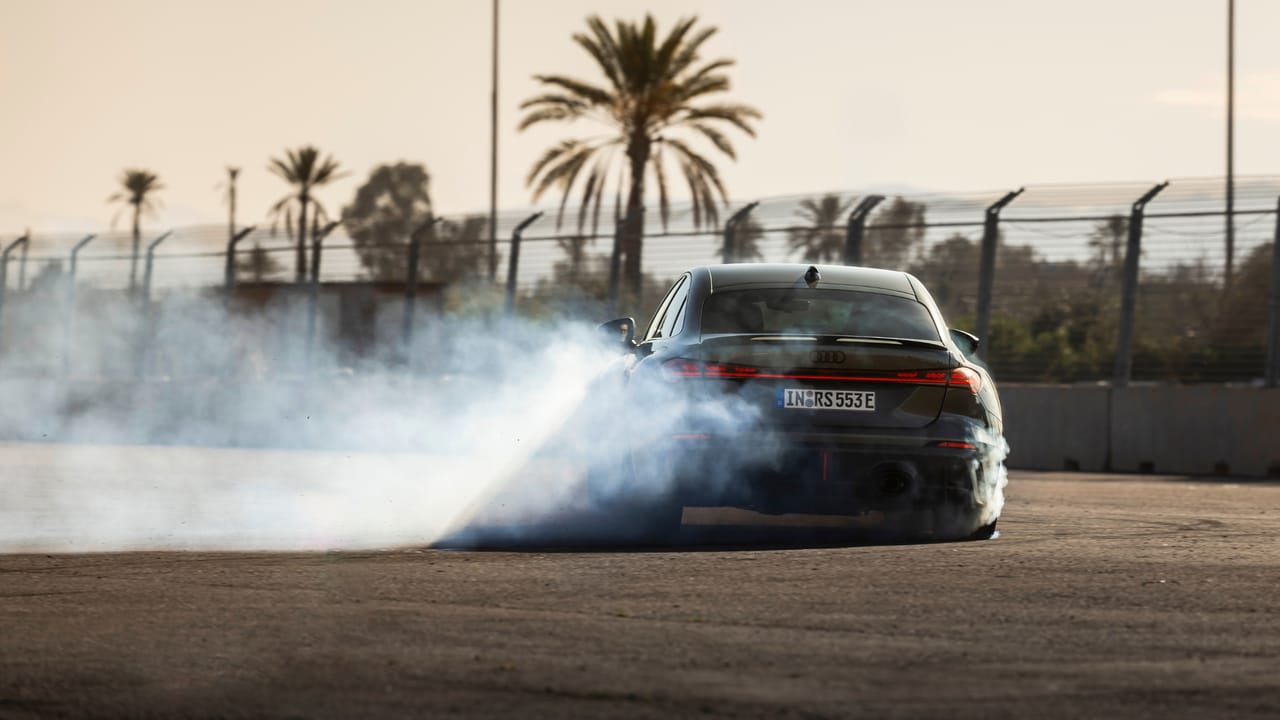
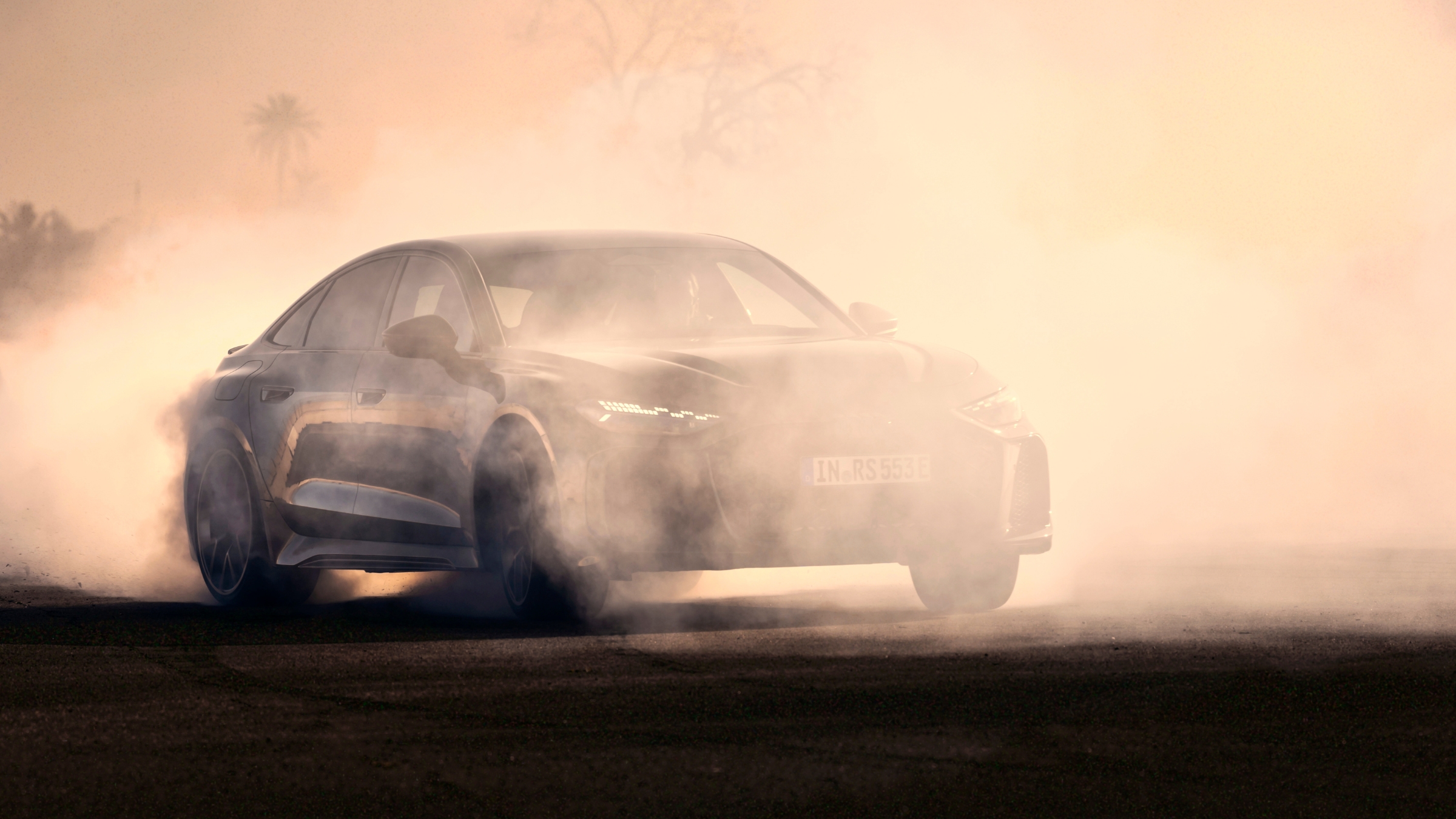
Indeed, TG is standing in a dusty street circuit on the outskirts of Marrakesh watching as RS vehicle dynamics wizard Roland Waschkau slaloms the car through cones, before donutting it back round in a cloud of tortured hydrocarbons.
Advertisement - Page continues below
Then it’s our turn. The RS5, yours from £90,220, instantly feels gym honed and as hard as nails. Getting slidey still takes technique, though. The trick is to maintain momentum as the yaw increases, then give it the full send at the end.
And it works: in RS ‘torque rear’ mode, it does a very accurate impression of a WRC car, Audi Sport boss Rolf Michl insists that this part of the car’s armoury is purely for fun, and that it’s unlikely many owners will bonfire their rear tyres like this. But there’s a dashcam and onboard telemetry, so it’s fun you can share if you’re so minded.

We also get some laps on the track. It’s tight and unforgiving, not the sort of place you’d bring a lardbucket of a car plagued with body control or understeer issues. Turns out the RS5 will sit quite naturally on the edge of adhesion, allowing you to keep things nicely balanced on the throttle. The steering’s 13:1 ratio means it’s significantly faster than a standard A5, and it feels it. There’s linearity and accuracy, a real sense of how hard the tyres are working. It’s a car you can really work with, that’s clear about its mission as the physical forces load up. Quite the makeover.
It’s also Audi RS’s first plug-in hybrid, a route that adds considerable complexity. The 2.9-litre, 503bhp twin turbo V6 receives hardware upgrades, but more notably is now emboldened by a 174bhp electric motor, fed by a 25.9kWh battery for a total system output of 630bhp and 590lb ft of torque. (The B9 RS4 made do with 444bhp.) The body structure is 10 per cent stiffer than the regular A5, though the same PPE platform obviously underpins it. The new RS5 will do 62mph in 3.6 seconds and 177mph all out (with the Sport pack fitted). Audi claims 74mpg combined, but even with the battery discharged it should be good for 29mpg.
Advertisement - Page continues below
How does it all work? Audi is wedded to its signature all-wheel drive recipe, but the new RS5 introduces what you might term a side hustle. It combines a Torsen centre differential with Dynamic Torque Vectoring on the rear axle – a world first, says the company. The centre diff might be a throwback to Quattros past but it’s state of the art here; it has a preload function so that it’s always partially locked.
The addition of a 5bhp e-motor means that, when appropriately geared, it can speed up or slow down the left and right driveshafts independently, in less than the blink of an eye. The result is an overall torque split that varies between 70/30 and 15/85 front to rear, an unusually extrovert figure for an Audi with quattro functionality, and a pointer to the RS5’s more gregarious personality.
The RS5 would feel half baked if the battery’s performance was suboptimal, so in RS Sport and RS torque rear modes, the state of charge is held at 90 per cent. In Hybrid mode, the battery is always being topped up, although you can select a preferred SoC using a digital slider. All very clever, if a little bamboozling at first.
There’s a bigger issue. Like BMW’s M5, the RS5 isn’t hiding the elephant in the room so much as absorbing it into its very being. In the saloon form driven here, it weighs, cripes, 2,355kg. It’s irritating that the message is one of excess mass successfully hidden, when really we should be avoiding the problem in the first place. But hide the kilos the RS5 most definitely does, and the extra electrons obviously give the car a mighty power and torque boost, as well as 50-plus miles of zero emissions running. There are significant tax benefits in many key territories.
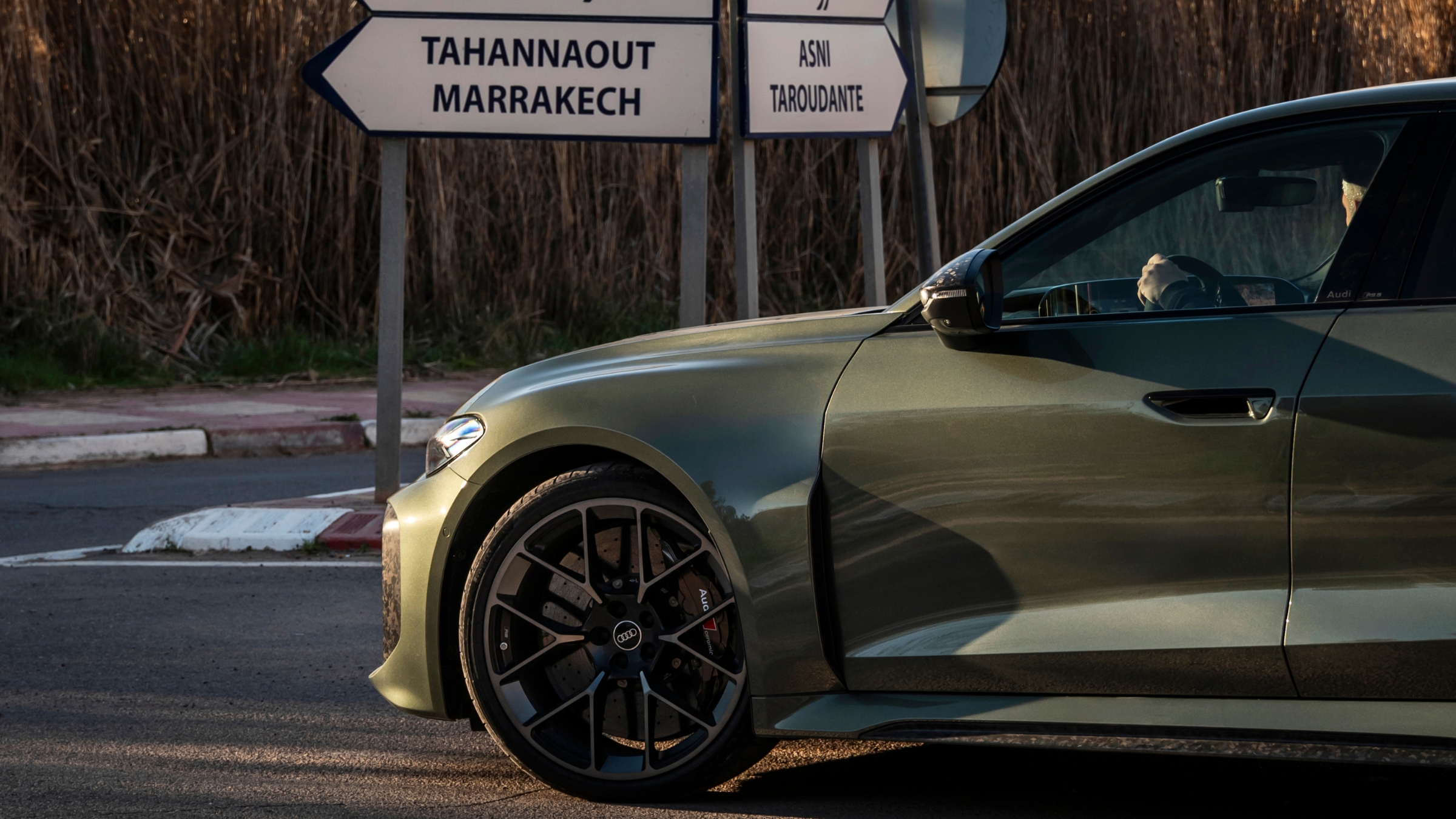
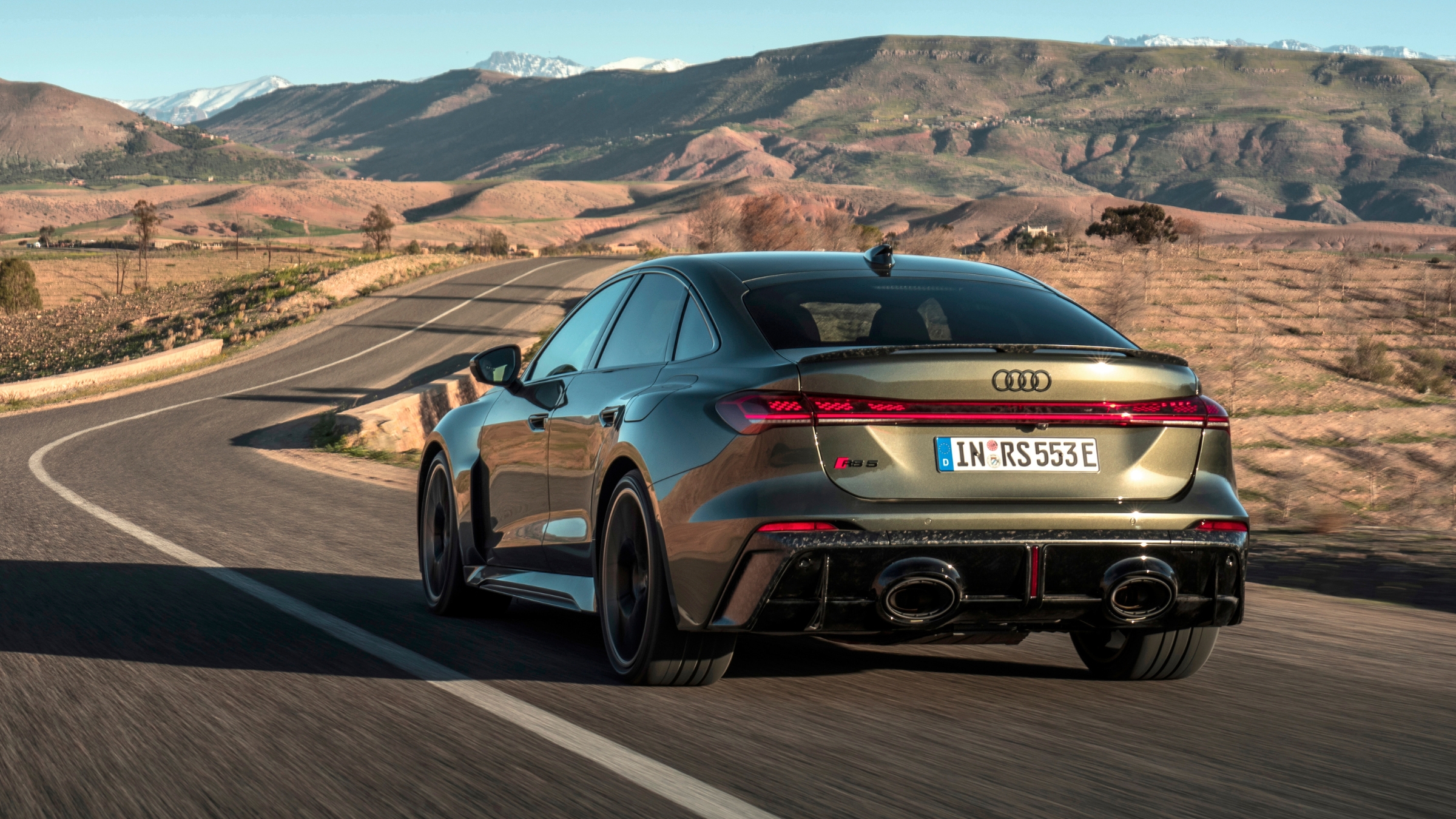
The Moroccan sun helps, but this is undoubtedly the best looking Audi in ages. Head on, RS has given the rather undernourished looking A5 the mother and father of all glow ups. It’s even better from the rear; check out its shoulders and those planet-sized exhaust exits. They sit further in-board because of the exhaust’s L shape and muffler. The new aero elements are finished in gloss black or an optional carbon design, and the rear lights feature a ‘chequered flag’ pattern. Thankfully, the design team stopped short of tuner-style self-parody.
Our route takes us away from the city and into the mountains. We dispatch Marrakesh’s teeming hinterland in EV mode. It’s hushed inside, despite those big tyres (285/30s all-round, but slightly wider at the rear for more lateral stiffness). It’s a high quality place to sit, even if the current Audi interior design philosophy is overcooked. A single-piece curved ‘MMI Panorama’ screen dominates things, blending an OLED 11.9in instrument cluster and a 14.5in infotainment display.
The screens are easier to use than some rivals’ efforts and there are useful shortcuts. The RS5 gets sportier graphics, and you can configure the display to foreground the rev counter and a shift light. There’s also additional performance data, including g-force readouts, tyre temp and pressure readouts, lap times, and more on the powertrain and launch control. The (odd shaped) steering wheel features RS and Boost buttons, which feel better than the plasticky stuff that adjusts the door mirrors.
Top Gear
Newsletter
Get all the latest news, reviews and exclusives, direct to your inbox.
Morocco is a mixed bag when it comes to the quality of its roads, but the gnarly stuff proves more illuminating – mainly because it’s similar to the shambles in the UK. The RS5’s multi-link, coil sprung suspension and twin-valve dampers do a terrific job of cushioning occupants from sudden intrusions, and delivers separate control for rebound and compression. There’s sufficient amplitude that you can feel the car ‘breathe’, not a scenario fast Audis past were necessarily acquainted with. It has conventional anti-roll bars but there’s no active rear axle (“Doesn’t need it,” tech chief Steffen Bamberger tells TG.)
In a straight line, in any of the many drive modes bar the pure EV one, the rear axle torque vectoring means that the RS5 hooks up in a heartbeat. Foot down, it travels 22.6m in the first 2.5 seconds compared to the old RS4’s 14.7m. Traction and force in action. But it’s on the twisty stuff that the car is revelatory. You can really feel the DTV do its thing on corner entry, sharpening turn in without hurting overall stability. On corner exit, the torque shifts to the outer wheel and helps rotate the car. It’s enormously satisfying, and natural feeling.
There’s a driving dynamics controller in play here, which measures steering angle, throttle position, as well as monitoring g-forces, yaw and slip angle, and helps target the differential torque as required – in five milliseconds. The ceramic brakes feel mighty, too, as they should given their size: 440mm diameter upfront.
To sum up, then. The PHEV format means compromise, and there are plenty of us who yearn for simpler times. Maybe we’ve got used to it, or maybe the engineers are getting the hang of it all now, but the RS5 manages to surmount the various challenges and blend the algorithmic elements more successfully than most.
Rather than wring their hands at the weight penalty, Audi’s RS team have taken the opportunities the hybrid system presents and run with them. Forget the drift mode – as fun as it is – the RS5 torque vectors its way out of trouble very convincingly on the sort of roads that really fire us up. As heavy as it is, there’s light and shade to its dynamics, and some real personality here, too.
Price: £90,220
Powertrain: 2.9-litre twin turbo V6 + e-motor, 630bhp, 590lb ft
Transmission: 8spd auto, AWD
Performance: 0–62mph in 3.6secs, 177mph
Economy: 74mpg, 86g/km CO2
Weight: 2,355kg