


Report 4
This DLSS 5-enhanced clip looks almost indistinguishable from real telly. Uh oh
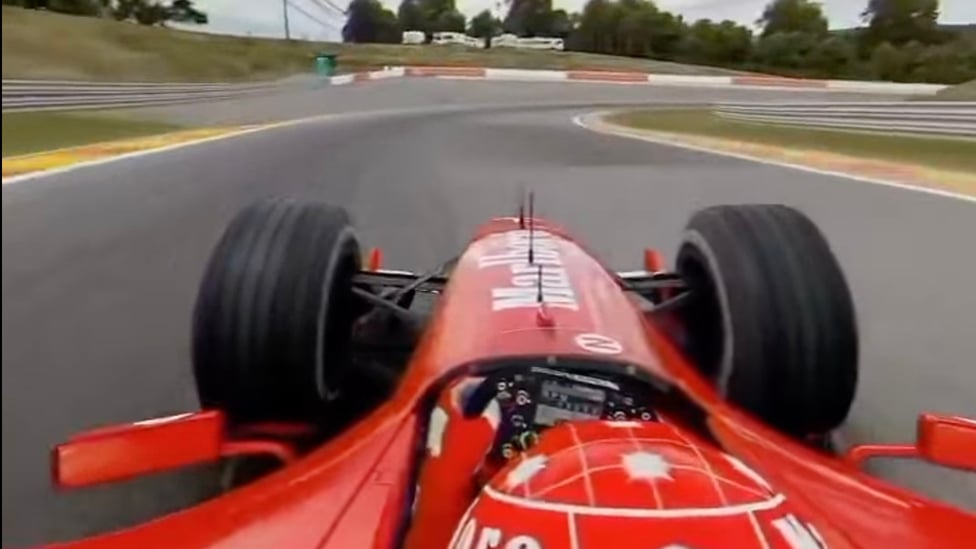
We can’t stop watching this clip of Michael Schumacher’s Ferrari F2004 at Spa. And not just because we miss the man, the machinery, and the era, but because it’s so hard to tell whether we’re watching Assetto Corsa or an old broadcast clip.
Spoilers: it’s Assetto Corsa. A heavily, heavily modded version thereof. If you don’t believe us, the flat trees either side of Spa’s straights are the giveaway, but it’s subtle.
What’s really doing the heavy lifting to trick your eyes here is DLSS 5, a post-rendering layer of AI visual subterfuge, applied in real-time. It’s proven controversial since Nvidia revealed it earlier this year.
How controversial? Somewhere on the scale between ‘Ferrari Luce’ and ‘national referendum result’, with concerns largely focusing on some profoundly yass-ified characters in Resident Evil Requiem and Starfield shown as part of a preview of what the tech could do.
But since DLSS 5 has hit the wild and modders have been experimenting with it on their own terms, sentiment has swung dramatically in its favour. You only have to watch Schumi’s Spa clip to see why.
This isn’t a one size fits all solution to gaming graphics, though. This clip looks especially true to life for a few reasons: firstly even though it’s from back in 2014, Assetto Corsa is a very moddable, almost open source game, making it easier for people to adjust lots of complex parameters and get the best rendering outcomes when injecting DLSS 5 into the pipeline.
Secondly, it almost certainly features multiple passes of DLSS 5, which is a very resource-hungry effect. We don’t know what kind of datacentre-grade rig this modder is running the game on, but to achieve 60 frames per second with just a single pass is proving nigh-impossible. Multiple layers of it? Forget it.
It’s also a low-resolution video clip, and it looks like it’s purposely applying some old-school, analog broadcast artefacts and defects to the image. In other words, the game assets are being obscured by the fuzzy image, which convincingly recreates the way the pre-HD sport looked.
Is it the future, then? Well, gaming graphics is certainly looking to AI for help. And ironically, that’s because the hardware progress has largely stalled while gaming graphics companies pivot to provide hardware to AI datacentres.
However, adding a further layer of irony that even Alanis Morissette herself would struggle to comprehend, even existing consumer graphics cards like Nvidia’s RTX 5090 have become so prohibitively expensive (we’re talking £4,000+ now, over double their MSRP) that there just isn’t the hardware available to run these advanced techniques in real-time and maintain a decent frame rate.
Get all the latest news, reviews and exclusives, direct to your inbox.
So games might look like this and remain playable, but it’s likely going to be a convoluted journey to get to that point.
Get all the latest news, reviews and exclusives, direct to your inbox.