






Interview
Top Gear
Jaguar MD on *that* brand reinvention: "Jaguar didn't work commercially"
Remember that Jaguar concept car? Arrived around this time last year? No?
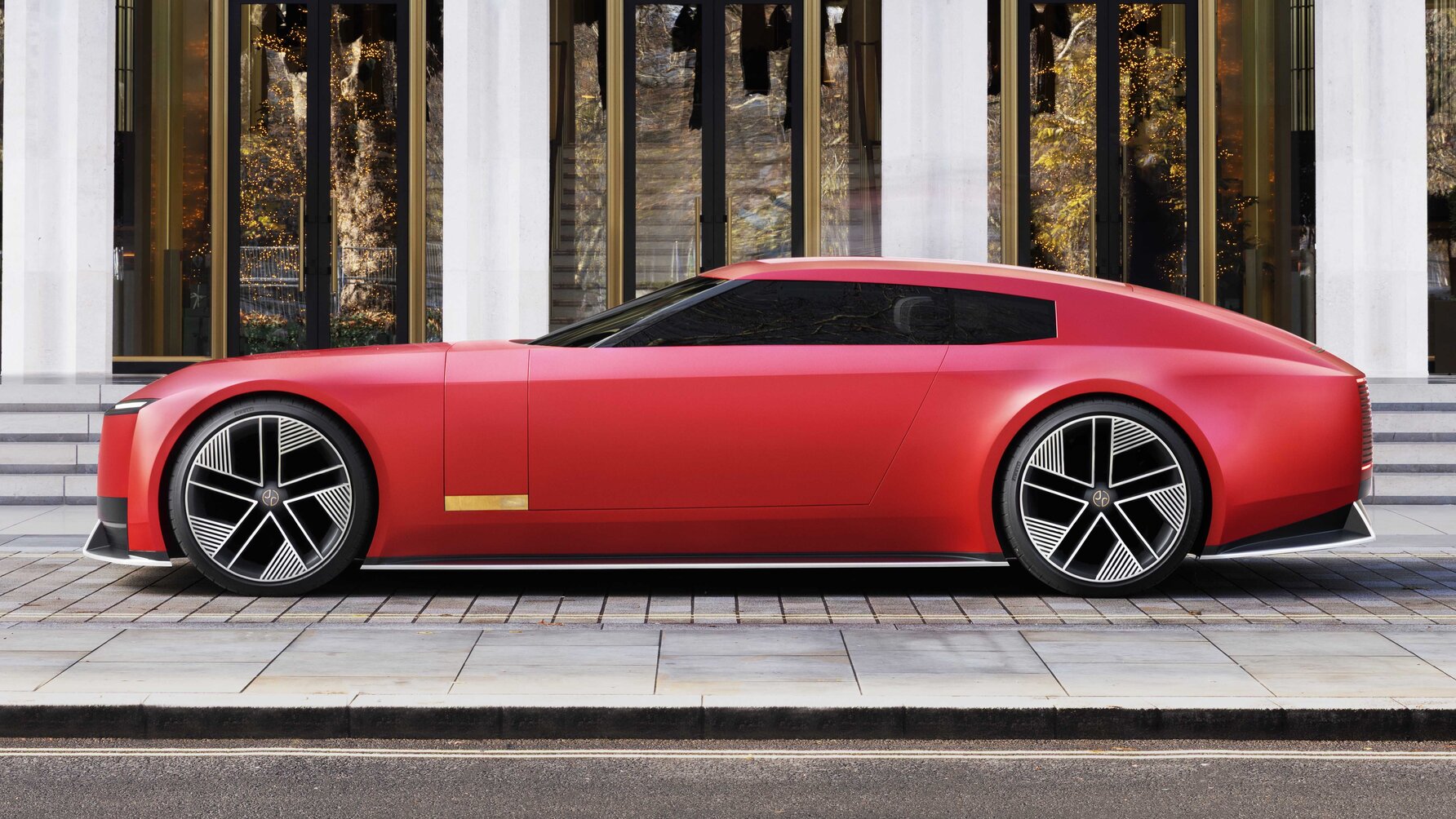
Jaguar's been through it of late. A year ago we saw its rebrand and clapped our eyes on the radical Type 00 Concept. Now, we've had a passenger ride in a prototype: a 1,000bhp tri-motor GT prototype. We'll see it proper in 2026.
Time for a little sit down, then, with Jaguar's managing director Rawdon Glover.
Advertisement - Page continues below
Let’s start with the big question – why did Jaguar need a total reinvention?
Rawdon Glover: Obviously, we were previously operating in this volume premium space, which is dominated generally by the Germans, but not exclusively. And it didn’t work. Jaguar didn’t work commercially. So we were at a crossroads, because just continuing as we were and saying “well, let’s just do what we’re doing and sell more", doesn’t work.
The Volkswagen Group sells seven to ten million cars. We’re selling four or five hundred thousand cars. The manufacturing economy is just night and day different - while we call it the premium segment, it’s brutally competitive, so we needed to change.
Why this decision to go lower volume, higher price?
If we look where JLR’s business model really does work, it’s with Range Rover, which is quite different in price point and product concept. So there was almost a model for us there in terms of the economics, harnessing the engineering resource and the design capability.
If you then look back to when was Jaguar successful, it was when it had a really concise range. For the majority of its history, it was about beautiful sports cars and beautiful saloons - not in large numbers, but at higher price points, and generally doing things different from the competition. There are lots of examples of that from our past, like disc brakes, the use of aerodynamics going back to the 1950s, the E-Type rewriting the rules.
Advertisement - Page continues below
Our founder, Sir William Lyons, talked about Jaguar being at its very best when it was “a copy of nothing". When everybody else is going there, that’s fine - have the strength of your own conviction to go and do something different.
All of that led us to where we find ourselves today. The linkage to the past is very clear for us. We understand what a Jaguar should drive like, we think we understand the brand dynamically. We understand the DNA of the company - what drives it, what its purpose is, why it exists on the planet. And I genuinely think if Sir William Lyons were here today, he’d be saying “that is what a 21st century Jaguar should look like.”
What exactly is this ‘higher price point’ you’re talking about?
In UK numbers, our average transaction price used to be about £55,000. This will be more than double that, so the centre of gravity in the UK would be about £120,000.
The launch edition of the new car will start at £140,000. Think of it in those price terms. If we think about the market where we want to play, the premium players do go higher than £130,000, but they tend to top out around £120,000 to £130,000. Then you’ve got to go all the way up to the ultra-luxury brands — Lamborghini, Bentley, Rolls-Royce — and they don’t really do anything under £300,000. So there’s quite a big chunk of space there, particularly at the lower end.
Top Gear
Newsletter
Get all the latest news, reviews and exclusives, direct to your inbox.
Tell us about the reaction to the Type-00 concept and the rebrand, from your point of view.
The reaction has been fascinating. It correlates strongly with the clinics. You get a group of people who get it straight away, love it, and want to see it. You get another group who say, “I don’t understand it. I don’t know where Jaguar has gone". But when you unpack the story and explain the thinking, they say, “Okay, I get it now".
And then there’s a group who say, “I understand it, but it’s not for me". And that’s okay.
Take the E-Type as an example, they weren’t going for nice — they were going for bold. They wanted to create something the world had never seen. And when it landed in 1961 at Geneva, it looked like it was from Mars. That’s the bar we’re aiming for. Time will tell, but that’s the challenge for me and the whole team. We want to be producing vehicles that people are talking about in 50 years’ time.
That’s what Jaguar should be doing — not worrying about carving out share in the compact SUV segment, which we were doing unsuccessfully.
What’s been the biggest challenge in bringing this first car to production?
We landed on a design concept that didn’t work on any existing architecture — ours or anyone else’s. Those proportions are why it looks like nothing else. So we developed our own architecture, the Jaguar Electric Architecture. Then the challenge becomes: how do you retain those proportions? How do you keep it low, put it on 23in wheels, get 400 miles of range, and maintain purity? That comes down to dedication, tenacity, and ingenuity in engineering — which is something we’re really good at.
That’s the Jaguar reinvention story in a nutshell. It’s about sweating the details and doing incredibly complex engineering so we don’t have to compromise on dynamics, range, looks, or comfort. First and foremost, it’s a new Jaguar — it looks like nothing else, drives like a Jaguar, and delivers incredible performance, much of which is enabled by EV technology.
This isn’t an EV-first relaunch. Being an EV on its own isn’t enough anymore. At this price point, people buy emotionally. It has to create irrational desire. That’s why we ripped up the EV rulebook - no cab-forward proportions, no cookie-cutter SUV stance. There’s a place for that in the mid-market, but not here.
What does success look like? Have you set a target number?
Success isn’t a moment in time. We’ve invested in a new platform and a new body line at Solihull. I know the return I need over the life cycle - around eight years - that comes from a combination of price and volume. The reason we’re launching with a four-door GT isn’t because it’s the biggest segment, but because it positions Jaguar at that price point.
What’s next? Are you looking at a three-model range like Lamborghini or Bentley?
The days of seven or eight models are gone. Expect a condensed range, all around similar price points.
Trending this week
- Car Review
Toyota bZ4X Touring