
Car Review
Audi Nuvolari review
Advertisement
“Audi builds a better – and more dramatic – Lamborghini Temerario. But you can’t have one”
Good stuff
Bold design, beautiful detailing, drives better than the Lamborghini it's based on
Bad stuff
Only collectors need apply: more than £500k, fewer than 500 available
Overview
What is it?
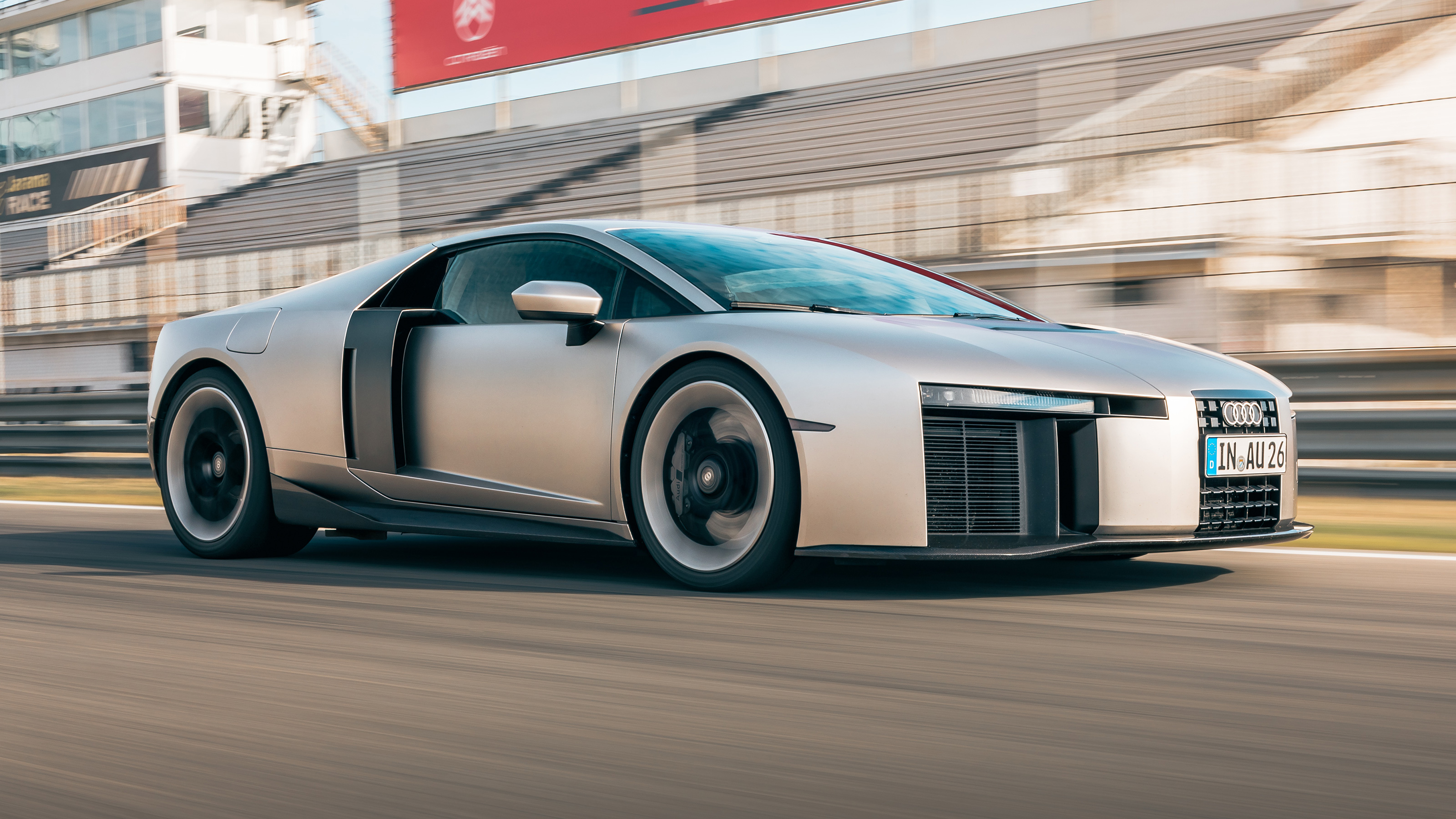
The Nuvolari is many things rolled into one. A replacement for the R8. A rolling sculpture. A reclothed Lamborghini Temerario. A preview of Audi’s new design direction. A return to simpler dynamics. A retro-futuristic, 1,001bhp, headline-grabbing supercar that’s probably the most bespoke road car Audi has ever produced.
Is it any good though?
To drive, it’s better than the Temerario it shares much of its technical make-up with (something we’ll come on to discuss in detail in the Driving tab), but as we’ve pointed out before, the Temerario isn't a beacon of joy in that area.
Advertisement - Page continues below
However, given its concept car looks, it is a surprise to note that Audi has clearly worked hard at making the Nuvolari good to drive – better than it needed to, in fact.
How’s that?
It’s a collector car, most likely destined to languish in air-conditioned lairs and emerge only for occasional appearances at concours events. Most will probably do no more than a few thousand miles in their entire lives and never trigger their traction control lights. We would have loved this car to be a genuine replacement for the R8, a car that may have cost £200,000 now, but would eventually drop down to relative affordability.
Instead, for whatever internal business reasons Audi has come up with, only 499 Nuvolaris are being built, each priced at £526,990. So, like the Mercedes-AMG CLE646 Spezialanfertigung, the way to look at this car is as a herald of the future. The AMG previews the return of the V8, the Nuvolari (it’s named after Tazio Nuvolari, a pre-war racing hero who’s worth a whole deep dive himself) a whole new design direction, pioneered by the Concept C that we all expect to appear as an electric production coupe in a year or two’s time.
But this isn’t electric, is it?
Well, it contains three electric motors. But it also contains a 4.0-litre twin turbo V8 that revs to 10,000. Total system power is 1,001bhp with 663lb ft of torque, and the hybrid battery permits an e-cruising range of 12 miles. There’s an eight-speed twin clutch gearbox sending power to all four wheels. If all this sounds familiar, that's because it is carried over lock, stock from the Temerario.
Advertisement - Page continues below
So is this just a Temerario in an edgy frock?
As far as the hardware goes, mostly, yes. Same chassis, same powertrain, same technical make-up. But after that it gets a lot more bespoke – as you’d expect when less than 500 are being created.
Where the Lambo has aluminium body panels, this has carbon. Where the Lambo has rear steer and advanced adaptive damping, this doesn’t. It’s a simpler car. Now, these aren’t decisions made to ensure the Audi is more exotic, they are primarily logical, financial choices. If you’re only making relatively few cars it’s cheaper to lay up carbon than invest in vastly expensive tools to press body panels. Likewise the complexity of integrating rear steer and adaptive damping is costly and time-consuming, so the Nuvolari does without.
But to answer the question you just posed, all the tuning, the software coding and development are unique to the Nuvolari. What’s interesting is that in a few key areas it was the same people working on both cars. Audi’s Chief Technical Officer, Rohven Mohr, used to have the same role at Lamborghini. The Nuvolari’s Performance Manager, Victor Underberg, was there too. So it wouldn’t be too much of a stretch to suggest that they took what they had learned from the Temerario and made the changes they saw fit.
Okay, I get the picture. But really this is a design study, isn’t it?
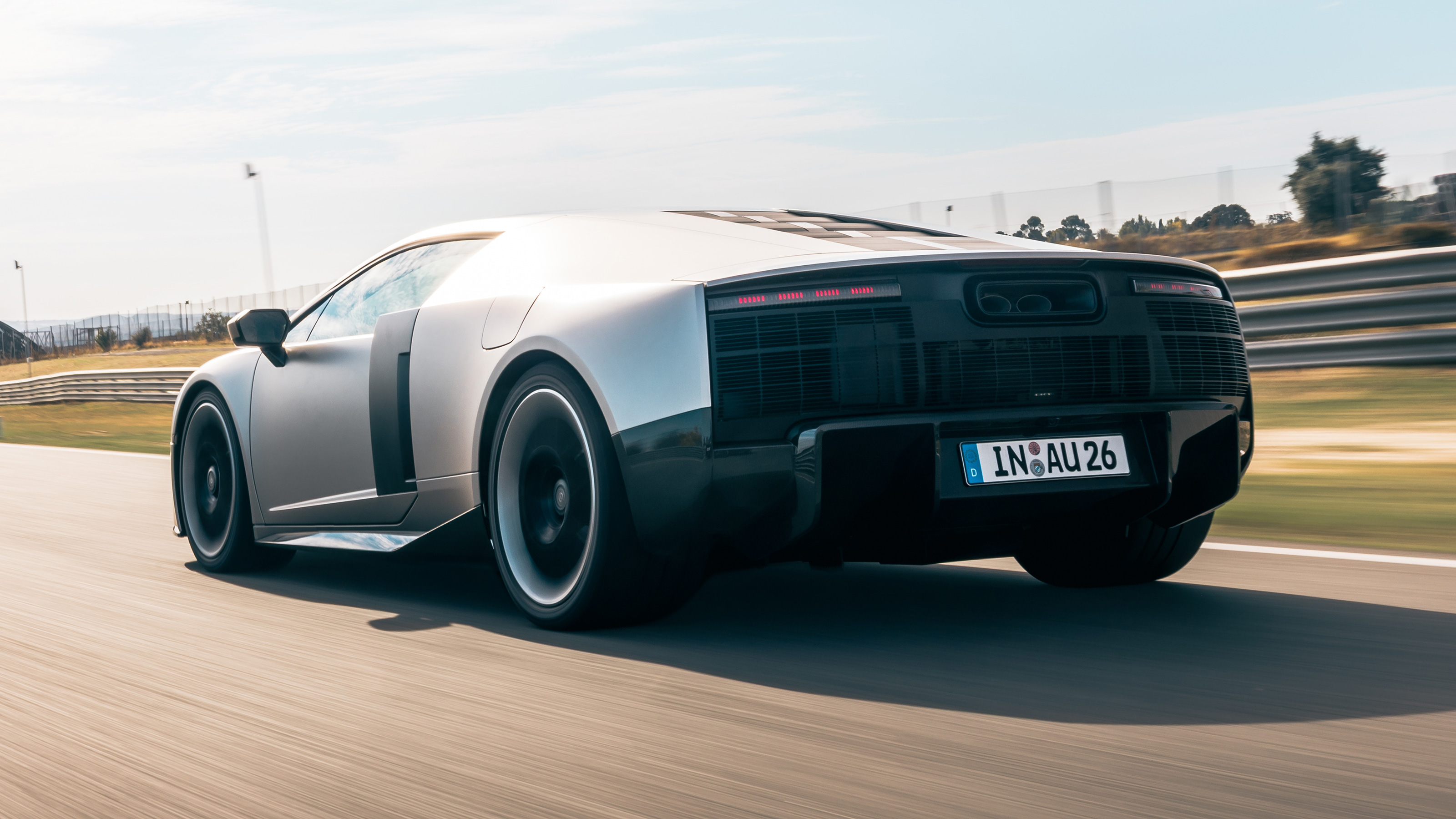
It is one of the most dramatically styled cars of recent years. It's the work of the team under Audi’s new design chief, Massimo Fraschella, who, given his previous job was number two to Gerry McGovern at JLR, is no stranger to reductive design. The lines are clean, sharp and bold. It has real drama and impact, with one of the starkest front ends we’ve ever seen.
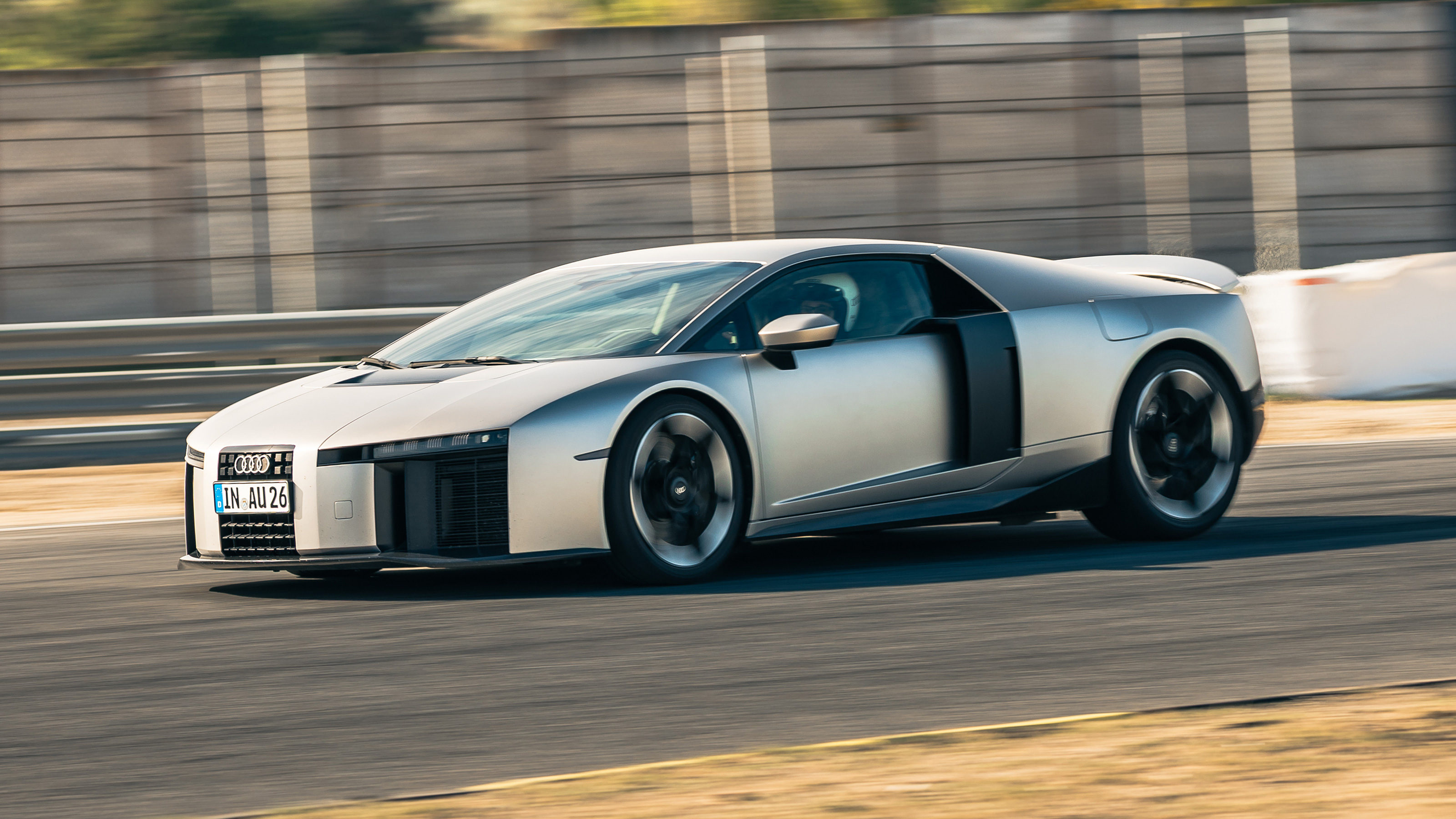
We’ve seen it described as cyborg-ish. Or monolithic. Both descriptions have merit, but here’s the thing that matters: so strong is the design that it disguises the Lamborghini origins almost completely. You can see them a little in the side profile, but that also reclaims some Audi ground by featuring the side blades familiar from the Audi R8.
It’s not voluptuous, it doesn’t have much movement or flow to it, but it is utterly unique and different and nothing like as divisive as the Jaguar Type 01 or Ferrari Luce – both of which also aim to take their brands in new directions.
The aesthetics have been allowed to lead here, haven’t they?
Yes, and that’s unusual with high performance cars, which have requirements for cooling, packaging and aerodynamics that usually have to take priority. Here, however, when engineering told Frascella they needed a raised wing to hit the downforce targets, he apparently told them “over my dead body”.
So there’s no wing, just a small integrated moveable rear spoiler. In order to create the downforce they needed an S-Duct was incorporated, pulling air in the nose, and ducting it up through the bonnet over the roof. The underbody is completely flat, with turning vanes taking the air where it's needed.
What’s it like up close?
The detailing is what makes it stand out. You discover the grilles aren’t just simple mesh panels, but machined aluminium. The rear panel across the back of the car is the same, a single piece of billet aluminium nearly two metres wide that takes 70 hours to mill.
You can’t do this if you are building cars in large numbers, so Audi is making the point: this is a special car. You see it elsewhere too, the Nuvolari name laser etched into the door blade, the four ring badge inlaid into the carbon wing.
Is the inside like this as well?
Obviously we’ll go into more detail on this on the Interior tab, but yes the cabin also makes good use of machined aluminium elements and fine detailing. You find that everywhere from the door handles to the manually adjustable seats. There's clearly been a strong emphasis on tactility and design throughout the Nuvolari. But not practicality. Don’t go looking for a boot. Or a frunk.
Why has Audi done it at all? Where did the idea come from?
Let’s deal with the second point first. The story goes that a handful of senior engineers and designers hijacked a meeting with Audi CEO Gernot Döllner in March 2025 with a bare idea for a supercar.
He said yes and gave them a deadline: the Monaco Grand Prix this year – just 405 days away. This super tight deadline informs the Nuvolari – you can somehow tell it was developed by a semi-autonomous skunkworks team. Rarely more than 30 people strong, that meant decisions could be made quickly.
As for why Audi made the decision to do it, well, as with the CLE646, it’s a car built in small numbers that makes a big noise. It creates a halo for the brand, signifies the new design direction, is a touchpoint for everything to come and gives Audi something to talk about that isn’t yet another SUV.
And it’s worth driving is it?
Yeah, it really is, mostly because it cures our major criticisms of the Temerario. It sounds better. It drives better. If you need the numbers, it does 0-125mph in 6.8 seconds and tops out at 217mph. More on the Driving tab.
I’m wealthy. What else should I be looking at?
Well, how about a Temerario? No? Us neither. Once specced it’s in the same price bracket as this, and less distinctive. It lost a twin test to a Porsche 911 Turbo S which remains a fundamentally exceptional car – but arguably the polar opposite of Audi’s design study.
If you want a straight supercar we still think the McLaren 750S is just about unbeatable, but since we all know you’re fibbing about the wealth thing, how about an original R8? Because they were deeply brilliant cars. You can pick one up for about a twentieth of a Nuvolari these days. This might push those values up a notch, too.
Photography: Jonny Fleetwood
What's the verdict?
“If the question was: ‘do you want the Nuvolari to exist, yes or no?’, you’d want the Nuvolari to exist”
Audi has copped a bit of heat for the Nuvolari. It’s been accused of everything from prioritising design over driving, to being a collector’s car denied to all but the wealthiest. The latter point is definitely true; the former definitely isn’t.
But here’s the thing to remember. If the question was: ‘do you want the Nuvolari to exist, yes or no?’, you’d want the Nuvolari to exist. And that means accepting the fact it’s going to be based on a Lambo, just as the old R8 was. And what's interesting is that Audi has done a better job than Lambo with the same bits.
Once again, it’s hard to judge as a product when it’s a limited edition car available only to collectors, but we can say this: Audi didn't need to develop it as comprehensively as it has. It would've been enough just to look good, but it goes much further than that. It’s just a shame that the business case wasn’t there to turn it into a production model.