







Car Review
McLaren W1 review
Advertisement
“The W1 is a car of singular purpose and precision, marrying advanced materials and aerodynamics to truly stunning effect”
Good stuff
Handling and ride, performance, incredible bandwidth, looks and feels like a £2m car
Bad stuff
It costs £2m, they’re all sold, engine could sound more musical
Overview
What is it?
It’s the core of McLaren’s engineering monomania, despite undergoing a re-set under the new boss. The W1 also has a distinct philosophy when it comes to delivering the thing that’s increasingly difficult to find in these confusing times – pure driving exhilaration. To which end, the 1,258bhp W1 is rear-drive only and although there’s a powerful electric motor, it doesn’t have torque vectoring. Hardware is king.
That sounds like an engineering ‘challenge’.
Many factors are at work here, but in order to achieve what the W1 achieves requires as stable a platform as possible and ridiculously good brakes. The W1 aces both. McLaren says the aero is the most advanced the company has ever developed for a road car. It uses full ground effect which makes the W1 only the second road-legal car to do so, the other being the Aston Martin Valkyrie.
Advertisement - Page continues below
You mean it’s a car you can actually use?
It’s up there with the Ferrari F80, and certainly much easier to live with than the awesome but quixotic Valkyrie. The W1’s bandwidth is truly mind-boggling. Let’s start with the simple act of getting into it. And simple it is. It has anhedral – gullwing – doors, so you don’t need to be a Yoga master for entry or egress. The doors’ shape assists the airflow from the front wheelarches into the high temperature radiators and provides an extra 100mm of cooling space. So the radiators don’t need to be as large.
Shall we talk about the way it looks?
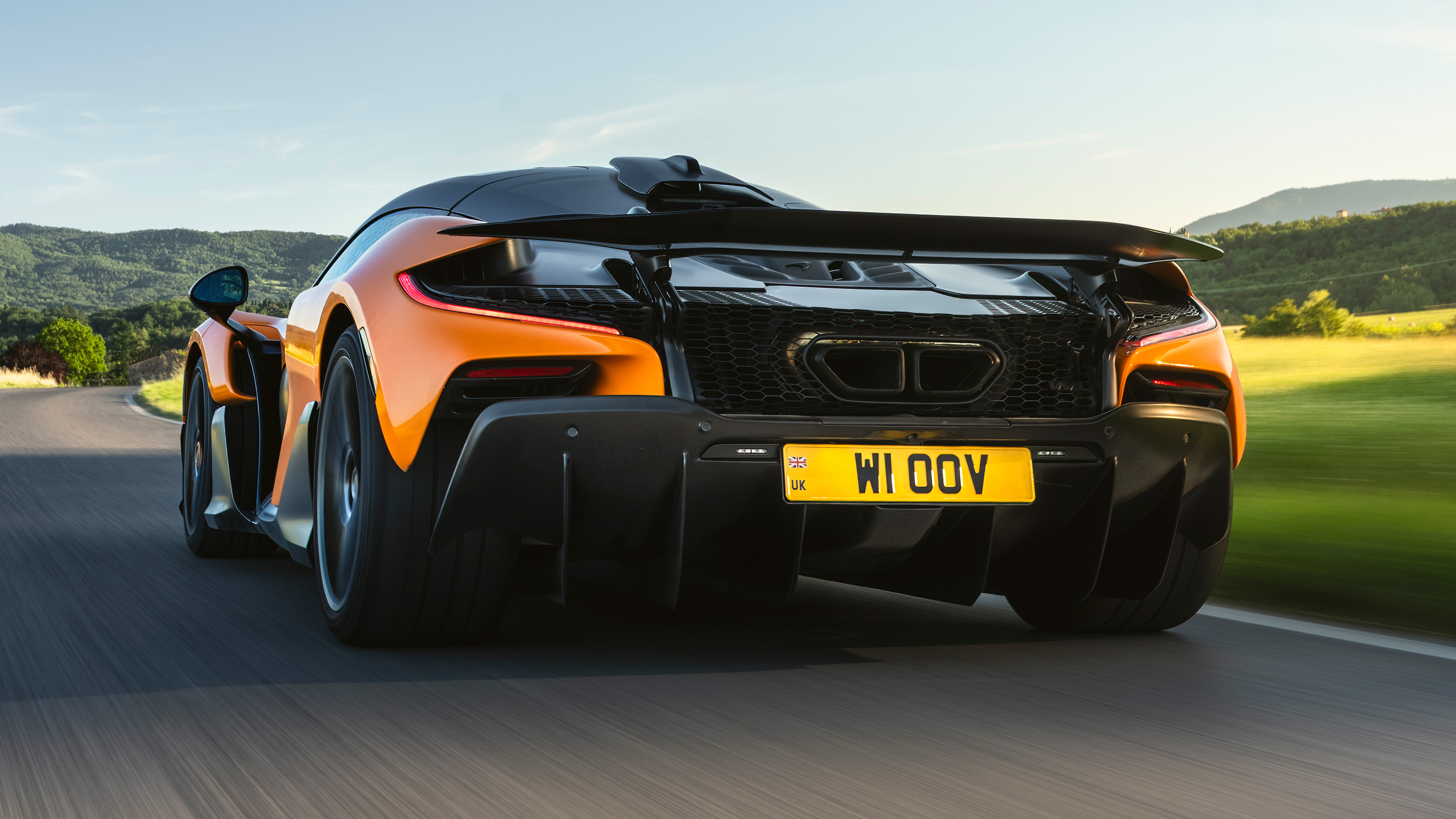
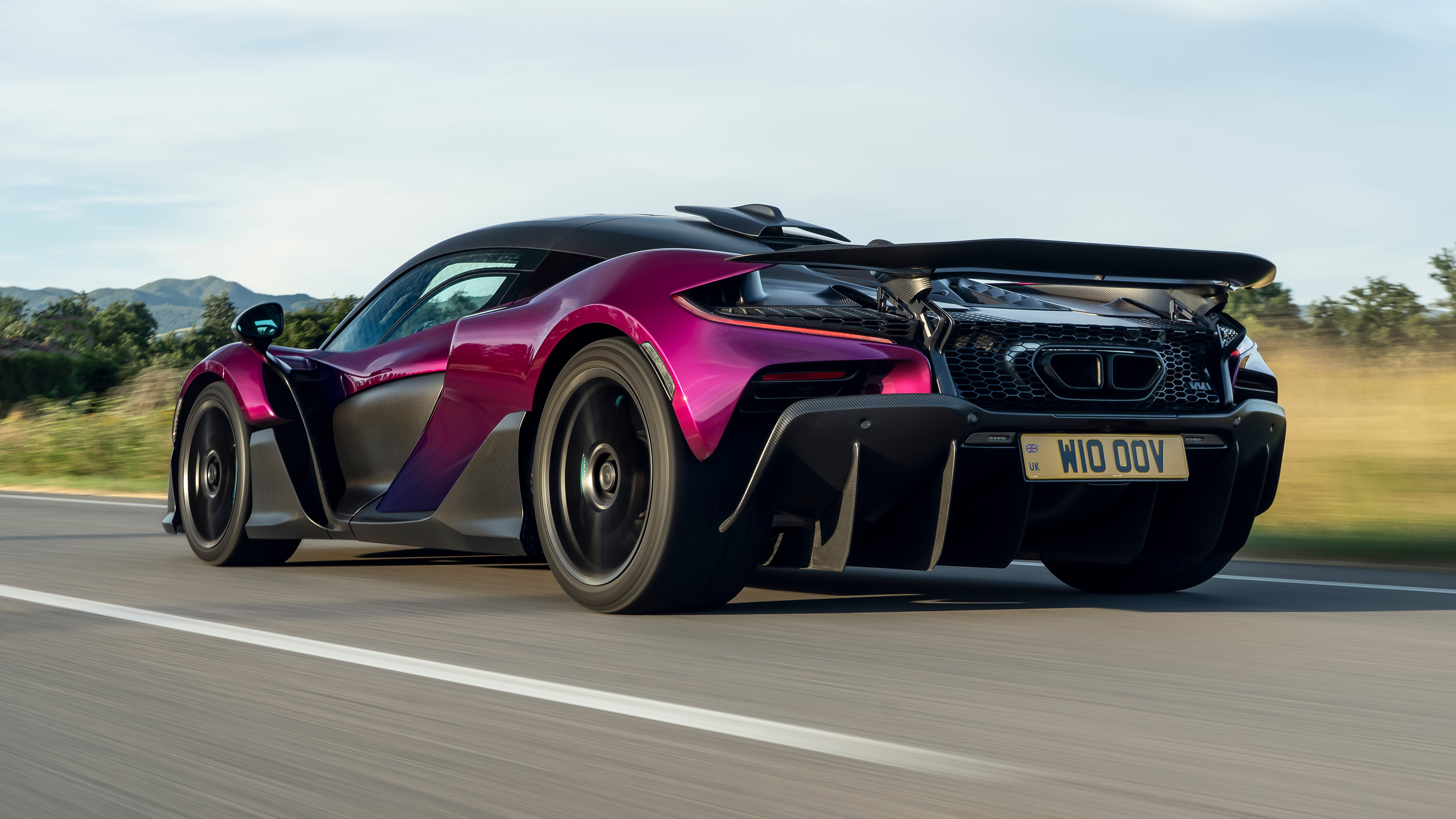
The keyboard warriors will have their view, but as ever, you’re unlikely to be disappointed if you see a W1 in the flesh. It has massive presence, and from the rear in particular a mighty stance. The 335/30 R20 Pirellis help here, even if 20in wheels seem unfashionably small.
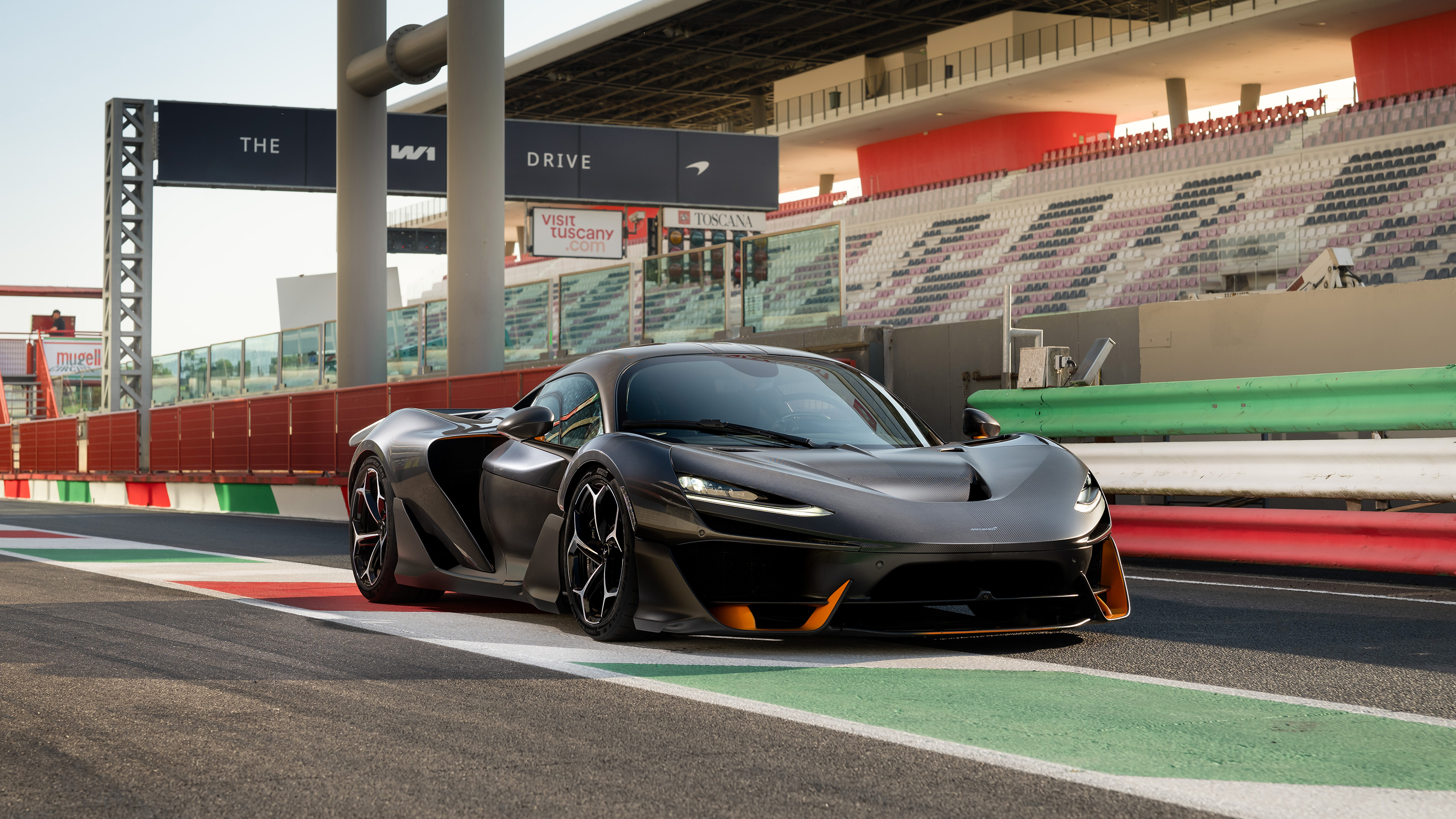
There are visible carbon fibre aero structures and exposed suspension components, its side pods’ intakes and ducts integral to the car’s form language. There’s a flow diverter at the back of the roof, that houses the radio and GPS antennae, but also sends clean air towards the rear wing. Cars of this immense capability long ago stopped being beautiful, whatever that means these days, but the W1 drips drama. With those fabulous doors open, the structure looks sculptural. And of course MSO exists to personalise the hell out of the car. Anything is possible, provided you have the required funds.
Advertisement - Page continues below
Is it not massively intimidating?
Actually, no. As long as you can park the fact that it costs £2m. And as for actually parking it, well that’s where the rear-view camera comes in. The W1 has the narrowest A-pillars on any McLaren so it’s easy to see out of. The sense of theatre is amplified by placing the ‘start’ button in an overhead panel on the roof, close to the rear-view camera mirror. You’ll also find the window switches, ‘D’, ‘R’ and ‘N’ buttons, plus the ‘Race’ mode one up there. Everything is beautifully constructed, with lots of exposed carbon fibre. It feels suitably epic.
And to drive?
It starts on the button, although there’s a pause before it fires up. An awful lot of energy is being corralled here. It settles into a gruff, almost industrial sounding idle, compelling rather than easy on the ear. McLaren spent four years developing the engine, and designed it to operate as the heart of an electrified powertrain.
It’s an all-new 3,988cc, twin turbo V8, with a lightweight block, cylinder heads and pistons, and uses 350 bar direct injection and port fuel injection. There are plasma spray coated cylinder bores, the valvegear uses sliding finger followers with diamond-like carbon coating to reduce friction, and there’s an internal viscous damper for the crankshaft. It revs to 9,200rpm, higher than any previous McLaren engine, with peak torque on its own of 664lb ft (988lb ft in total).
And the hybrid bit?
The E-module is mounted to the side of the transmission. It consists of a radial flux e-motor that can spin to 24,000rpm and has F1-comparable efficiency, plus an integrated motor control unit. This box of tricks weighs just 20kg, and adds 342bhp. Compared to the P1, the hybrid components are 40kg lighter, and deliver twice the power. The E-module is fed by a 1.384 kWh battery, and the whole thing is housed in a cavity within the W1’s monocoque, fully protected but mounted as low as possible to help the centre of gravity. The W1 will do 1.6 miles in electric mode, but there’s always enough power in the battery to start the engine and enable reverse gear. With a quoted dry weight of 1,399kg, the power-to-weight ratio is 899bhp-per-tonne.
Tell me more about the tech and how it works.
The suspension has Comfort, Sport or Race modes, and active heave damping for maximum dynamic control. Then there’s the aero. In Race mode, the ride height drops by 37mm at the front and 17mm at the rear, hunkering the car down and giving it even more visual menace. Its active front wing delivers a level of performance that’s similar to the rear wing on most supercars. The Active Long Tail extends rearwards by up to 300mm through a 180-degree arc, far beyond the edge of the W1’s body. Four e-motors move the wing up or down and alter its angle; it also works as a drag reduction system (DRS) and an airbrake.
Its active front wing delivers a level of performance that’s similar to the rear wing on most supercars
Already something of an angry Transformer design-wise, the W1 now looks absolutely furious. More importantly, it also pumps up the downforce, with close to 1,000kg available at 173mph. For reference, the Ferrari F80 generates 1,050kg at 155mph.
What’s under the skin?
The W1 gets a new Aerocell monocoque, made from pre-preg carbon fibre, the sort usually reserved for high-end motorsport or very low volume cars. It has a torsional rigidity of 51,000Nm by degree, so it’s tier one endurance racer stiff. The tub has aero surfaces that were only possible by raising the floor, which in turn has elevated the footwell position. Airflow under the car meets a structural rear diffuser, which shrink-wraps around the powertrain. It’s made of a material called Intermediate Modulus Carbon Fibre (IMCF), an even higher strength and more heat resistant composite. There’s no need for a strut brace which in turn means the diffuser can be bigger. It also acts as a rear crash structure.
Other highlights?
The front suspension uses titanium torsion bars and an active heave crosslink, as mentioned, while the rear setup has a Z-bar with active droplinks to optimise the car’s vertical motion. The front uprights and wishbones are 3D printed in titanium. This is also the first McLaren road car to use pushrods which are linked to inboard dampers, for more aero goodness.

The transmission is an all-new eight-speed dual-shift with a much higher torque capacity than on previous McLarens. There’s also an all-new hydraulic E-differential. Powertrain options in Race mode include a GP setting for consistency on longer runs, or Sprint for the full enchilada. Hit the boost button and you get all the electric oomph for warp factor seven acceleration. The Aero button triggers the DRS.
Sheesh. That’s impressive. Almost too much to compute.
On paper, maybe. Yet the W1 makes it all amazingly accessible. It’s an aero car, which basically means it gets better the faster you go. So the challenge is primarily one of self-belief, of pushing yourself to match the car’s massive capability, although you can’t help wondering how the bespoke Pirelli Trofeo RS tyres can cope with the vast loads being put through them (‘Normal’ Pirelli P Zero R tyres or winter tyres are available). Whatever you do, the W1 can do more. And then more again. It harmonises its component parts in a way that makes it difficult to separate them, should you go looking for highlights.
Can you try, please?
OK, then. The electro-hydraulic steering is perhaps the best fitted to any road car, a redefinition of linearity and feel. Then there’s the way the car scythes across the landscape, capable of intergalactic speeds but utterly unbothered by whatever’s thrown at it. If anything, it’s even more impressive on the road than it is on the circuit. Not once does its chassis run out of answers, or do we hear the graunch of expensive carbon fibre interfacing with asphalt. Which is a relief on a £2m motor car (there is a nose lift for speed bumps). The brakes are also insanely good, whether you’re finessing your way down a mountain pass and revelling in the delicacy, or defying physics on a hard stop from 190mph on track.
And the gearbox is absolutely sensational to use, the full-size paddle-shifters working with a satisfyingly mechanical click, the whole process happening in an almost overwhelming blur.
What's the verdict?
“1,258bhp through the rear wheels should be unmanageable, but instead the W1 is a paragon of feel, feedback and traction”
McLaren describes the W1 as an ‘everything’ car, designed to work as effectively on the road as it does on the track. There are those who insist that chasing this particular idea can only result in unavoidable compromise, and that you’d be better off buying a decommissioned GT race car for your track fun, and a Range Rover in which to get there.
The W1 begs to differ. This is a car of singular purpose and precision, that marries advanced materials science and aerodynamics to truly stunning effect. It would be a little reductive to think of it as a 750S with twice the power, but it takes everything we love about that car and just dials it up. By rights, 1,258bhp through the rear wheels should be unmanageable, but instead the W1 is a paragon of feel, feedback and traction. It’s battling physics and the tyres are surely the limiting factor in a rear-drive car with this sort of firepower, but everything feels… pure. A multi-million pound machine it may be, but the W1 is a truly monumental achievement.