




Advertisement
Driving
What is it like to drive?
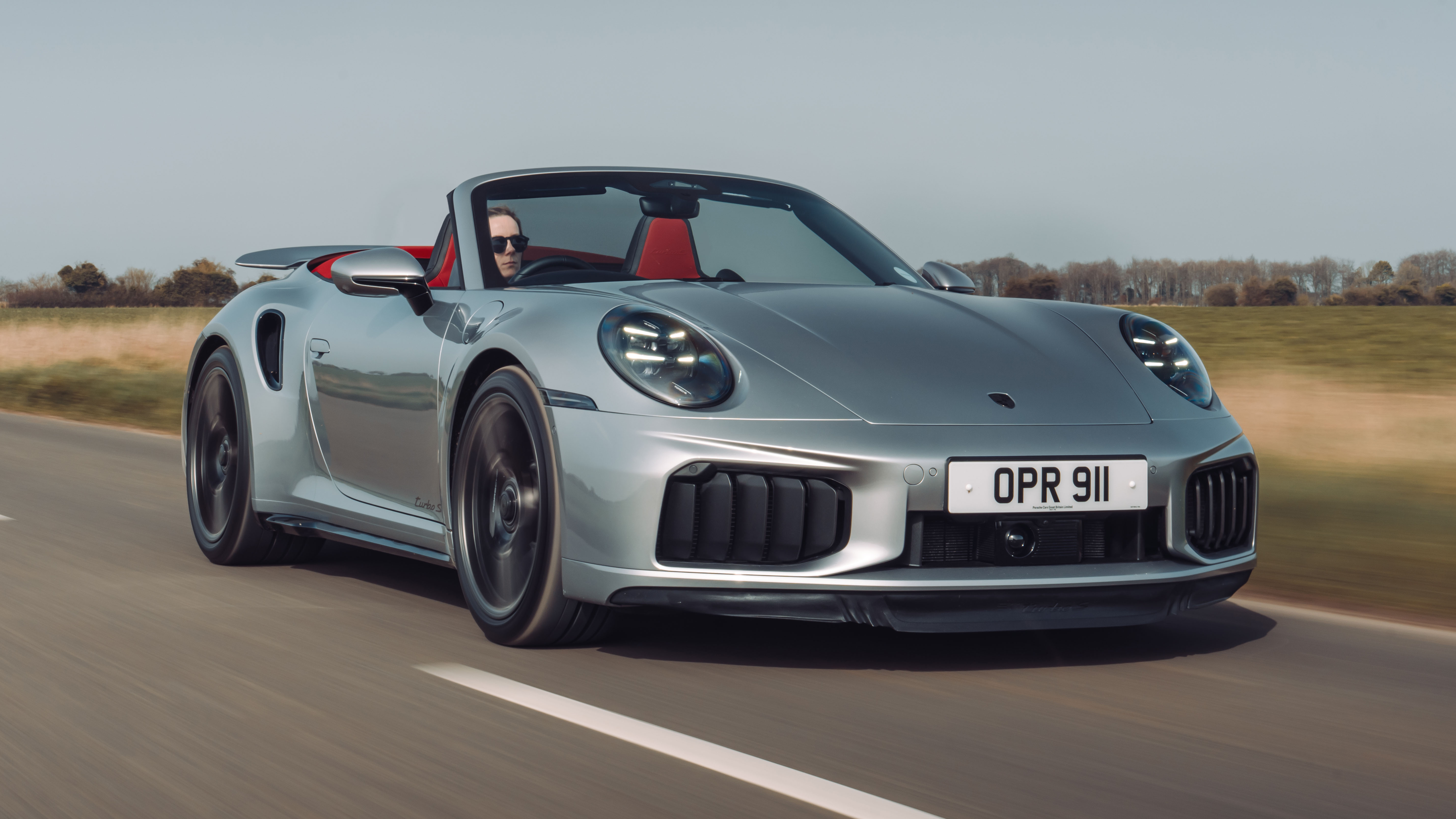
‘Fast’ is a really petty way of describing it. So how about this instead: it’s really good at magic tricks. As in turning ‘over there’ into ‘here’ without anyone noticing. The engine kicks the lungs out of occupants, yet the suspension is calm no matter what forces it’s dealing with.
You arrive at every corner 20mph faster than you thought possible, and then stop quicker than conceivable thanks to the genuinely sensational brakes. It’s a hugely stable, flattering and confidence-inspiring car. All this it has in common with its predecessor. So let’s start somewhere different.
Advertisement - Page continues below
Will you notice the turbos are electrically driven?
No, Porsche has chosen not to make a virtue of this change, or fundamentally alter the car's character. It could, we’re sure, have fitted a set of giant blowers and given the Turbo S 850bhp or more. Instead, they’ve done the incremental gains thing. Just with better call up times for the turbos.
Anticipation, the brace, brace for turbo impact is part of what made the Turbo exciting. Now, after a fractional pause, it goes. And then kicks again as exhaust gases take over from e-motors. It’s a good trick, means you can precision play with the throttle through corners, rather than just hoof it out the far side, and for more normal concerns such as joining motorways, it’s bliss.
Still not as pure as a naturally aspirated motor, and to really get a feel for the engine you need to take control of the gearbox, otherwise the first thing it does is kick down – which is lag, in another form. Fourth gear is a monster though. So wide is the torque plateau (590lb ft from 2,300-6,000rpm) that third is often too ferocious. Instead let the engine show you what it can do at 2-3,000rpm, how quick it can get up and running.
There’s a new level of torque fill going on here, presumably thanks to the 80bhp electric motor within the gearbox, that sustains acceleration and keeps the turbos blowing even between the very brief twin clutch gearbox gaps.
Advertisement - Page continues below
Does it sound good?
We suspect Porsche is doing its best to retain some flat six character in spite of stringent regulations. It sounds lean, like not a drop of petrol is going uncombusted, the noise is a little flat, a little thin and muted, the turbos don’t fizz with intent, just hiss gently in the background. All kind of fine in a car designed to be used day in, day out, but not overtly characterful alongside, say, the Aston Vantage’s twin turbo V8. The last gen, to our ears, was more guttural.
What’s launch control like?
In a word, stupendous. Even alongside top line electric cars and monstrous McLarens, there’s nothing that gets itself off the line more effectively and with less fuss, than this. As we said in the Overview, everything needs to be warm and dry, but then it’ll happily spear to 60mph in 2.2s.
The traction management between clutch, gearbox, engine at 4,000rpm launch speed and fat tyres (255 width front and 325 rear) is absurd. And it’ll do it again and again. It’s quite the party trick.
That’s how to get myself into trouble. How do I get out?
With perhaps the best brakes fitted to any road car. Ten-piston/420mm front brakes and four-pot/410mm rears, mean it’ll stop 50ft before your brain will, but you never need to pummel them with everything. In fact you don’t want to – there’s so much feel and precision in the pedal that you go looking for opportunities to slow the car. Even approaches to traffic lights are a chance for deep satisfaction.
Geek point there. Tell me about the Cabriolet? Wobbly?
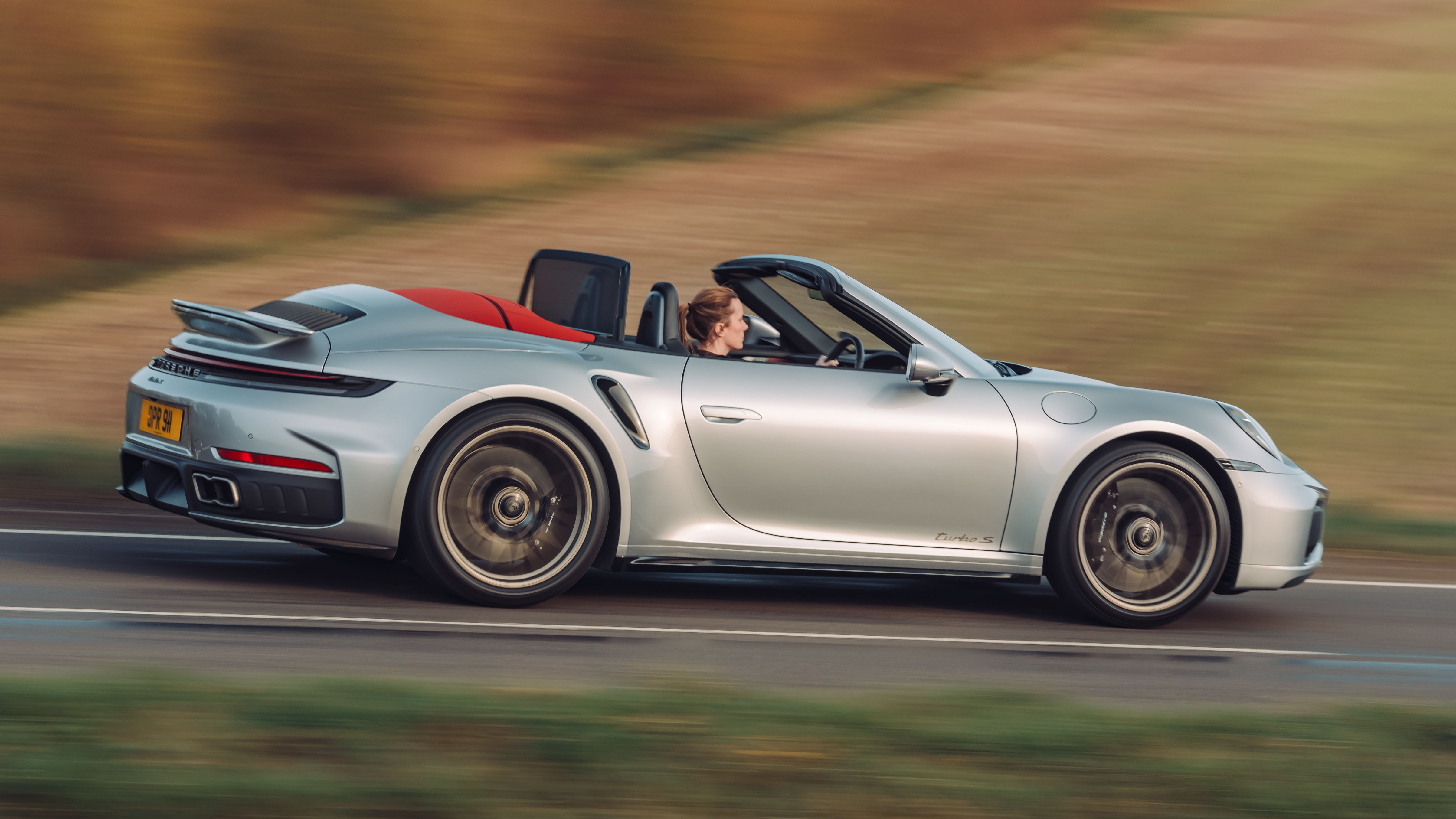
What do you reckon? Of course not. Bar a fractional wobble on the very worst surfaces, it’s every bit as together as the coupe. It is 85kg heavier, and you do notice that in some direction changes, but not in how it rides or behaves. It’s as smooth as the coupe and the roof is brilliantly well insulated.
Look as well at how smoothly integrated it is – no rankles in the material and the rear glass is completely flush. It’s the neatest, sleekest soft top integration we’ve ever seen.
The roof drops by key from outside, or button at up to 30mph and, if you stick the windows up and raise the integrated wind deflector, it remains unbelievably calm in the cockpit right up to motorway speeds.
Is it as fast around a circuit as a GT3 RS?
If your name is Jorg Bergmeister, no. In the GT3 RS he posted a 6min 49.33s lap of the Nürburgring. In the Turbo S he was 14s slower at 7min 03.92s. However, for us mortals who don’t understand downforce and damper clicks, in a Turbo S we will be much faster. And more confident and comfortable.
This is the fastest car down a road when you don’t know what’s coming, bar none.
With the electronically assisted steering damping out most of the road imperfections and the engine muted out back, it is deceptively, wickedly fast. Just easing onto a motorway, you can look around to change lanes and look down at the speedo to see you’ve effortlessly crested, well… never mind.
This makes it an exceptionally easy and comfortable GT car in which to unfurl hundreds and hundreds of miles.
But can it still be a proper supercar too?
The short answer? Yes. The other side of the Turbo’s character is equally impressive in an entirely different way. You have to dial in Sport or preferably Sport Plus mode to really wake it up. But when you do, every sinew in the car tightens up nicely.
It feels like the wheelbase shrinks a couple of inches, 250kg gets jettisoned and the turbos go from meek to wild. The splitter and wing extend and the gearbox hangs onto ratios longer. Either way, the effect is electrifying, the car drawing from apparently bottomless wells of grip and power.
And on track it's as if the Turbo engineers have been copying the GT3 team’s homework. Sure, there’s so much grip from the AWD, even the Turbo S’s prodigious pace won’t ever catch you unawares. But if you start deliberately ramping everything up and loosening the ESP (on circuit, of course), this thing will deliver all the thrills and spills we’ve frequently craved, but not always discovered, in a Turbo chassis.
Variants We Have Tested
Trending this week
- Top Gear's Top 9
Nine funky Brazilian cars with Volkswagen engines
- Car Review
Porsche Panamera