



25
Come on, keep up! Donkervoort has been around since 1978 and they’ve been radically evolving, reimagining and re-engineering a concept based very much along the lines of the Lotus Seven ever since.
Where Caterham has stayed true to the original Seven look, feel and execution and sought progress through new engines and refining the recipe, Donkervoort has kept the philosophical touchstones – notably a fastidious devotion to lightweight engineering and analogue thrills – but diverged into a whole different world of material technology, wild styling and the swagger of a hypercar built at 7/10ths scale.
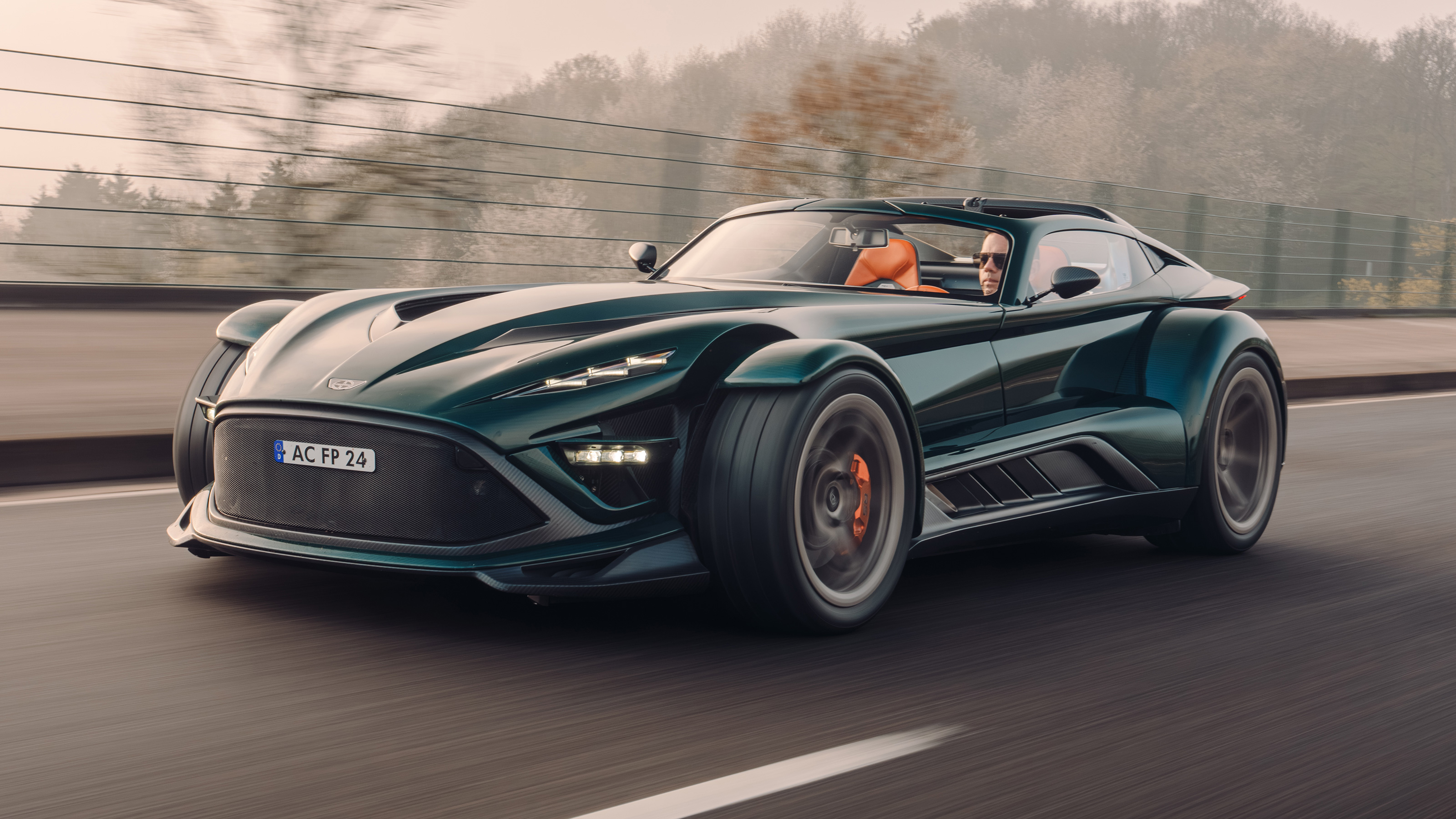
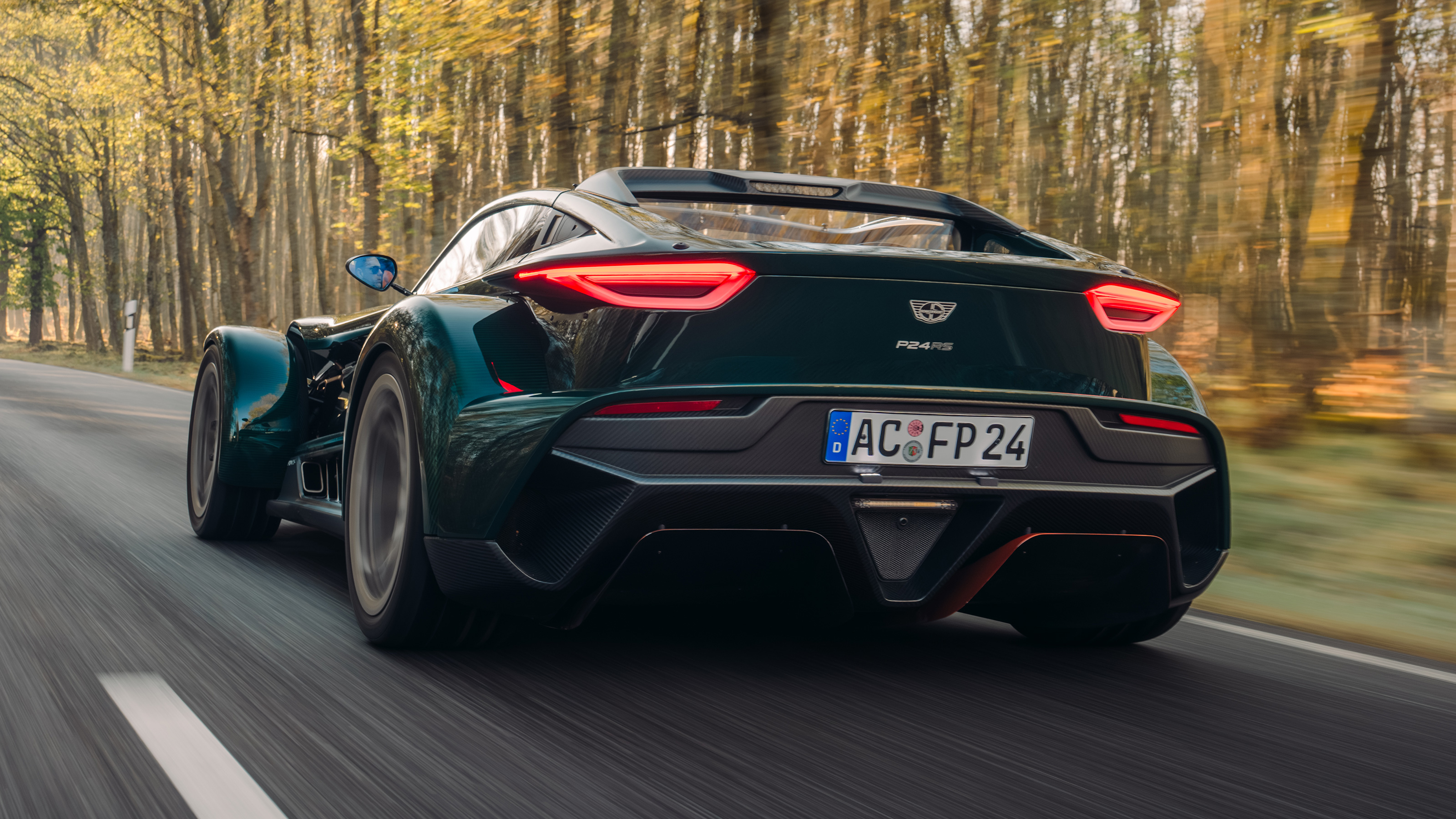
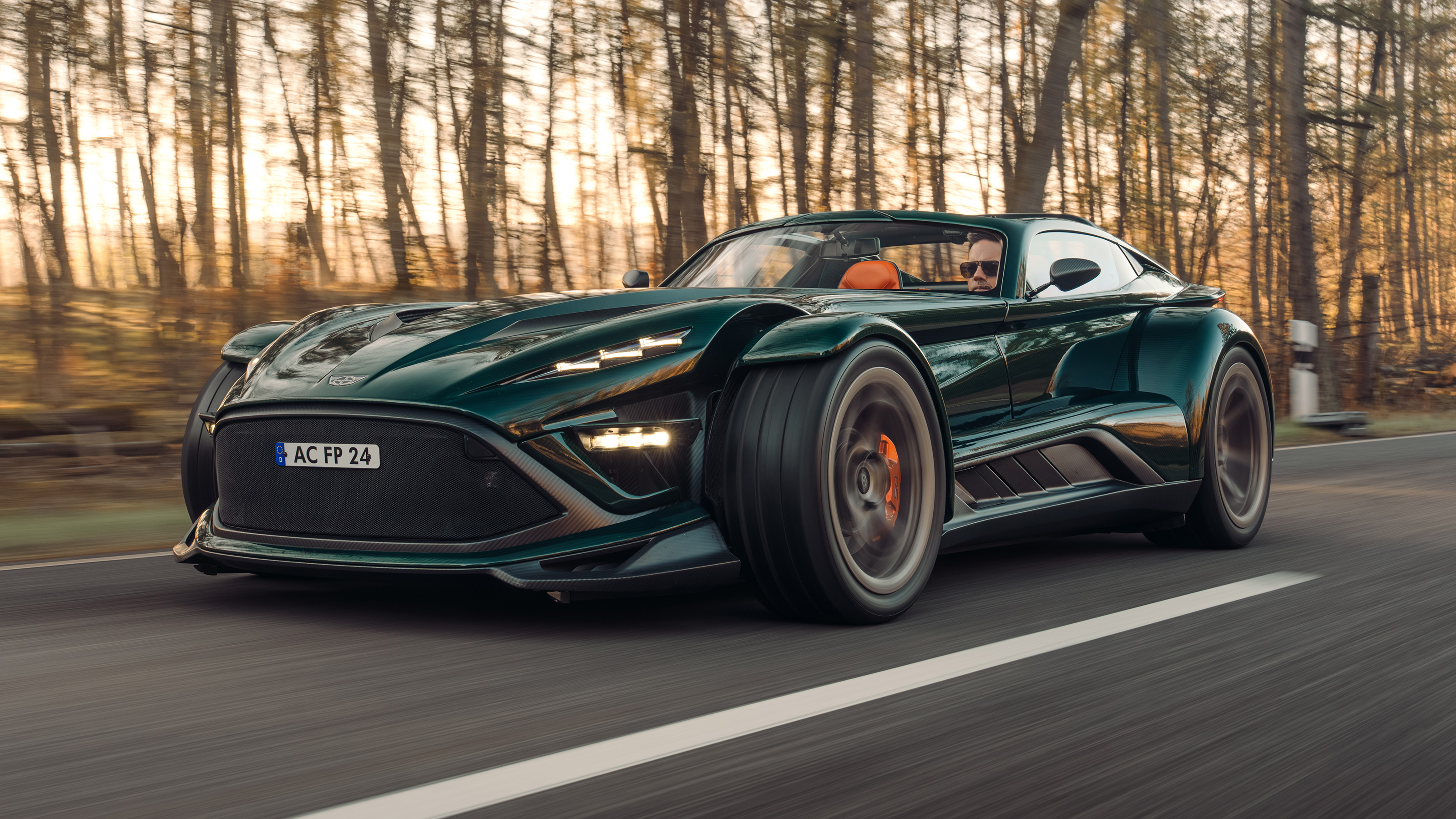
This car, the P24 RS, is their latest creation and a culmination of everything they know. It also marks a departure from a long association with Audi powertrains. This car’s predecessor, the F22, had the superb five-cylinder turbocharged engine familiar from the RS3, but in its place now sits a dry-sumped 3.5-litre twin turbocharged V6 engine dubbed ‘PTC’ or ‘Power to Choose.’
Small and light. Thanks to a chassis made up of tubular steel bonded to proprietary ‘Ex-core’ carbon fibre side panels, a carbon fibre front subframe made with the same process and a carbon fibre body, the P24 RS weighs just 780kg dry. It also has double wishbone suspension, electronically adjustable Tractive dampers that control roll stiffness and eliminate the need for anti-roll bars, optional carbon ceramic brakes and – as if to wear its hardcore credentials as a badge of honour – lists traction control, ABS and even power steering as options.
Anyway, that monster engine. Based on the Ford Ecoboost V6 as seen in the GT but with a bespoke dry-sump system, unique smaller turbochargers by Van Der Lee, 3D-printed exhaust manifolds and a unique intake system, it lives up to the PTC tag with Comfort, Touring and Performance modes, which deliver 400, 500 and 600bhp respectively. The power-to-weight ratio is similar to a Ferrari F80 and all that grunt is delivered through bespoke 275-section rear tyres by Nankang.
Donkervoort claim 0-124mph in 7.4 seconds, a top speed of over 186mph and 2.3G of cornering force even before you fit the track-only aero kit. It’s a wicked addition and consists of a deep front splitter and a pair of C-shaped rear winglets for the rear not unlike a Ferrari 296 Speciale. So equipped the P24 RS makes 90kg of downforce over each axle. This is a hardcore car but with a carbon fibre targa roof it’s eminently usable and even has 300 litres of boot space. That’s more than twice the capacity of a Porsche 911.
Perhaps the more pertinent question is what does it deliver, as the Donkervoort is truly a unique experience. On the one hand it’s an open front wheel sportscar with a rorty engine, hefty five-speed manual ‘box (who needs six, they say, with this much torque and so little mass?), little in the way of driver aids and a riotous balance. On the other, it’s so beautifully finished and feels every inch the artisan hypercar in miniature.
But then again, it’s logical and Dutch and feels like it’s engineered to be used a lot thanks to its roomy interior and practical luggage space. Yet it’s not really practical as you need to be very supple to slither into the driver’s seat, the engine is loud and angry thanks to side exit exhausts that emerge just a few centimetres from each turbo housing and because, well, it has 600bhp and can make a dry road feel like a wet one if you have a heavy right foot.
And yet within even a few miles the Donkervoort starts to make perfectly imperfect sense. It feels like a properly sorted car and actually manages to meld so many elements into a cohesive and seriously appealing whole. Nimble and brimming with feedback like a lightweight track car; bespoke, hand crafted and analogue like a gold standard restomod and with the material technology and finish of a high-end supercar. The P24 RS feels unique and blows my preconceptions apart. It’s wicked fun and deeply intriguing.
Not really, no. The P24 RS is not a car for beginners but it’s clearly engineered and set up by people who really understand dynamics and cherish the interaction delivered by the very best drivers’ cars. With suspension set to 1 (out of 5, with a zero setting that leaves the active elements of the dampers untapped), the P24 RS has a taut, physical ride but there’s a sense of sophisticated control and the stiffness of the structure is evident by the sheer efficiency of the suspension’s movements. Better yet is that this polish isn’t at the expense of raw excitement and immediacy. The P24 RS feels alert, alive, lightweight and delightfully bonkers.
Get all the latest news, reviews and exclusives, direct to your inbox.
The P24 RS feels alert, alive, lightweight and delightfully bonkers
One thing that isn’t light in feel or action is the five-speed ‘box. If you’ve ever driven a TVR, the short, hefty throw will be familiar. I completely understand the argument that the abundance of torque means there’s no need for six forward gears, but in a car defined by interaction and intensity, a lighter, more precise ‘box with shorter ratios seems a no-brainer. Sport mode, for sharper throttle response and more exhaust theatrics, will also provide a rev-match function, but it’s not yet programmed on this prototype and the throttle pedal is set too low for easy heel-toe downshifts. I can live without the rev-match tech, but would like a fix for the pedal placement.
Even in Touring mode with 500bhp the adjustable motorsport-style traction control is busy. It sounds epic though, stuttering and crackling as the ignition cuts, pure motorsport-style. But in the corners and thanks to superbly judged steering and the information that bubbles up through the carbon fibre Recaro seat, there’s entertainment rather than intimidation. In fact, pretty soon the idea of clicking down to traction controls levels 3, 2 or maybe even off altogether doesn’t sound too silly, after all.
The balance is lovely, with just a smidge of understeer followed by shallow angles of power oversteer. Something about how you sit so connected to the rear axle and the characteristics of the mechanical limit-slip differential create such a clear sense of what’s happening down where tyre meets road. Turn up the wick to 600bhp and you really need a good handle on car control and a brain attuned to reading the surface. Talk about engagement. The P24 RS ensures you’re absolutely dialled-in to the dynamics and immersed in the environment around you.
There’s no escaping that, for sure. But while €298,000 plus local taxes (called it £312,000) is a huge amount of money, perhaps the Ex-core carbon fibre componentry takes the sting out? Essentially this is a proprietary carbon fibre process that combines traditional pre-preg carbon lay-up with a unique foam core. The powdery foam is sandwiched between the carbon layers and laid in an aluminium mould. Heating elements then cure the foam and carbon. No pressure is required, no autoclave necessary and it allows for intricate, complex shapes and you can even insert metal fixings into the part to 0.1mm accuracy. It’s a much faster process, too.
Ex-core is now a standalone company and the technology is licenced to Toyota for their WEC programme and several F1 teams. The P24 RS uses bonded Ex-core side panels to reinforce the chassis and provide masses of structural integrity – 58,000Nm per degree is way more than a McLaren, for example.
The P24 RS is a very hard car to definitively judge – it’s a hyper-evolved Seven-type car that can easily exceed £375,000 with options. Which is nuts. But it delivers a unique experience and has the ingenuity and imagination of some of the best supercars and hypercars. I guess you could say that if Koenigsegg built a lightweight, purist sportscar it would be something very much like the Donkervoort P24 RS.
If Koenigsegg built a lightweight, purist sportscar it would be something very much like the Donkervoort P24 RS
Still not convinced? Well, Donkervoort plan to produce 150 P24 RS models in the next few years and over 80 have already been sold. They have a loyal, fervent customer base and are finding new enthusiasts in new markets from the US to the Middle East. It’s never going to have wide appeal, but we’re happy Donkervoort exists and love everything about this wild, wacky, arresting, insane and brilliantly exciting little car.
Get all the latest news, reviews and exclusives, direct to your inbox.
