



25
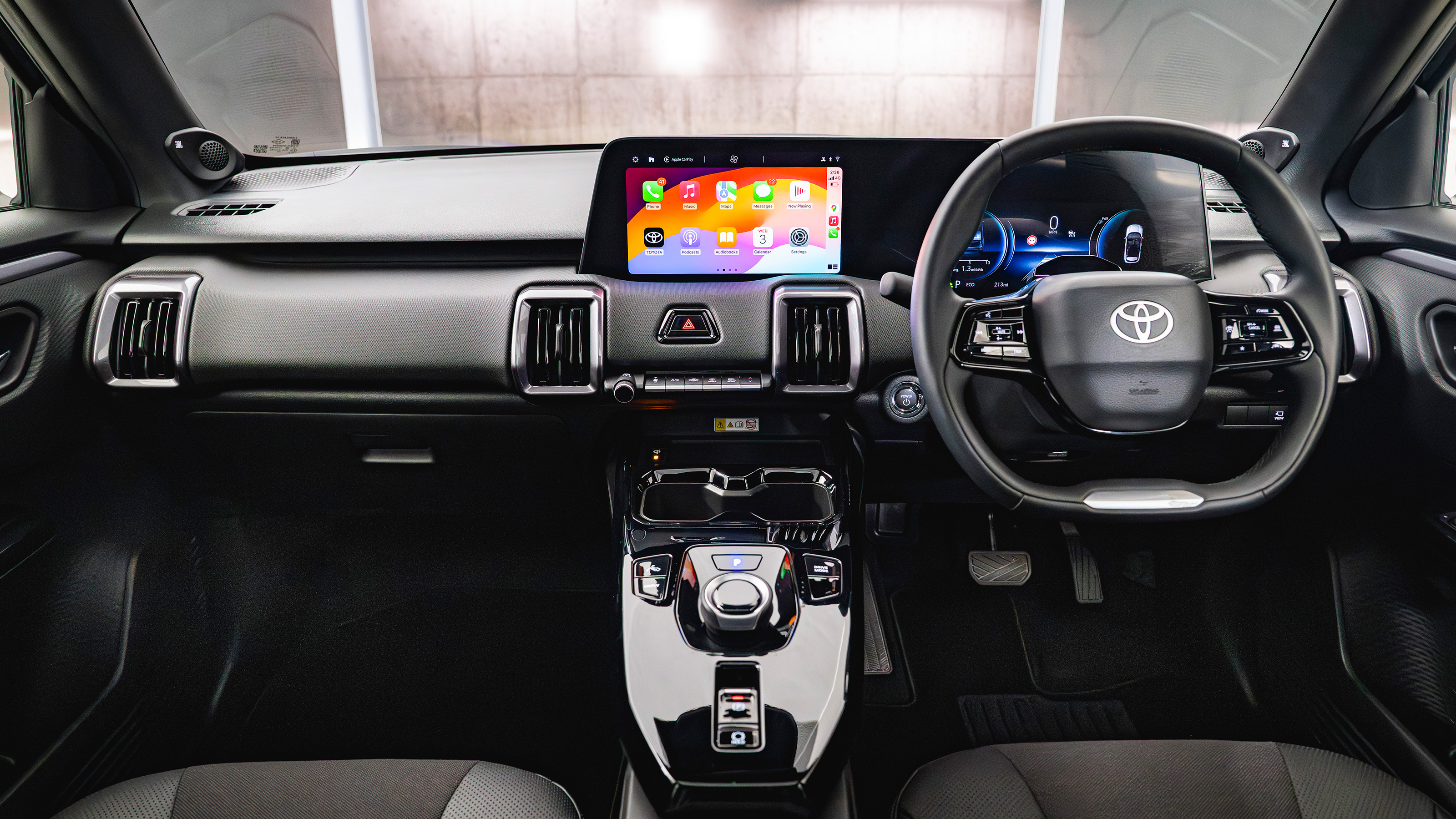
It’s not Toyota’s best work, let’s put it that way. From a usability point of view, it doesn’t depart from the typical blueprint used by countless other manufacturers these days: dual 10.25in driver display and 10.1in touchscreen, a handful of buttons for the climate control with more functionality in the screen, and a rotary drive selector on the centre console.
Visually, it just doesn’t work. Which means you have no desire to spend time on one. What’s with the ugly vents? And the plastic so shiny you could shave with it? No amount of ambient lighting can rescue this hodge podge of a design.
Oh, and everything is black – no hint of colour like you get inside the eVitara, even in the top-spec model. Build quality looks pretty sturdy, but the materials are mostly disappointing with hardly any soft-touch. The seats are a mix of fabric and synthetic leather in the top-spec model – they’re comfy enough, but nothing special.
Storage? There’s plenty, although the cupholders, glovebox and central cubby are all on the small side. The door bins aren’t bad.
The touchscreen is a disaster. Not so much in terms of layout – the structure is actually better than you get on most other Toyotas – but if you could distill a sloth into a user interface, it’d look like this. Can’t imagine that sentence has ever been written before.
Press an icon, any icon, and the system will spend what feels like three millennia thinking things over before giving you what you asked for. It’s the same story with the Suzuki, and quite how either car was released into the wild with so little apparent processing power is a mystery.
The nav is also pretty ropey, but you’ve got the option of hooking up your phone via Apple CarPlay or Android Auto. So there’s that. And the driver display is fine on account of it not bombarding you with info you don’t need.
Are you nine? Congratulations! You’re going to have all the legroom you’ll ever need until your 14th birthday. By which point mum and dad’s lease will have expired anyway.
For adults, headroom ends at about 6ft. Maybe 6ft1 if combined with a grade one hairstyle. Legroom is okay and you’ll get extra wriggle room if the driver and front passenger notch their seats up a bit. The back doors open wide so ingress and egress is easy, but there’s not much light back here. Put a bucket in the footwell and pretend it’s a sensory deprivation chamber.
The Urban Cruiser’s one party trick is that the rear bench slides by 160mm, so you can adjust for kneeroom or bootspace as needed. Can’t find the latch? Look for the three dots on the lid. The boot itself is tiny, measuring 244 litres with the seats all the way back or 310 with them forward. There’s no load lip, but the floor is quite high up. Heavy shopping nightmare.
Drop the seats entirely and 566 litres of loadspace is yours. This is demonstrably less than you get in this car’s main rivals.
Get all the latest news, reviews and exclusives, direct to your inbox.
