





Big Reads
VW Golf vs Toyota Prius: which of these plug-in hybrids is best?
Uh oh, the price of fuel has shot up and it looks like electricity will too. Fight back with an eco hatch warrior
Why haven’t plug-in hybrids swept to power on Planet Car? They’ve got so much in their arsenal: an e-motor for stealth in sleepy hamlets, cheap-ish local electric travel, a trusty tank of petrol for the long haul when you need it, and usually a deep well of torque for combating... well, the armada of Jaecoos that have invaded middle lanes across the country of late.
And just think: for every lithium-guzzling BEV, we could have half a dozen or so PHEVs winning back ground on our size infinity carbon footprint. Shock and awe for the thinking motorist.
Advertisement - Page continues below
And yet, their market share in the UK is just 12.8 per cent. Any number of which will be company cars where the charging cable sees as much daylight as a fossil buried deep in the Earth’s crust. The early dinosaurs have evolved too.
Photography: Jonny Fleetwood
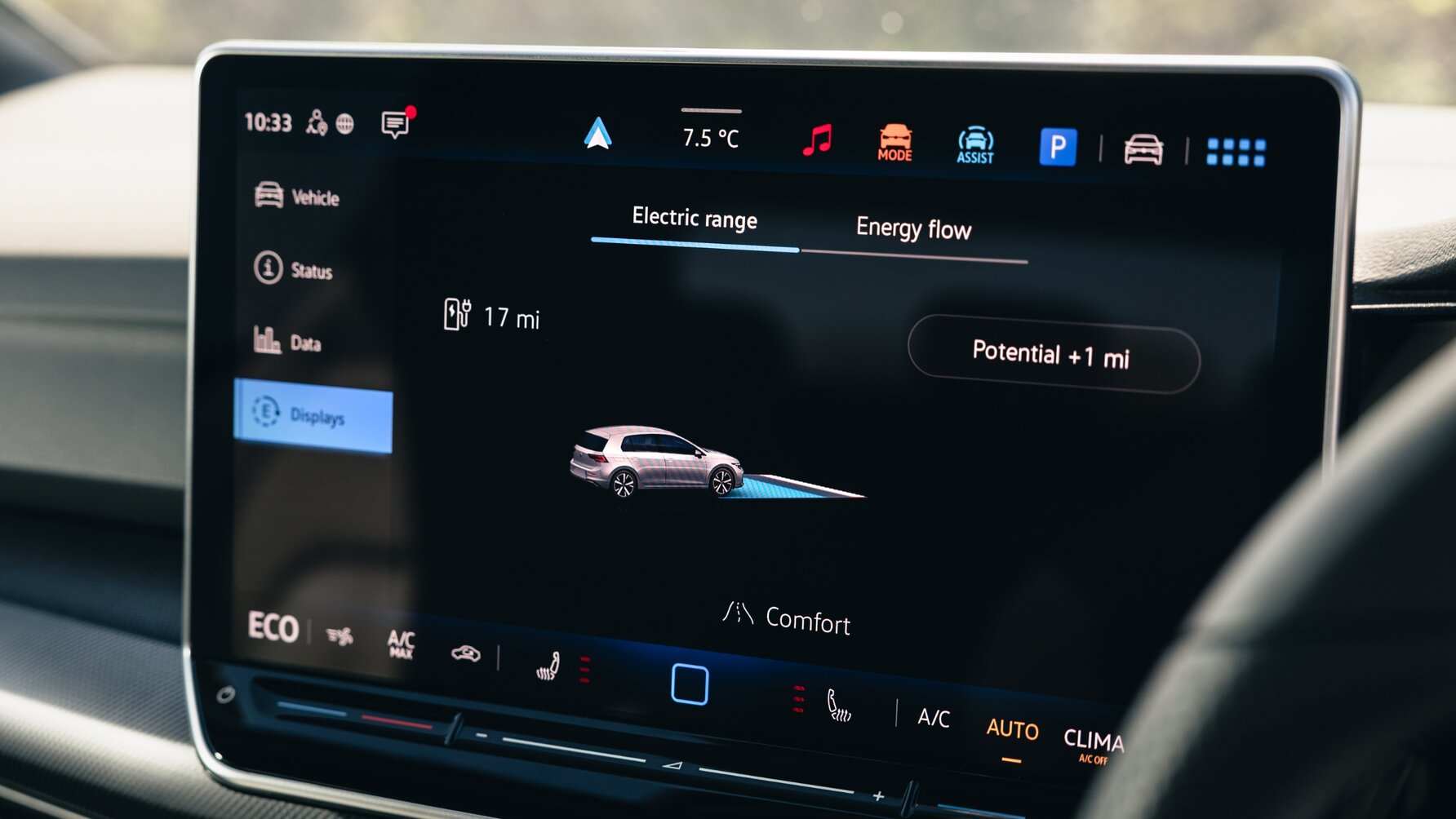
Take the Golf: when VW introduced the Mk7 GTE a decade ago, it had an 8.8kWh battery and 31 miles of e-range. Now it’s 19.7kWh and 81 miles. You could go months on end without visiting a forecourt. How blissful does that sound when the price of oil is only ever one Truth Social post away from rocketing skywards?
It’s the kind of vulnerability that makes you wonder why Toyota ever stalled on bringing the fifth-gen Prius here. ‘Too many hybrids already’ was the thinking to begin with, before ‘it looks the bog’s dollocks’ sensibly won out inside the Toyota mind hive.
Advertisement - Page continues below
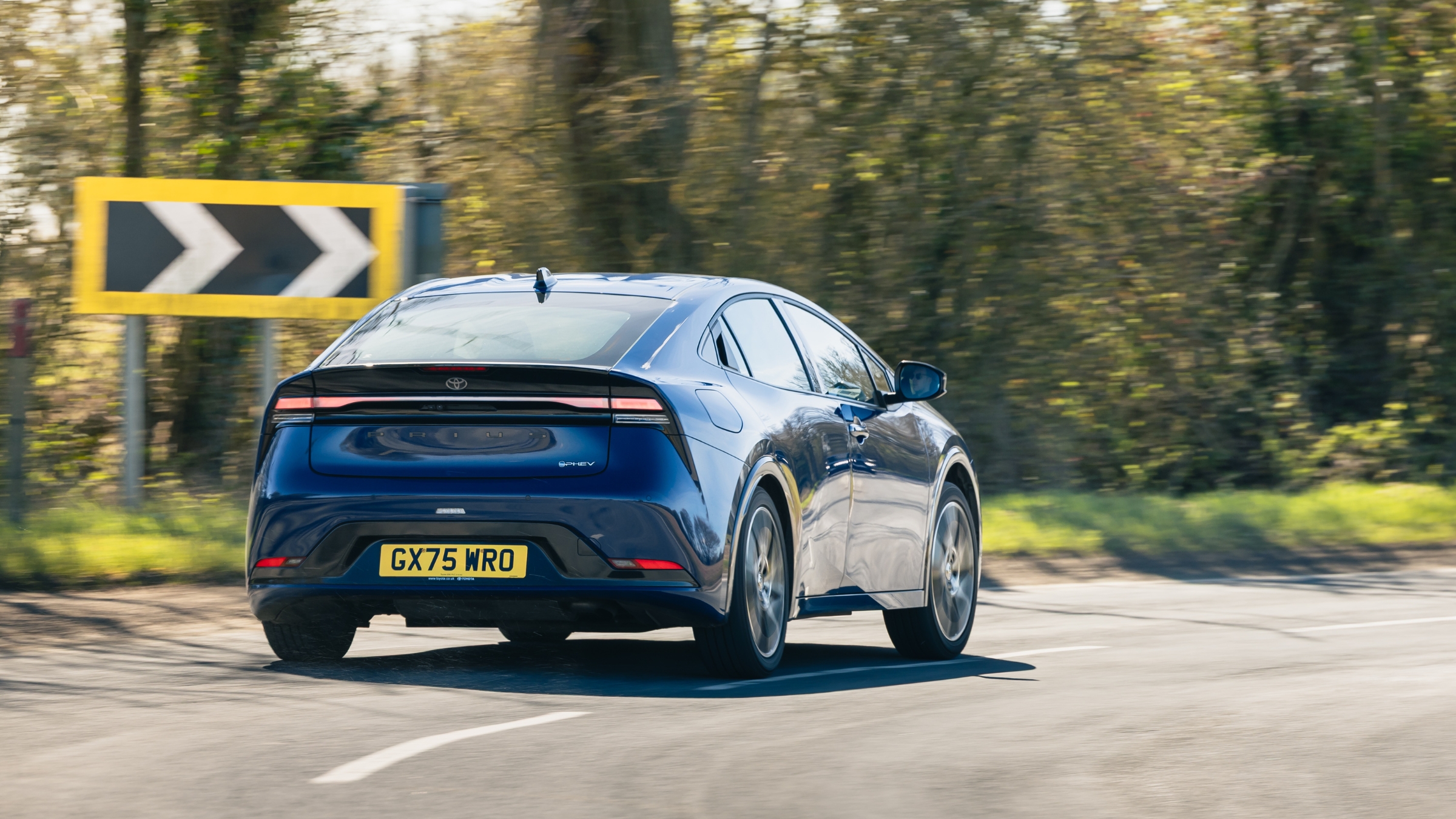
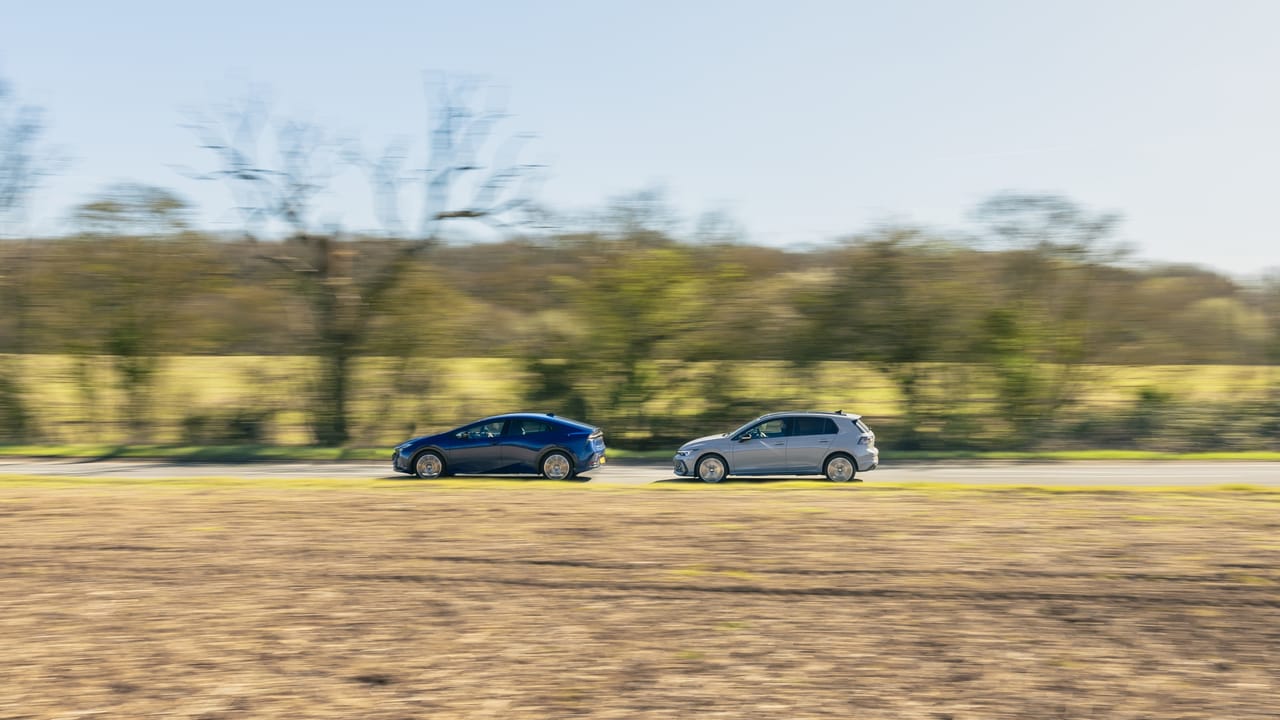
The Prius pulls off that Lotus Emira trick of looking drop-dead, knee-slappingly good when by rights its ceiling should be ‘quite nice actually’. Too bad Hollywood has moved on, because the Prius is A-list material now. The Mk8.5 Golf... looks like a Golf. Which isn’t criticism. But the Toyota grabs your attention in a way that the VW just can’t as one of several lookalike offshoots.
It’s one thing to impress onlookers though, bedazzling the driver is another matter. The Prius plug-in is softly sprung – what else would it be with so many destined for a life of minicabbing? – but on first impression the chassis feels responsive and able. Keen, even. Turn the wheel and there’s just a hint of the car pivoting around you; the sort of handling that’s mildly gratifying when your only exposure to cornering is a succession of roundabouts. Milton Keynes, basically.
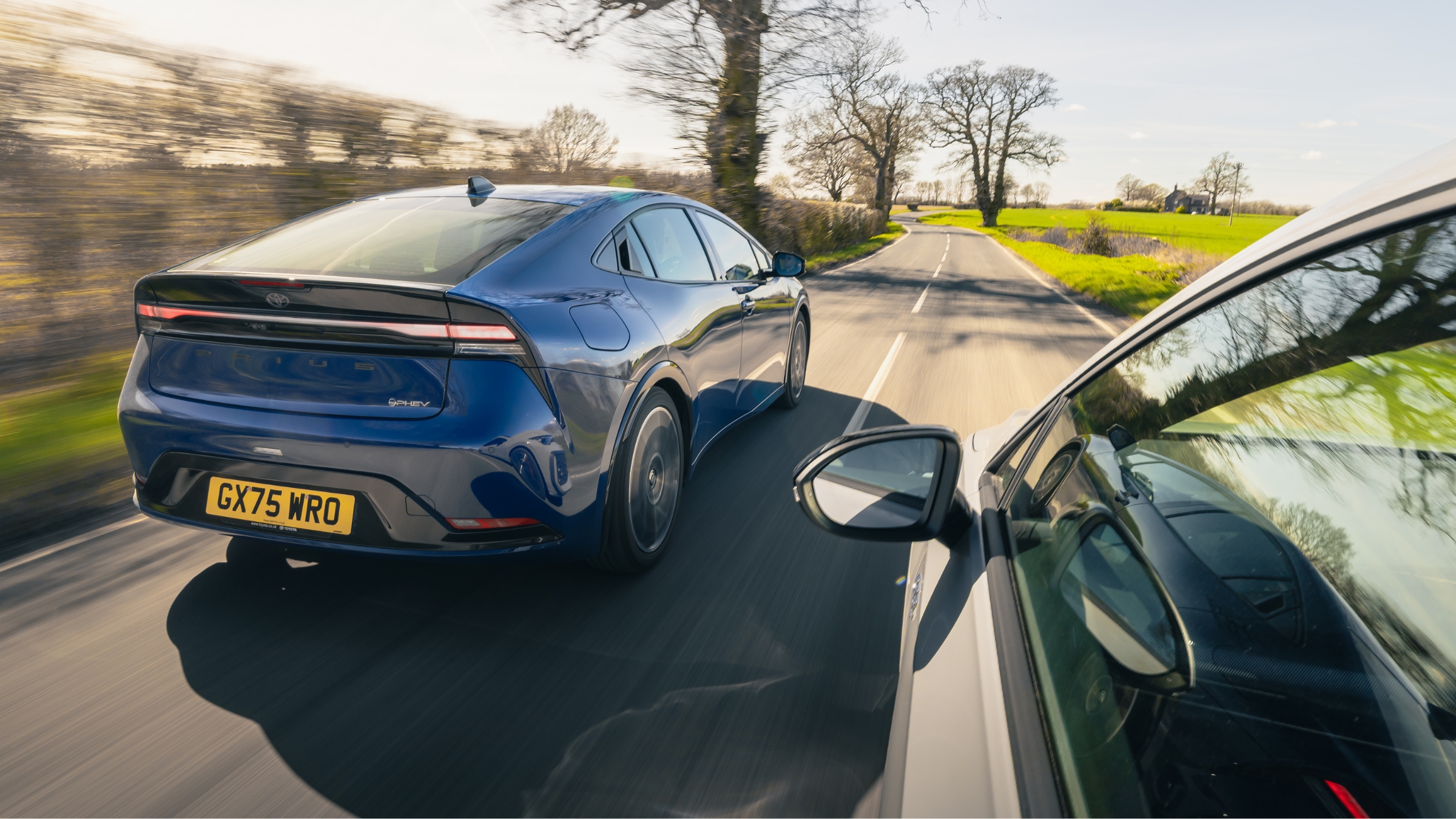
Then you get in the Golf and remember what focused dynamics actually feel like. The GTE is firm and direct; a vastly more incisive machine. As you’d expect from something advertised as an ULEZ-friendly GTI. Being that bit heavier than its sporty cousin it inevitably begins to feel flat-footed, but only at speeds that simply don’t concern today’s opponent. Apples ’n’ oranges, etcetera.
And these are plug-ins don’t forget, which means they live and die on the success of their powertrain. The Prius marries its 2.0-litre 4cyl and motor with an e-CVT, while the Golf’s four pot is turbocharged and fed through a six-speed DSG. There are shift paddles, but if you leave them be the VW is marred by hesitation as the engine and motor wait on software to divvy up the power.
Give it some welly and the revs flare and strain – hardly unique for a PHEV, but that 1.5 is gruff and actively discourages the kind of zeal the car’s supposedly made for. Just goes to show that hybrids aren’t a good sport unless the engine can stand on its own two feet. A Revuelto? Lovely jubbly. A GTE? Not so much.
The Toyota is no musician either, but it’s happier to lean on the motor when you ask for a brisk getaway. So there’s less lag and less noise, but still far too much to be thought of as refined. At a constant speed it settles down to a reverential murmur... or maybe our ears are still paying the price for exploring the throttle. Neither car makes a meal out of shuffling between petrol and electrons in their respective hybrid modes, nor are their brakes inconsistent – an early PHEV defect that’s nowhere near as common as it used to be.
Which brings us to what happens when you take the engine out of the equation. Both these cars run a front-mounted electric motor, the Prius’ good for 161bhp and the VW just 114bhp. A stark difference on paper, but in reality much of a muchness: both cars pootle around agreeably and will reach the national speed limit without relying on a leg-up from internal combustion.
Top Gear
Newsletter
Get all the latest news, reviews and exclusives, direct to your inbox.
But you’d need a sliproad the length of that runway in Fast & Furious 6 to get there, so petrol-free motorway driving isn’t really a goer. Something to think about if your WFH privileges have been withdrawn.
As is e-range. At 81 miles WLTP (60 ish in practice) the Golf will surely now get 99 per cent of people to work and back on one charge, but the Prius clearly isn’t as much of a Swiss Army knife. When it was launched Toyota proudly claimed energy density had shot up by more than half versus the old car, but today its 13.6kWh battery and promise of 44 miles WLTP look trifling, even for a hatchback.
And OK, the 19in alloys on this Excel cost it nine precious miles over the base car, but frugality is modern day Toyota’s greatest strength. It’s virtually impossible to get less than 60mpg out of any of its hybrids, this one included. So how has it let the Prius fall so far behind on what should be the main reason for buying a plug-in hybrid?
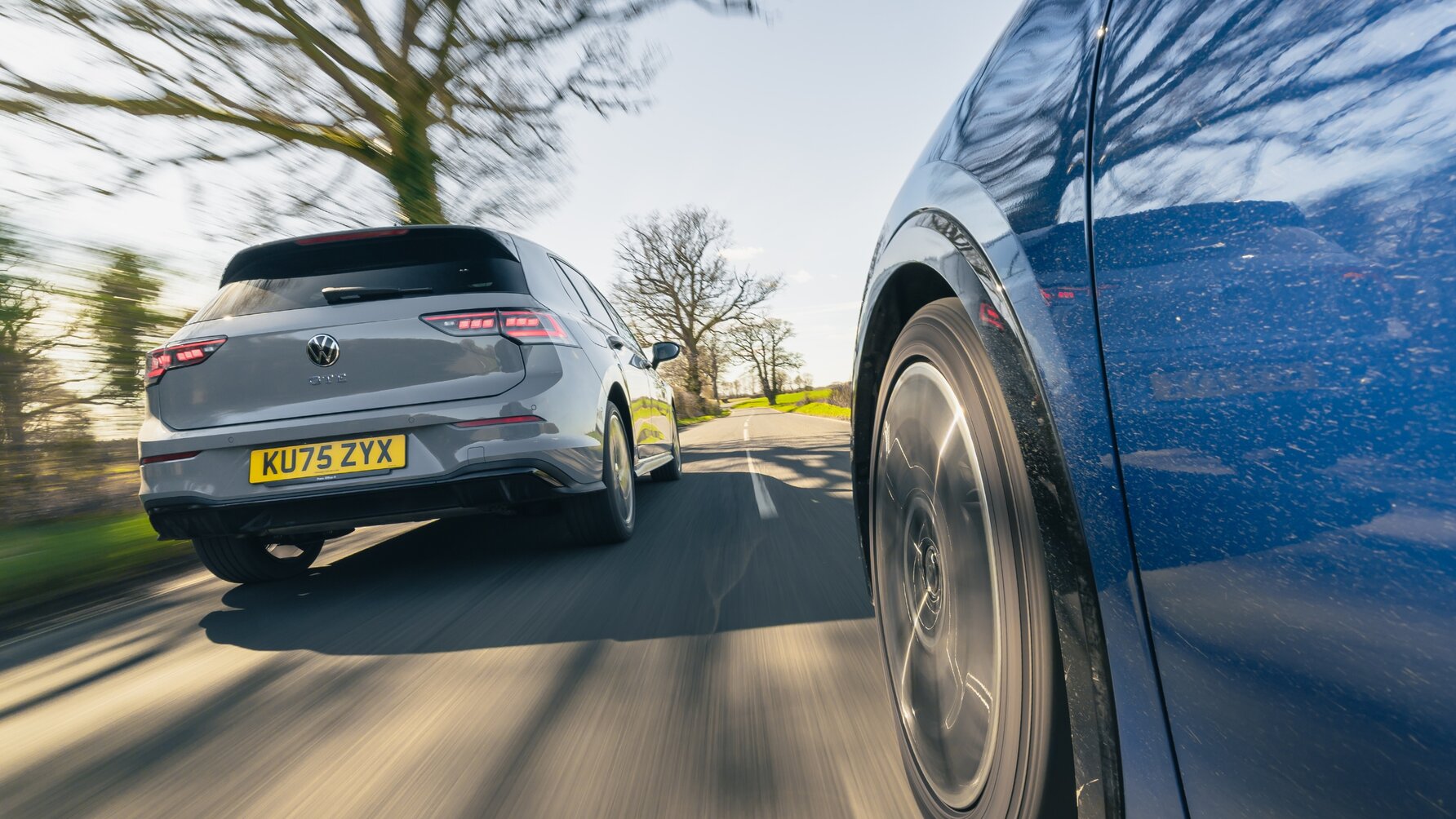
The Toyota grabs your attention in a way the VW just can’t
Speaking of dropping the ball, let’s poke around the Golf’s interior. Tee hee. Unless you’ve lived in a cave for the past seven years you’ll remember the hash VW made of the Mk8’s cabin, and how the new boss has vowed not to repeat horrors like touch-sensitive sliders ever again. A facelift in 2024 sought to undo some of the damage, reintroducing proper buttons on the steering wheel and overhauling the touchscreen for something less... crap. But the lack of joined up thinking is still plain to see.
There’s a capacitive button for the drive mode and a shortcut on the touchscreen doing exactly the same job. Why? There’s gloss piano black everywhere, so you’ll be festering in your own fingerprint collage in no time at all. There’s no switch to toggle in and out of EV mode – that’s unforgivable in a plug-in.
Not a trap the Prius falls into. The centre console, dashboard, steering wheel and doors are peppered with switchgear, including for the climate settings. You could imagine a newcomer feeling overwhelmed by the sheer volume of controls and symbols, like ordering dinner from a foreign menu. But that will pass with time.
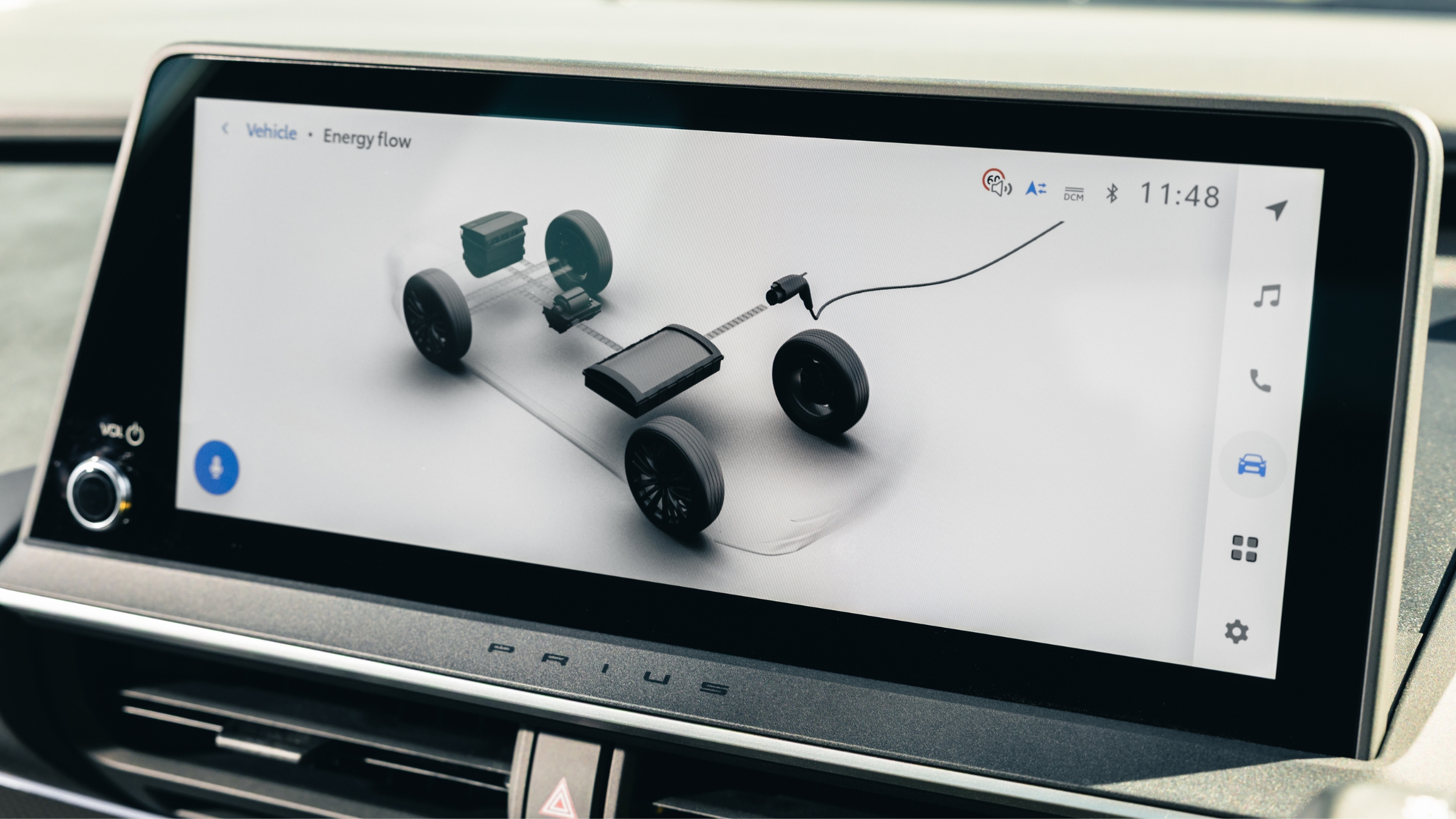
The 12.3in touchscreen is where the Toyota trips up. And not just a stumble, we’re talking a full on, 250-quid-from-You’ve-Been-Framed style wipeout. It runs the company’s Smart Connect+ system and good grief is it the worst digital interface fitted to a car. There’s nothing on it. You get tabs for the nav, media, your phone, and that’s basically it.
Of equal importance apparently is the icon that cues up only two options for the web browser and notifications. Huh? Meanwhile – and clearly in another building entirely – whoever was in charge of the driver’s display was forced to cram all the individual ADAS settings in with the trip computer. It’s nuts.
And it makes VW’s latest system look like peak Windows XP. The graphics are super crisp, and although it goes to the other extreme with too much going on, the menus are easy to bounce around and there’s none of the lag that caused so much grief pre-facelift. But the less said about the ChatGPT-powered voice assistant the better.
The Prius isn’t as much of a swiss army knife
Materially there’s little to separate them. Both apply faux leather, although the Golf has check pattern seats in its favour; the Prius is more business-like, and distracts from its cut-price plastics with a mix of finishes across its shapelier dash. The driving position in the Toyota is lower slung than in the VW, but those A-pillars are a menace at junctions and as the back window’s just a crevice a rearview camera is a must.
Turns out that svelte roofline ain’t so practical, and with the battery under the bench a six-footer has almost no foot or headroom. Oops. The Golf is way more accommodating, and with multiple pockets in the backrests and a through-hatch to the boot, comes across as the more thoughtful car.
What about equipment? Let’s have a kit-off. Wait no, that sounds mildly disturbing. Trim battle? Too hipster. Specification altercation, that’s the ticket! The GTE has three-zone climate control, heated seats, adaptive cruise control, smartphone mirroring, a rearview camera and parking sensors, plus 18in wheels (17s are standard) and ‘sports suspension’ consisting of MacPherson struts and a multi-link rear axle (versus the Toyota’s trailing arm double wishbone). The Prius has all that too, but the wheels are bigger and the AC’s dual-zone. And wins a USB-C 10-port thriller 6-4.
On finance both will set you back about £600 a month over three years off the back of a 10 per cent deposit; Toyota’s interest rate is slightly better. Not exactly cheap.
And that right there is why plug-ins don’t rule the roost: 40 grand hatchbacks in an era of belt tightening? That’s a dealbreaker, however cheap you can make the e-mileage. But if you’ve got the means, it’s the Golf you want.
Trending this week
- Long Term Review
We lived with the bestselling Alfa for six months. Should you?