



25
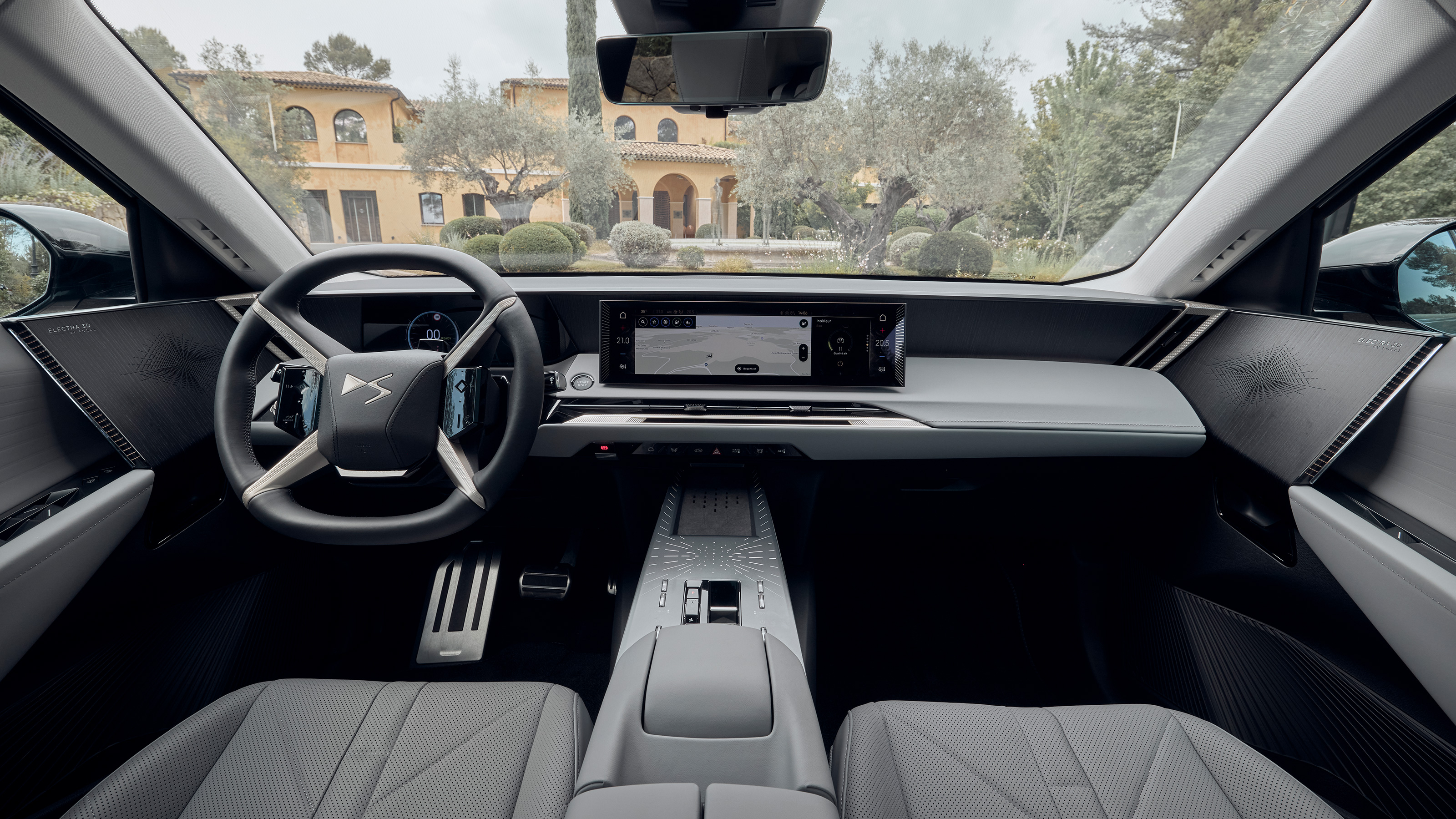
The No 7’s other USP is its ambience inside. Much like the recent Jeep Compass, this is a Stellantis crossover (and corresponding design team) that’s walked past the usual parts bin to carve out some of its own bespoke switchgear. Which does an awful lot to convince you this car is worth its sizable price premium over an equivalent Citroen C5 Aircross or Peugeot 3008.
Your immediate first impression will naturally be of its four-spoke ‘wheel. Though your initial miles might be driven in a slightly disjointed manner, its thumb rests settle your hands nicely at nine and three and it doesn’t take long to get closely acquainted with.
Though lower door and dashboard sections are in the hardy plastics of its Stellantis relations, everything you’re likely to brush on a daily basis is covered in a plusher material and there are perky colour options, too: among the No 7’s more dazzling trim options are purple Nappa leather and navy Alcantara. Be brave, folks…
It’s a mite longer than the outdoing DS 7 – in both wheelbase and overall length – though it’s more to finagle space around the battery rather than gainfully improve legroom. Perching in the old and new cars alongside each other doesn’t reveal a night and day difference. And RIP to some of the quirkier touches of the outgoing car; its reclining rear seats and supercar-esque centralised window switches are gone.
While the No 7 possesses a larger footprint than the old DS 7, its boot volume can be construed as a step back: the Hybrid and FWD E-Tense models offer 560 litres seats up (1,570 litres seats down) and the AWD E-Tense 515 (1,525) litres, compared to 555 (1,752) litres in the outgoing car.
It’s 2026, so lots of functions live within the central 16in touchscreen, but DS says it’s angled equally at both front occupants rather than making any cloying claims about ‘driver focus’ in a car that’s otherwise about nothing of the sort. A wise choice.
It’s a nicely integrated, hi-res display that’s (relatively) easy to operate on the move, while its ADAS functions can be extinguished via a shortcut button, too. The headline screen is supplemented nicely by an artful driver instrument display and, in the UK, a standard head-up system.
Get all the latest news, reviews and exclusives, direct to your inbox.
