



25
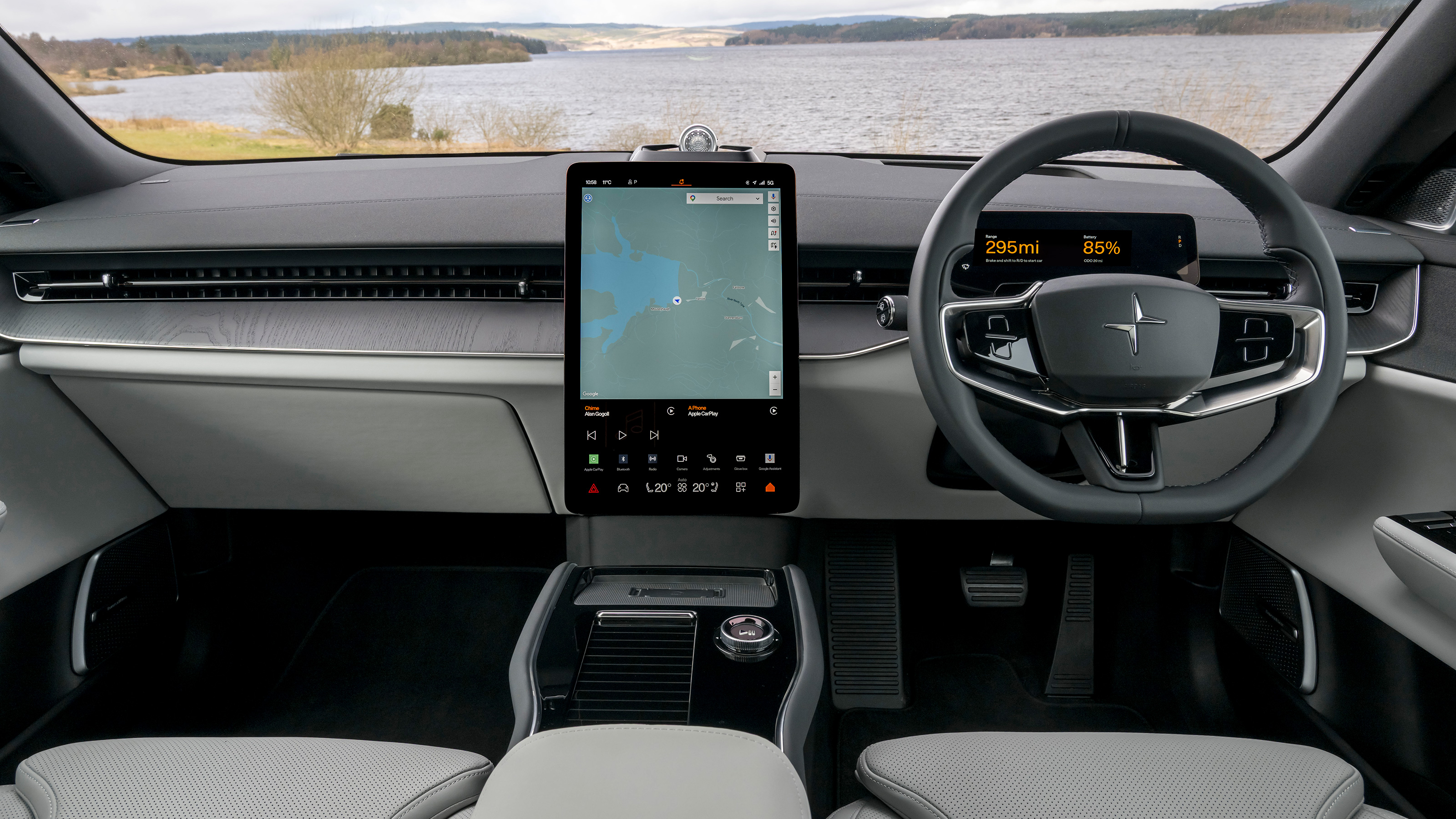
It’s very Polestar in here. The design is simply lovely, with gently curving shapes and beautiful use of different textures and materials. The seats are handsome and especially comfortable, and there’s joyful mood lighting. All cars come with a huge panoramic roof, so there’s loads of natural light and a feeling of Scandi wellbeing.
Polestar makes a big deal of its sustainability attempts. That has driven a heavy inclination to recycled materials but used in a stylish manner. Just to get you used to the terminology, there’s Bio-attributed MicroTech fabric, welfare-secured wool, recycled PET and Econyl (the nylon-esque stuff made from old recycled plastic bottles), repurposed aluminium and again, ‘welfare-secured’ Nappa leather from Bridge of Weir. Whether all this needs to be labelled self-righteously in various places around the cabin is another matter.
Anyway, the most environmentally costly part of manufacture isn't the trim materials but the CO2 in minerals and metals sourcing, and this is falling. The cradle-to-gate (manufacturing) carbon debt of the Polestar 3 is actually smaller than the Polestar 2 when that was first launched.
A 14.5in portrait display in the centre console that dominates, with a little driver’s display in front, plus a head-up display. The big screen feels slightly out of place; something a little less ‘stuck on’ would be nicer, but you can see why it’s needed.
Android Automotive OS is underlying the operating system, so there’s Google baked in, with all the functionality that brings, and yes – there’s Apple CarPlay. It’s also pretty well connected and the updated Polestar 3 claims eight times faster processing speeds than its predecessor (from 30 to 254 trillion operations per second, if you must know) to help dipping in and out of the car’s myriad of functions tangibly swifter.
Its issue is, as ever, a lack of physical buttons. Certain functions are always in the same place – climate at the bottom, crucially – and you can split the top of the screen according to preference. But other important stuff (such as drive configuration functions and driver-assist systems) are buried deep in menus. Hit the little 'car' icon, then a tab, then a drop-down, then the switch you wanted. It can be maddening and feels perilous while you're also trying to, y'know, drive an actual car. Bottom line, the screen is big but it remains a bit too distracting if you don’t have a co-pilot to help fiddle with stuff on your behalf.
Very. The packaging takes full advantage of the electric-only platform. The long wheelbase allows for a big shallow battery, giving heaps of rear legroom, and the floor isn't too high, so rear passengers can tuck their feet under the front seats. It’s a genuinely nice place to be, front or back. Plus there’s loads of places to charge phones and store stuff, and a big dual-level centre console.
Shout out to the (currently) standard Bowers & Wilkins stereo too. It brings 25 speakers of Dolby Atmos goodness and even if you aren’t a muso, it has the power to astonish with the depth of its sound – and the unabashed joy of its Abbey Road mode that allows you to play producer and fine-tune the precise delivery of your favourite tunes. For some it may resemble a USP for the whole car, the B&W experience all the stronger when there’s no engine noise to contest with.
There’s a 484-litre boot, with a useful under-floor bin. It swells to 1,411-litres if you drop the seats, which is fine if not cavernous. There’s also a useful 32-litre frunk. Oh, and it’ll tow up to 2,200kg braked in Dual Motor or Performance form (1,500kg as a Rear Motor). A switch in the boot deploys an optional electric towbar; another lowers then raises the air suspension to couple the ball hitch.
Get all the latest news, reviews and exclusives, direct to your inbox.
