



25
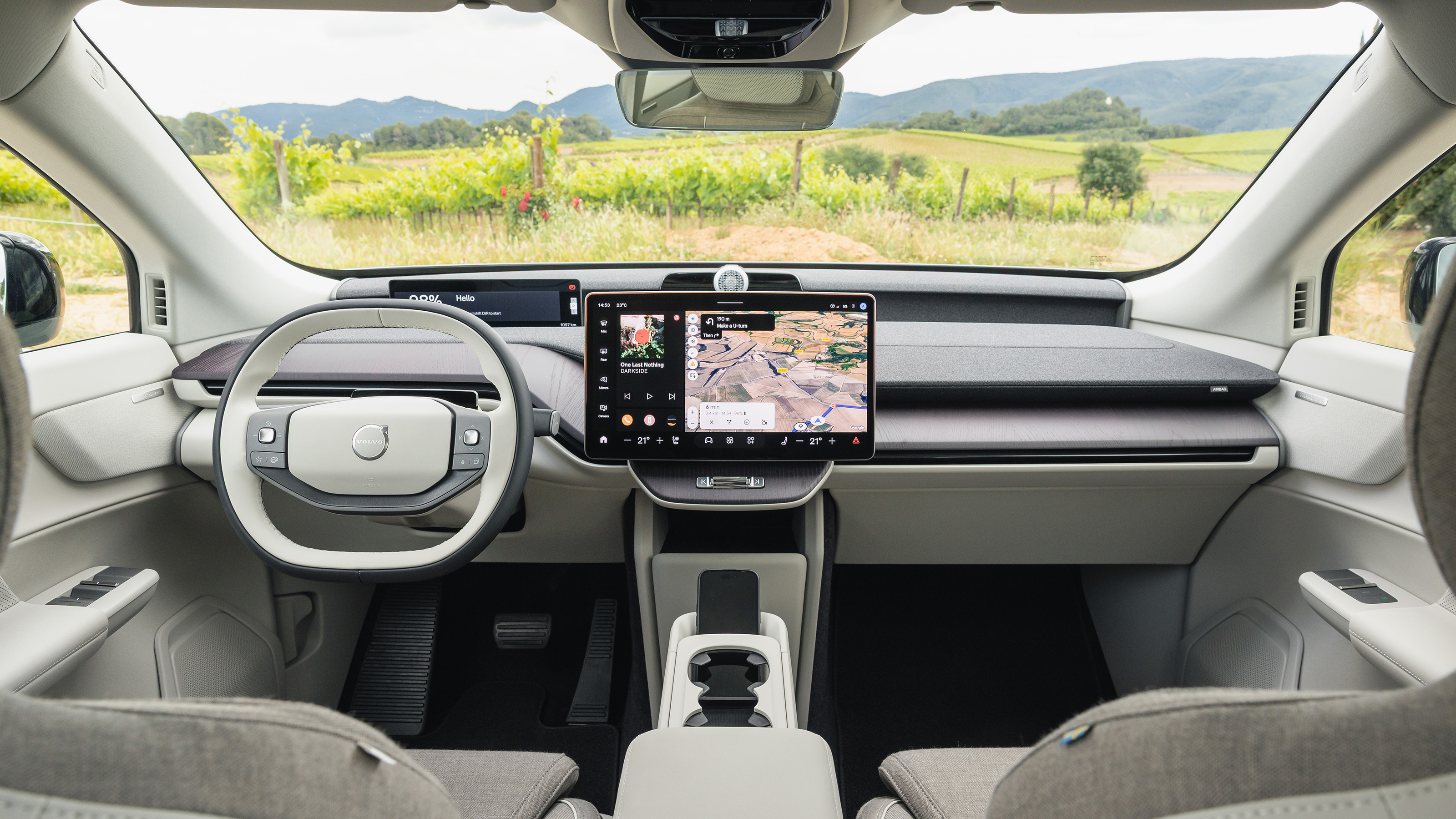
The EX60 aims for a restfulness that its rivals seem less bothered about. The materials inside are lovely, with recycled polyester across the top of the dashboard and a bio-attributed Nordico on the seats, door panels, and centre armrest. That’s a PVC with more recycled polyester behind it. There’s weathered ash or rubus fused reddish-toned wood.
You can upgrade from there to a perforated Nordico, a wool blend, or ethically sourced Nappa leather. And if the thought of besmirching your airy XE60 interior by introducing it to small children – the most imaginatively destructive force in the universe – there’s a charcoal alternative. Or cardamom. Light brown, basically.
Volvo is also big on ambient lighting, and there are six ‘themes’ to choose from. There’s illumination in the door pockets, panels, cupholders, centre console, and the luggage compartment. The LED tech minimises the blue to keep the colour as close to natural sunlight as possible. Less ocular fatigue that way. A new feature also throws dappled light across the interior.
An electrochromic panoramic roof is standard on the Ultra. You have to go into the main screen menu to activate it, which detracts ever so slightly from the well-being.
You sit high, the seats are terrific slim-line jobs, and everything is as soothing as a walk through a Swedish forest (one of the nice, non-horror movie ones). But it’s not perfect. As noted, Volvo has joined the band of car makers that has decided to reinvent the wheel. The effect is similar to the one Peugeot serves up with its ‘i-Cockpit’, reducing the wheel diameter for no apparent reason. It’s fully adjustable, of course, but it never quite seems to end up exactly where you’d like it.
There’s a sprinkling of buttons on the wheel with decent haptic feel. The door-trims are nicely sculpted, but their shape means it’s a little tricky to actually pull the door closed.
Infotainment is via a central 15.04in landscape touchscreen, although the driver gets a smaller 11.4in display for all the key read-outs directly in their line of sight. You sense that the UX designers might have preferred to eliminate this for absolute visual cleanliness, but we had no issues with it. It’s customisable to the point where you can minimise everything for zero distraction. The BMW iX3’s panoramic display is more interesting, but no more effective in reality.
The set-up is broadly similar to other Volvos, although there are subtle but meaningful graphic and HMI variations. A context bar on the driver’s side of the screen displays relevant functions – hazard warning, one-pedal drive and door mirror adjust among them. A little Volvo graphic on the lower icons display is the gateway to further screens.
There’s zero lag on any of this stuff, as you’d expect from the HuginCore system. A single core computer is now in command of the EX60; that means less complexity and wiring, faster response times, rapid OTA upgrades, and real-world data collection. Cripes. We remember when a radio/cassette player and central locking were key USPs.
The interior real estate is also different to other Volvo models, with a bespoke centre console and central storage bin rather than a glovebox ahead of the passenger. That opens with a cheap-feeling button, rather than via the touchscreen, as on other Volvos. Swings and roundabouts. There are two USB-C outlets in there, and a wireless charging pad above.
Volvo has been criticised for migrating key ergonomic functions to the main touchscreen, and the lack of physical controls for the seats, mirrors and steering wheel adjustment remains controversial. Volvo, remember, used to make its switchgear sufficiently chunky for users to operate its cars’ functions whilst wearing gloves. Gets chilly in Örnsköldsvik.
Most likely you’ll set everything up, save it in your profile, and never look at it again. Or you might be one of those drivers who likes tweaking their driving position and mirrors on the fly. Of course, it gets less annoying the more you use it. But we spotted a perfectly shaped space under the touchscreen for physical climate control switchgear, and reckon it might make a comeback.
As it is, the three-zone air con system is extremely clever, even if the graphics are a bit complex. The air vents are electronically controlled, and there’s also interior-sensing tech that can tell if no one is sitting in the front passenger seat. It saves energy. An air purification system saves people with hayfever (other allergies are available). The interior can be pre-conditioned via the inevitable Volvo Cars App. There’s also a heat pump as standard.
Although most of the cabin feels high quality, the texture of the plastics takes a downward turn the lower you go. The cupholders are stashed cleverly within the centre arm-rest but pop out with a surprising lack of finesse.
The EX60 comes with built-in Google services, including Google Assistant, Maps and Waze, the Google Play store, although Android Auto and Apple CarPlay are also standard. It also has 5G built in.
Oh yes. We need to talk about Google Gemini. In fact, we could talk to Gemini about Gemini, and indeed did end up having an existential debate with this AI assistant about the morality of LLMs ‘scraping’ the internet to feed the all-encompassing hive mind that’s going to ruin us all… but that’s a separate conversation. Honestly, it works brilliantly. It’s pretty much the talking car that Knight Rider promised us all those years ago.
The rear seats are power reclinable, and have a 40/20/40 split. There’s a substantial centre armrest here, too, with a couple of decent-sized cupholders. Integrated booster cushions are also available so that smaller children can get more comfortable. There are two USB-C charging ports.
With the rear seats up, there’s a maximum of 634 litres of storage space in the luggage compartment; folded away, you’ve got 1,647 litres to play with, although this is not a car for trips to the tip. There’s also a 63-litre underfloor storage compartment, and a waterproof bucket accessory. Car makers talk about ‘lifestyle’ products. In Sweden, they actually design and manufacture them. They’re outdoorsy folk. The frunk, meanwhile, can take 58 litres.
The Bowers & Wilkins audio system is a corker. There are 28 high performance speakers, double dome tweeters, and an overall output of 1,820W. After all those efforts to create a sanctuary and beat the NVH, this system brings the noise in spectacular fashion. You’ve got 3D surround sound here and Dolby Atmos, provided there’s access to Apple Music or a streaming service that supports fully immersive audio. There are speakers upfront, in the headrests, doors and in the roof. And a sub-woofer.
Get all the latest news, reviews and exclusives, direct to your inbox.
