OpinionTop Gear
Opinion: F1 going back to V8s makes the V6 hybrid era a complete waste of time
12 years after scrapping V8s, F1’s next step towards planet-friendly racing is… V8s. Why did we bother?
Commuting in the WFH era; any time you got up to watch Andy Murray in the Australian Open final; the finales of Lost and How I Met Your Mother and Game of Thrones. Yep, the category is Things That Made You Go ‘Well That Was a Waste of Time'.
According to reports, F1’s V6 hybrid era is about to spear head-first into that group. Not one full season into a new set of engine regs, the next set is on the cusp of being agreed, so hated are this year’s battery-limited cars which make going slower through fast corners – the very antithesis of the sport – the quickest way around a lap. Can someone fetch me the Sir Patrick Stewart facepalm meme?
Advertisement - Page continues below
The basics are thus: in 2030, F1 looks set to switch from today’s 1.6-litre turbo V6 hybrids with 53:47 ICE/EV energy split – a balance that was already being watered down for 2027 and beyond – to a 2.1-litre V8 turbo with much less hybrid power.
The V8 combustion element will generate about 780bhp, says BBC Sport, while the motor will chip in up to 270bhp for a peak of 1,050bhp in overtake mode and 900bhp otherwise.
It’s 2.1 litres because two extra cylinders can be bolted onto the existing engines to slash development costs; extra fuel will be needed, but that’ll be more than offset by a reduction in powertrain mass.
Interestingly – and in a crushing blow to rose-tinted spectacle wearers – the new V8s likely won’t be noisier. Sorry you lot: you might not like hearing it (and likely can’t anyway because of the tinnitus), but the modern F1 audience doesn’t like having its eardrums ground into a fine powder in the name of light Sunday entertainment.
Advertisement - Page continues below
Anyway. All of which raises the question: was the V6 turbo hybrid the biggest waste of time of the modern era?
If the mainstream media (or as I call it, ‘the media’) is to be believed, Prime Minister Andy Burnham is eyeing up a future return to the EU, and the reversal of Brexit – regardless of your political persuasion – will surely raise the Why-Did-We-Bother bar to unprecedented heights, as it dawns on the nation that it spaffed away a decade of Parliamentary debate so it could spend the next decade in longer airport queues.
Until then though, it’s the V6s that take the spoils. Back in 2014, the V6 turbo hybrid was the next big thing in F1’s glorious green future: “Look, we’ve made the most thermally efficient engine in the world! Greenpeace loves us now!” a spokesperson didn’t say at the time, but would’ve done if they’d been allowed a sense of humour.
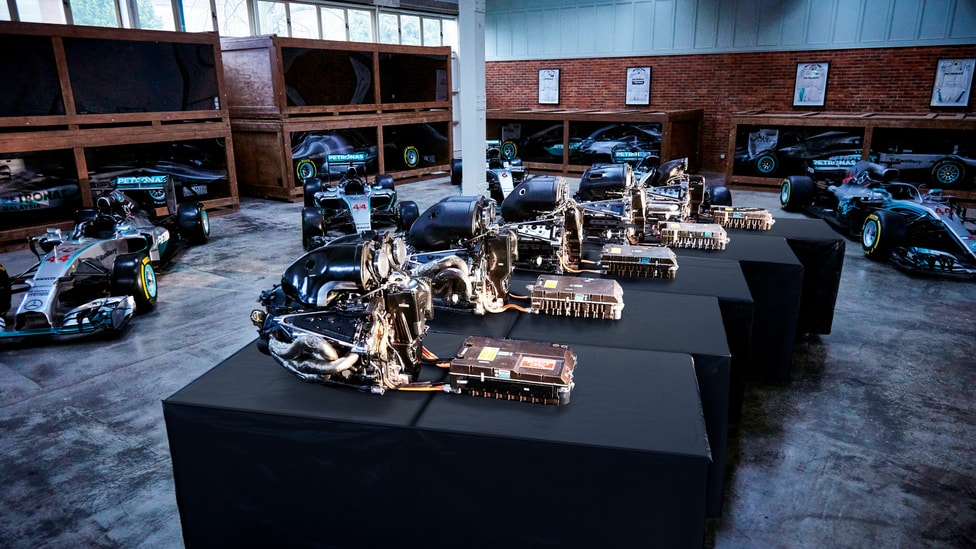
Billions invested by Mercedes, Ferrari, Renault and Honda, and a corporate message of climate responsibility rammed so forcefully down our throats that it would constitute a form of torture too far for some of the states F1 likes racing in. All was well.
Top Gear
Newsletter
Get all the latest news, reviews and exclusives, direct to your inbox.
Then in 2021 came cleaner, greener E10 fuels and all was even more well. And then this year the sport adopted a fully sustainable fuel made from carbon capture, biomass, and municipal waste, and F1 unlocked the right to trot about the globe guilt-free forever more. What do the supertankers, cargo planes, and Europe’s dozens of massive diesel lorries matter when Kimi Antonelli’s Monza heroics are powered by bin juice?
This is the straw that’s broken the camel’s back. F1 has a net-zero carbon footprint target to meet in 2030, but as far as the cars go synthetic fuels mean it can basically do what it likes. Fuel efficiency now only matters as an issue of car weight, not road relevancy. Burn baby, burn!
Which makes you wonder why F1 – by which I mean the teams, the FIA, the commercial rights holder, and official ‘Friend of F1’ Jack Whitehall whose merit to or purpose of that title escapes me – didn’t have this epiphany before it committed to the V6 turbo 2.0. In the build-up to the Australian Grand Prix back in March, we were encouraged to give the regulations time to bed in, as though the fundamental flaw behind the energy balance was going to be solved by a simple code change on a laptop betwixt games of Minesweeper.
But at Silverstone in July I was chatting to (and I’m about to break my own rule about name-dropping, so… cringe alert) 1995 British GP winner Johnny Herbert, and being a former driver and occasional steward and therefore a man in the know, he told me: “They did know two years ago that it was not gonna work.” Great. Well done everyone, good process. Thanks for the Madring.
The reason we ended up here, and didn’t just cut straight to V8s – or as democracy-lover Mohammed Bin Sulayem wanted, naturally aspirated V10s – is, of course, politics. The whole point of changing the rules was to attract new engine manufacturers. It worked: in came Audi (on its own) and Ford (with Red Bull), and Honda made yet another screeching u-turn on its exit. Cadillac will build its own engine when the 2030 rules come into play.
But the price paid for having six engine makers in F1 is that they could only agree on a formula that sucks. The old MGU-H – the complicated tech that recycled heat from the turbo – was jettisoned because newbies couldn’t hope to compete with established players.
Dual-axle brake regen would’ve helped with the energy loss from that, but it was deemed unpalatable because Audi mastered it in WEC. So instead we got single axle recovery only. And the battery couldn’t be huge, because batteries add weight. And heavy F1 cars are dangerous. The answer? Lift and coast. Or as Fernando Alonso calls it, the battery world championship. The pinnacle of e-motor sport.
So here we all are, retracing our steps back to 2013 minus about 300cc and only a motor to show for our troubles. But look on the bright side: some of those seasons were competitive! And the polar bears are still with us! And, um, ‘GP2 engine!’ was good telly.
Sigh. It wasn’t worth it, was it?