




Car Review
Ferrari 849 Testarossa review
Advertisement
“Ferrari’s replacement for the SF90 Stradale is faster, more agile and more fluid. Is that enough to carry that iconic name?”
Good stuff
Staggering performance, high-quality dynamics, realises the potential of Ferrari’s PHEV twin-turbocharged V8 platform
Bad stuff
Divisive looks, engine is less special than 296 GTB’s V6
Overview
What is it?
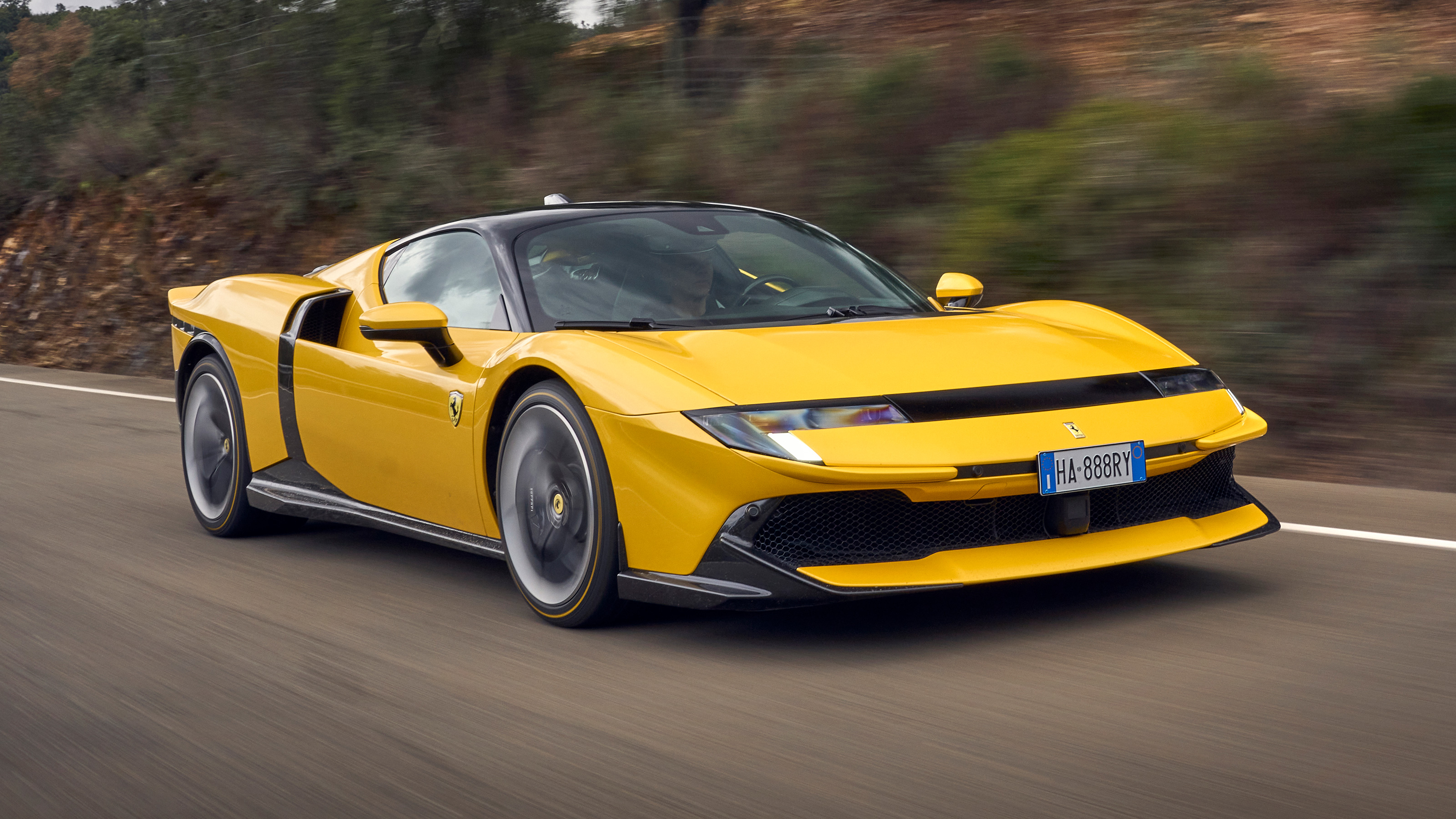
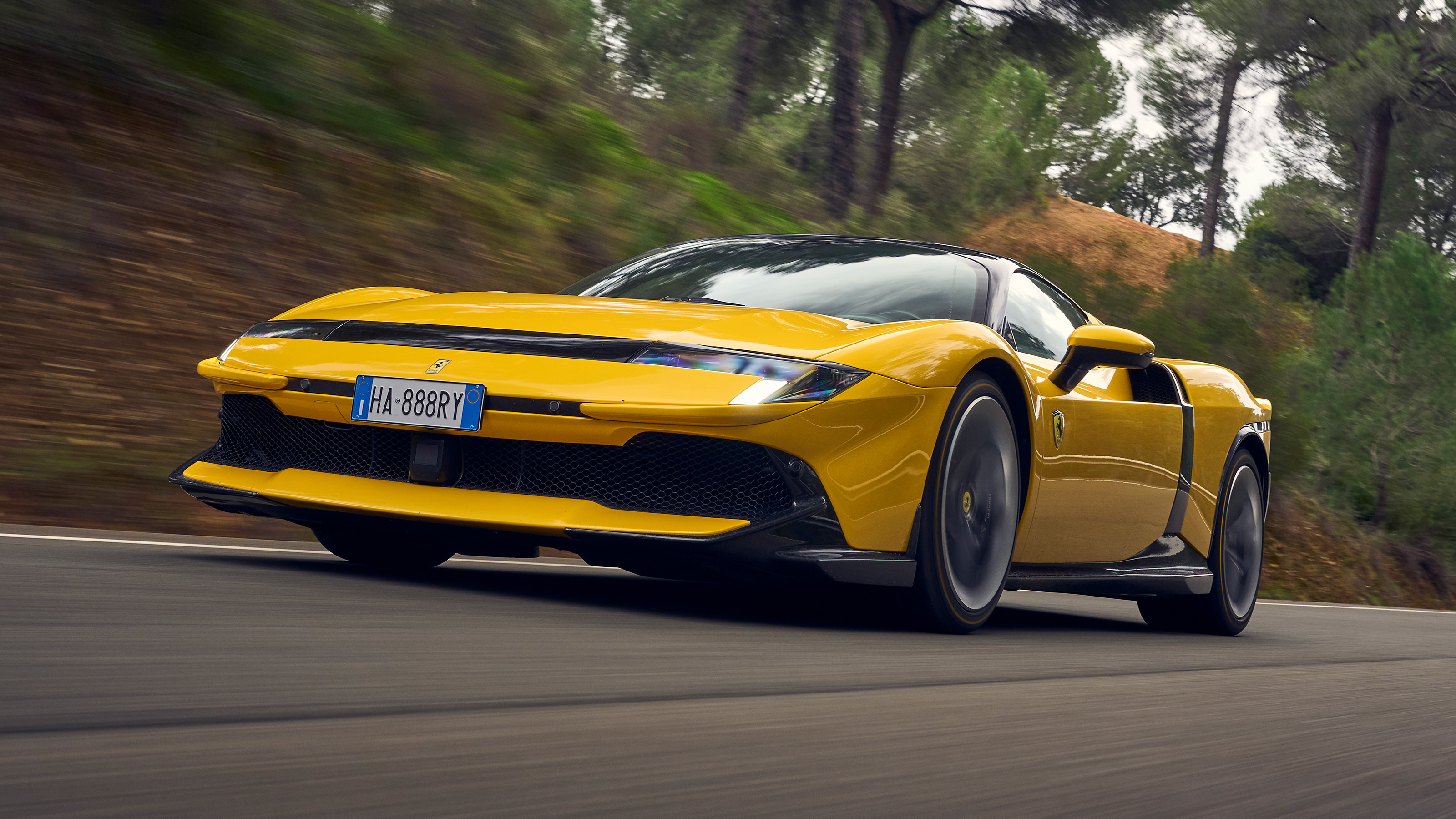
Well, it’s another controversial Ferrari, that’s for sure. Chief Design Officer Flavio Manzoni is pushing forward his bold new styling themes for Ferrari with relentless energy. So much so that the 849 Testarossa’s launch was met with mild bemusement at the name (seeing as it doesn’t appear to have too much in common with the Testarossa most people know and idolise) and then a lot of regret that Pininfarina is no longer in charge of the colouring-in at Maranello.
Beneath the skin, though, it’s very clearly an SF90 Stradale replacement that’s been uprated, refined and given a much bolder, more aggressive identity to separate it from the smaller, simpler and cheaper 296 models. The headlines are a jump in total power output from 987bhp to 1036bhp, an increase in downforce to 415kg at 155mph (with the £42,115 Assetto Fiorano package) and a complete dynamic make-over from chassis and brakes to the engine itself.
Advertisement - Page continues below
Ferrari claims the 849 Testarossa can reach over 205mph, cover 0-62mph in under 2.3 seconds and that it laps Fiorano in 1:17.5s – that’s 1.5-seconds faster than the SF90 Stradale and just two-tenths shy of the extreme SF90 XX. The coupé costs from £407,617, with Spider prices starting at £442,467.
Is it really that different from the SF90 Stradale?
The mechanical layout is identical. That means a 4.0-litre twin-turbocharged V8 supplemented by an electric motor in the eight-speed dual-clutch transmission and a further two for the front axle. In simple terms the latter allow for true torque-vectoring and aid traction, whilst the former helps with torque fill and superpowers the already pretty intense combustion engine.
The 849 now has the biggest turbochargers ever fitted to a Ferrari production road car and the 4.0-litre engine is vastly changed, with a new block, new heads, lighter cams, titanium fixings used throughout, much better cooling and a very trick fully Inconel exhaust system. It produces 819bhp at 7,500rpm and 620lb ft at 6,500rpm all on its own. Should that sound too scary, you can always opt for eDrive mode and enjoy a front-wheel drive EV Ferrari for 25km of near silent progress.
And the aero?
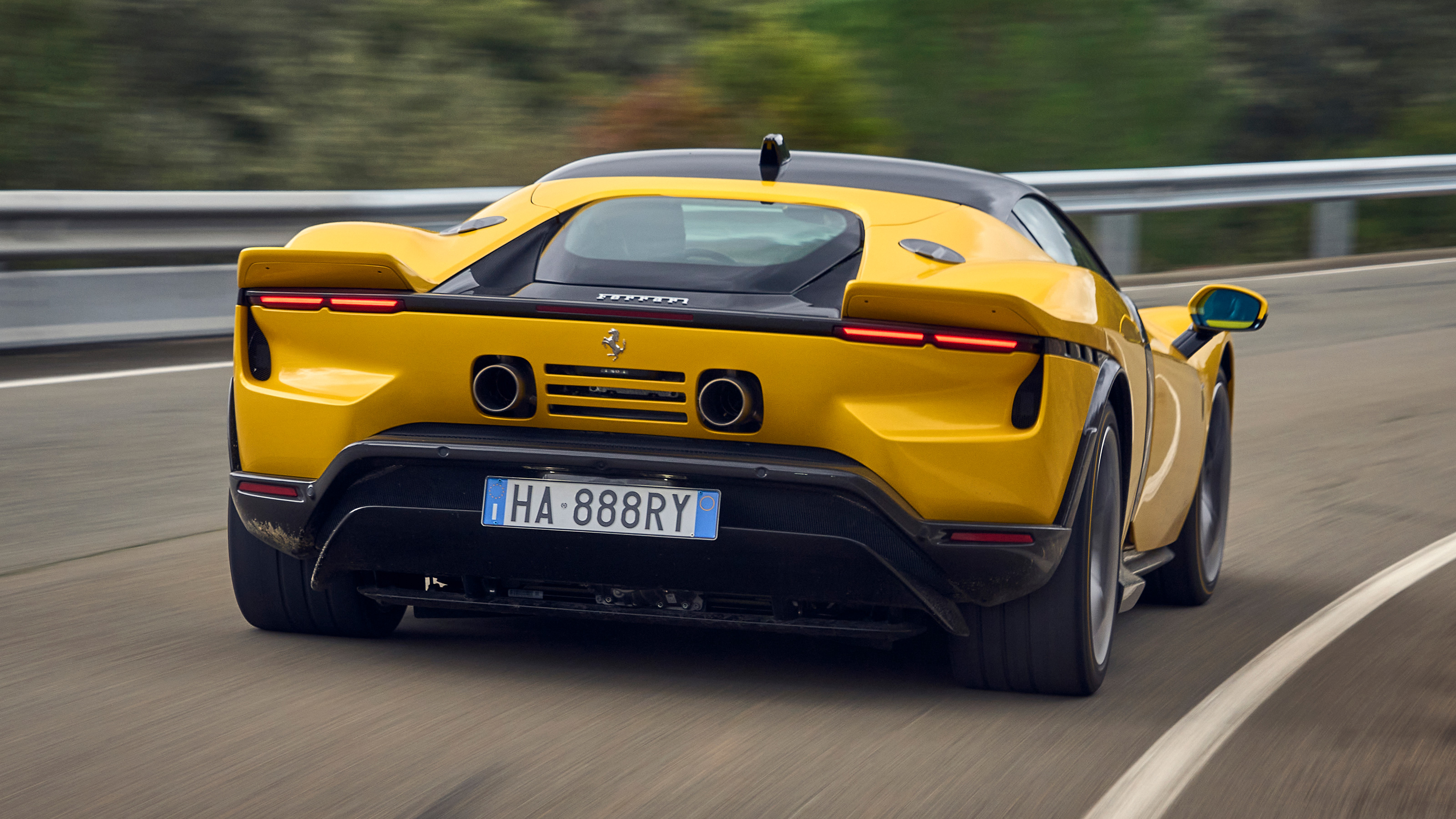
In terms of aerodynamics the Testarossa is inspired by the 512 S and 512 M prototype racers of the late ‘60s and early ‘70s. Hence the distinctive ‘twin tail’ design, which Ferrari upgrades to ‘twin wing’ should you opt for the Assetto Fiorano package. There’s an active element between the two small flicks that can add 100kg of downforce when in its highest position.
Advertisement - Page continues below
The front underfloor has been completely redesigned and features three pairs of vortex generators, plus Ferrari really shapes and works the air to feed the underbody in the first place (as well as the intercoolers with that distinctive, vertical side intake). The rear features a multi-level diffuser with more vortex generators and whilst it’s no more powerful than that fitted to the SF90, it produces its downforce with a 10 per cent reduction in drag.
The suspension changes are just as significant and whilst Ferrari provides numbers for context – for example a three per cent increase in lateral grip, 10 per cent increase in roll stiffness, 35 per cent lighter springs – they’re also keen to point out that driving excitement and fun were key parameters. As ever, the suite of sophisticated tools used to create the dynamic identity is mind-scrambling and is now manipulated by the Ferrari Integrated Vehicle Estimator (FIVE) system.
Now, we could explain this system but a direct quote from Ferrari’s literature might be useful here. Ready? Okay: ‘FIVE is an estimation system capable of creating a digital twin that replicates the behaviour of the car in real time, based on a simplified mathematical model powered by real measurements (acceleration, 6D sensor).
‘FIVE accurately estimates performance characteristics that cannot be directly measured, such as speed (with a margin of error of less than 1 km/h) and yaw angle (margin of less than 1°) of the vehicle, improving traction control, electronic differential management and e4WD system delivery. These estimates feed into all vehicle dynamics controls, making the response more precise and repeatable.’
Crikey. It sounds heinously complex?
It is heinously complex, but Ferrari has an incredible ability to turn information and sophisticated chassis controls into a transparent and intuitive driving experience. The new Testarossa is no exception. Yes, there’s Side Slip Control buffing away your sharp-edged inputs, ABS Evo working its magic to provide ultimate stability and 6D sensors feeding back all sorts of information. But given an empty racetrack and Ferrari’s latest PHEV, you’ll just feel and enjoy an incredibly precise, shockingly fast and stunningly well-balanced supercar at the height of its powers. It’s seamless despite the savagery of the performance and breeds instant and assured confidence.
Special mention should go to the programming for the e4WD system. The SF90 sometimes displayed some odd behaviour at the limit and the front axle’s actuation seemed a bit inconsistent and very obvious. For the most part that’s eradicated in the Testarossa. Go for a quick lap and the car just feels extremely stable and secure but still displays plenty of adjustability. It still has well over 800bhp going to the rear wheels, so oversteer is there for the taking but the balance is very good indeed and such is the communication through the chassis that it’s never a surprise.
What's the verdict?
“The massively powerful engine feels lacking in character and spine-tingling excitement”
The 849 Testarossa is a remarkable car and feels like a leap forward from the SF90 Stradale. We thoroughly enjoyed it on road and track and it’s very hard to fault the optimisation of this complex platform and powertrain. Ferrari really does create scintillating cars that offer you incredibly thrilling yet easy access to captivating performance. In that sense, it’s a triumph.
Yet, the massively powerful engine feels lacking in character and spine-tingling excitement when you consider the price point and hence one huge part of any Ferrari’s appeal seems to be missing. Furthermore, the 296 GTB seems to undermine the 849 Testarossa in many ways. It’s lighter, offers more ‘purity’ due to its rear-drive configuration, feels every bit as sharp and connected and is so fast that the Testarossa’s power-to-weight advantage seems vaguely irrelevant.
The fact it has a sweeter but equally savage engine is the killer blow. At the other end of the scale there’s the incredibly impressive Lamborghini Revuelto with an old-school V12 and, finally, the dynamic capability to stand toe-to-toe with Ferrari…
The Rivals
Trending this week
- Car Review
Toyota bZ4X Touring