
25



264 miles
84kWh
641bhp
3.4s
0g/km
164Mph
Not yet. And clearly your playground trading card knowledge has gone all fuzzy because you’re thinking of Magmar – careful now, millennial brain fog is real.
Going off on a tangent is actually an apt way to start here: Genesis’ schtick is meant to be luxury but Magma is its new performance arm, ushered unto the world by means of the single weirdest Le Mans Hypercar entry of 2026 plus some admittedly epic-looking concepts, like the 3.2-litre V8 GT and 3.5-litre V6 G90 Wingback estate.
The name is a nod to the ‘volcanic origins of the Korean peninsula’, and whatever you think of an opulent car brand branching out into so-called performance models, naming it after *checks notes* molten rock is undeniably very cool. You can almost feel the heat of the lava.
Why indeed. BMW has the M division, Mercedes has AMG and Audi has the RS badge, but those are massive firms with massive remits; Bentley has dabbled with the Supersports and Rolls-Royce has its Black Badge line, but neither are exactly hardcore. The closest precedent on paper looks like Lexus and the cult classic LFA. Except there’s no V10 in sight here.
Meanwhile the GMR-001 finished a lowly 13th at Le Mans, so it’s hard to think of that as a serious racing enterprise and not a cynical, 200mph billboard.
But to understand Magma, you first need to understand the mothership: Genesis is for customers who’ve outgrown the Hyundai product ladder and want something… more. It’s also for people who feel like a number in the Germans’ algorithms: Genesis wants to know its buyers by name the moment they walk into the dealership, fresh cuppa in one hand and brochure in the other.
And Magma is what happens when you expand your definition of luxury to include more than posh seats and cushy suspension. Luxury is pummelling an X3 at the lights; luxury is turning heads outside the clubhouse with a bright orange spoiler; luxury is making friends and family squeal involuntary swear words on an open B-road. Hence the box of tricks.
Oh yes. Nothing you’ve not seen before – the GV60 Magma and its tech are based on the caged animal that is the Ioniq 5 N – but most of them have been Genesised to distance the car from the Hyundai and Kia’s copy-and-paste GT line-up.
Magma is what happens when you expand your definition of luxury to include more than posh seats and cushy suspension
Get all the latest news, reviews and exclusives, direct to your inbox.
So there’s a virtual gearbox that simulates an eight-speed DCT, with ratios exclusive to the Magma; active sound design that mimics a V6 revving to 9,000rpm; an electronic limited-slip diff that enables a Drift Mode; GT and Sprint modes, the latter of which puts the steering, suspension, motor and e-LSD in their most aggressive settings, and a Boost button that unlocks full power in bursts of 15 seconds.
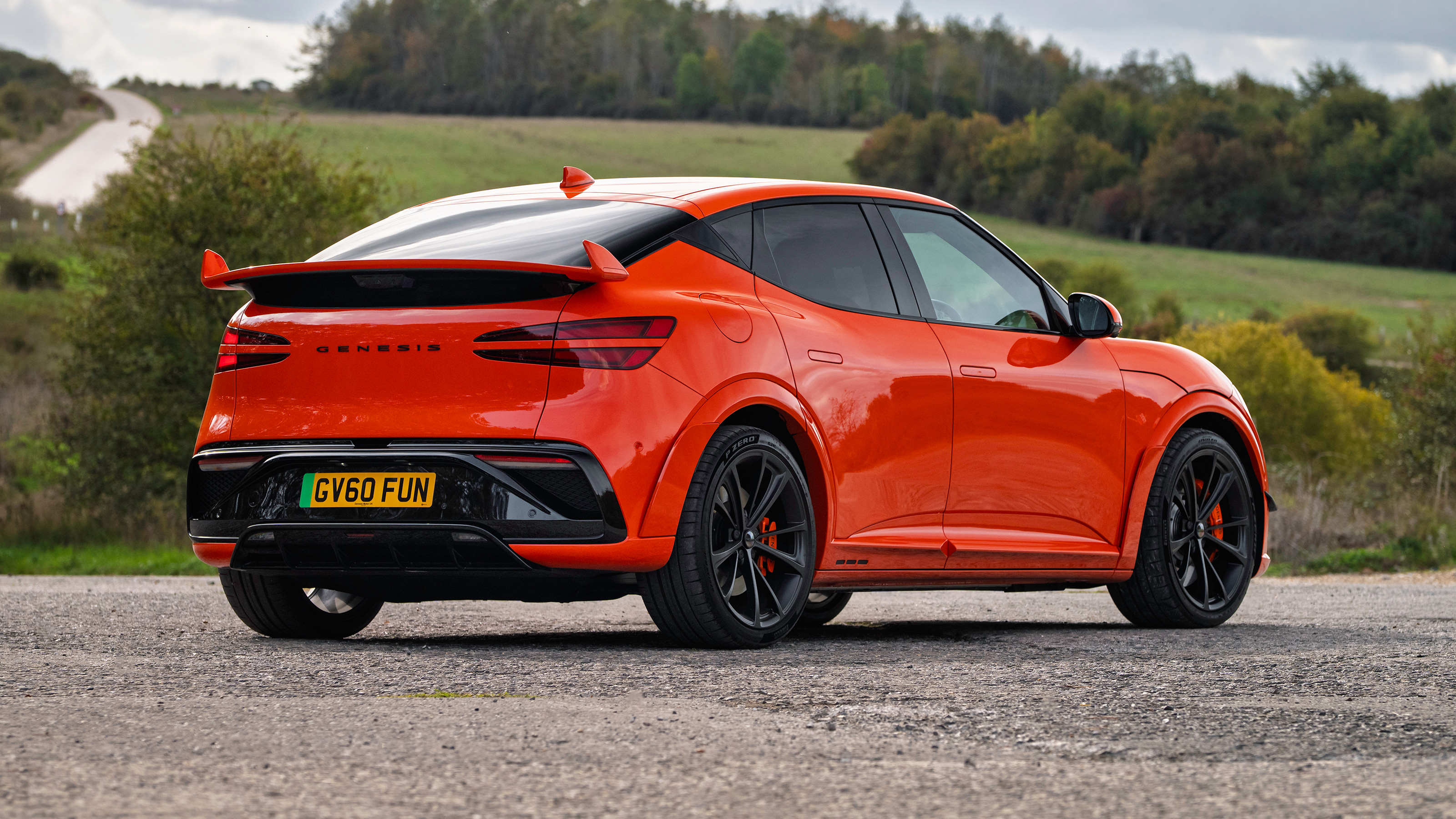
Ride height has fallen by 20mm over the standard GV60 and the track width is up by 10mm, with the Magma’s 21in wheels shod in grippy Pirelli PZ5s. The chassis and suspension setup are both bespoke, with the geometry of the latter revised for performance.
Chunky monobloc brake calipers (always orange, regardless of what paint you choose) cling on to 400mm front discs and 360mm rears; 62-0mph in 33.8m is the claim, with regen off both axles to combat brake fade. Naturally all that was honed at the Nurburgring. Where else?
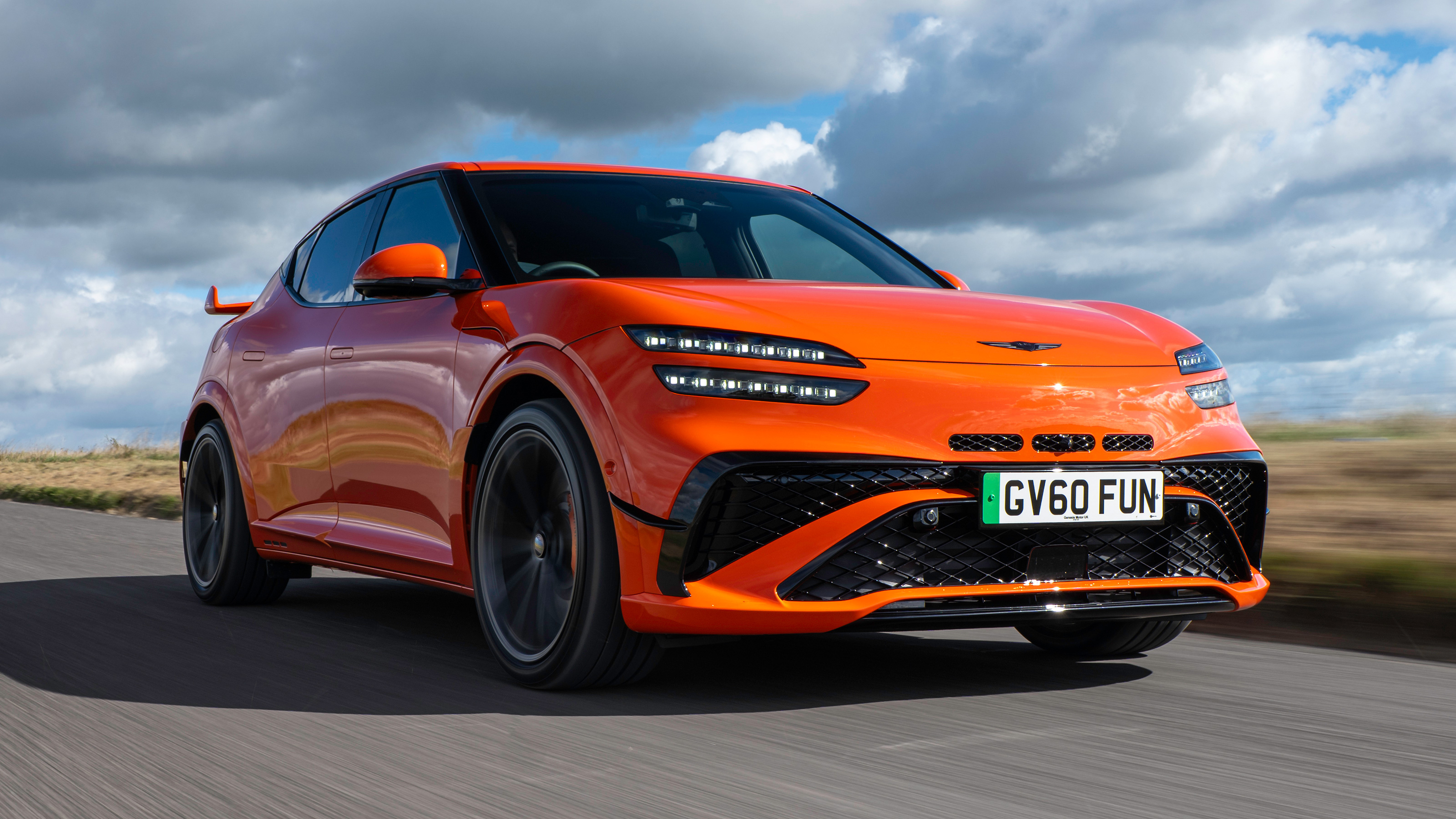
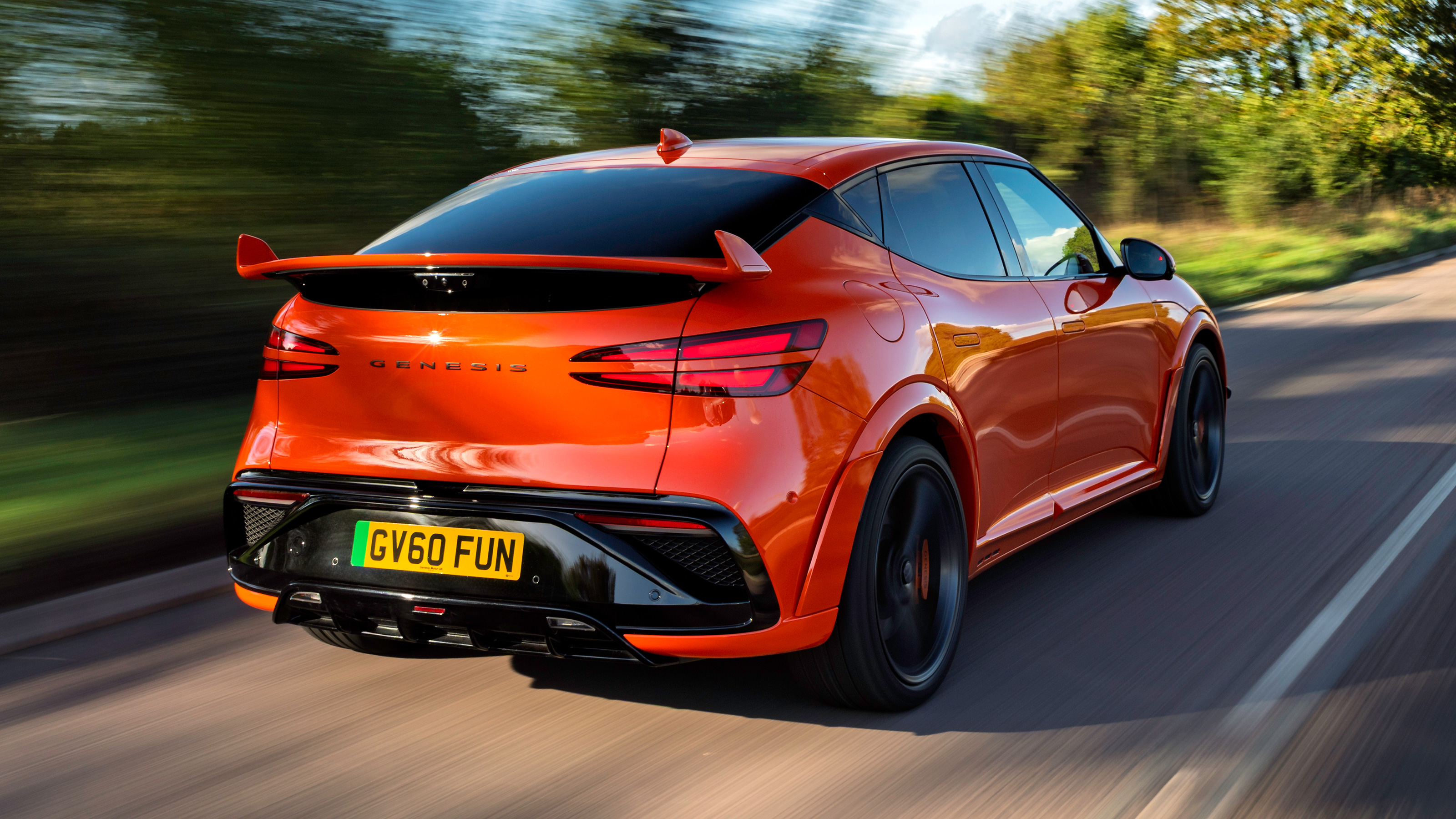
The front end is new, with improved cooling and what looks like the makings of a twirly moustache on either side of the grille. Genesis says ‘a lot of the aero is functional’, which suggests some of it isn’t. But that rear wing adds downforce.
Inside you get bucket seats, faux-suede seats, black aluminium switchgear, a Magma-fied digital interface with gauges for battery temperature and G-force, plus aluminium pedals. You won’t find Magma badges anywhere; ‘subtle silence’ and ‘modesty’ are the key buzzwords here. Reminder: it’s bright orange. Ahem.
Then there’s the powertrain: it’s an 800V dual-motor job with all-wheel drive, generating 641bhp and 583lb ft combined on boost; launch control will slingshot you from rest to 62mph in 3.4 seconds, to 124mph in 10.9s, and max out at 164mph. Pretty nippy then. Torque vectoring can shift up to 65 per cent of the oomph to either axle.
The battery is 84kWh gross, and DC charging peaks at 264kW for a theoretical 10-80 per cent blitz in 18 minutes. Claimed range is 264 miles WLTP – actually pretty meagre given the size of the pack. Sustained exuberant driving (well, that is the point of it) suggests the reality is even bleaker – think 200 miles in mild temps and even less in single digits.
Not so fast. I was as sceptical as you heading into the test drive, but after a few minutes on a clear, twisty road things started – and as a lightweight devotee, I’m reluctant to write this – to make sense.
First it draws you in with the fake engine sound: in contrast to the 5 N’s sci-fi soundtrack, the Magma plays a V6 anthem that, despite being entirely synthetic, is at least grounded in something real. At max volume it’s surprisingly engrossing, and the rise and fall of the pitch acts as an information stream to help your brain compute your use of the throttle. Handy.
It’ll ‘rev’ to 9,000rpm, an arbitrary figure chosen because it feels right, says Genesis. The motors actually spin up to 20,920rpm; more than F1’s scariest mid-Noughties V8s. Now there’s an idea for the future.
Then you start to tap away at the Virtual Gear Shift, operable via the paddles behind the steering wheel. This too feeds into the experience in a way that’s not purely superficial, as it is with, say, the Honda Prelude’s S+ Shift system. Here you get a limiter that demands an upshift for further acceleration, and downshifts introduce mild ‘engine braking’. Though of course it’s regen in disguise. Instead of having to count your way through the ratios, they’re sensibly placed in the middle of the driver’s display. Are you listening, Kia?
And then you start to chuck it around. Cor. The acceleration is one thing – all that torque means you’re hurled towards the national speed limit like someone’s lit a fuse underneath Krakatoa – but what’s really impressive is how well the Magma grips through turns. Those beefy 275/35 P Zero 5s shepherd the mass with astonishing dexterity, never allowing that 2,240kg of heft to have authority over the driving experience.
All that torque means you’re hurled towards the national speed limit like someone’s lit a fuse underneath Krakatoa
Let’s not over-egg it: the GV60 isn’t the most precise thing I’ve ever driven and never could be. But it makes up for that through the immediacy of its responses, and the level of trust you can put in it even when the weather gets gnarly.
Now someone bring me an A110 so I can cleanse myself. Please.
Of course not. The brake pedal is a bit soft for a ‘performance’ car, though the brakes themselves – the same size as those on the 5 N – generate more than enough stopping power for regulation speeds. Also, it has the turning circle of a sperm whale, and for all the laudable switchgear in the cabin it’s still heavily reliant on the touchscreen. Which at one point appeared to struggle rendering Android Auto, and bizarrely is home to the on/off toggle for the VGS. Several menus deep, obviously. Why is a defining feature hidden away like gold bullion?
The main shortcoming is the ride: it’s punishing at lower speeds, especially if you’re sat in the back. In 20 minutes it set my watch off for hitting my steps goal for the day. Genesis says several components have been revised over standard GV60 – including the lower arms, hub carriers and link structures – and the existence of the ‘Comfort’ mode suggests the electronic control will soften everything off to the point you’ll forget this isn’t a regular GV60. But even that shudders along urban roads like a horse-drawn cart. Without the smell of faeces, at least.
Oh, and one final thing: it’s £75,100.
Quite. The Lord made the world in six days and on the seventh He was getting over that asking price. Seventy five grand?! That’s biblical. £15k more than the Kia EV6 GT; £10k more than the Ioniq 5 N, both of which have the same power; it’s six more than the Alpine A390 GTS. Only the Porsche Macan makes you look at the Magma like Genesis isn’t breaking a secret, eleventh Commandment: thou shall not take the mick.
It suggests Genesis hasn’t fully worked out what Magma is for yet. It bills it as its ‘alter ego’ and charges accordingly for it, but by sailing the GV60 out into uncharted waters it’s lost sight of the mainland: can you really tell those who came for plushness that they’ll stay for… debilitating suspension?
Remixing N division tech was the easy bit. Putting a truly unique spin on it, that’s the hard part.
Get all the latest news, reviews and exclusives, direct to your inbox.
