


25
It's familiar to start with. It has that in common with the bodywork. The rhythms and tones are similar, I recognise the throb and churn. But there’s a point, a moment when that changes, when I realise just how different things are now, how fundamental the shift in philosophy. From what I can see, looking across from the passenger seat, it’s about 3,000rpm. That’s where this Bugatti separates from everything that’s gone before, taking off on an entirely different trajectory.
“It’s cool, no?” shouts my driver. I look across at Mate Rimac, grinning from behind the steering wheel as the engine runs down and our eardrums recover. Yeah, Mate, it’s pretty cool. No, scratch that, it’s ******* insane.
Sorry. I’ve never experienced anything like this V16. It has such intensity, such ferocity that it changes not only the car’s character, but Bugatti’s whole trajectory. We’d got used to Bugattis having that enormous blown quad turbo W16, a mammoth motor that sat heavily in the car and needed to be fed enormous quantities of air and fuel before it got up and started swinging. It was a giant in every way. Now the powerlifter has been exchanged for a track athlete. Less outright power maybe, but more explosive, quicker reactions, higher limits. Forget about hybrid for the time being. Its presence here is limited. And optional (potentially in more ways than one).
Photography: Mark Riccioni
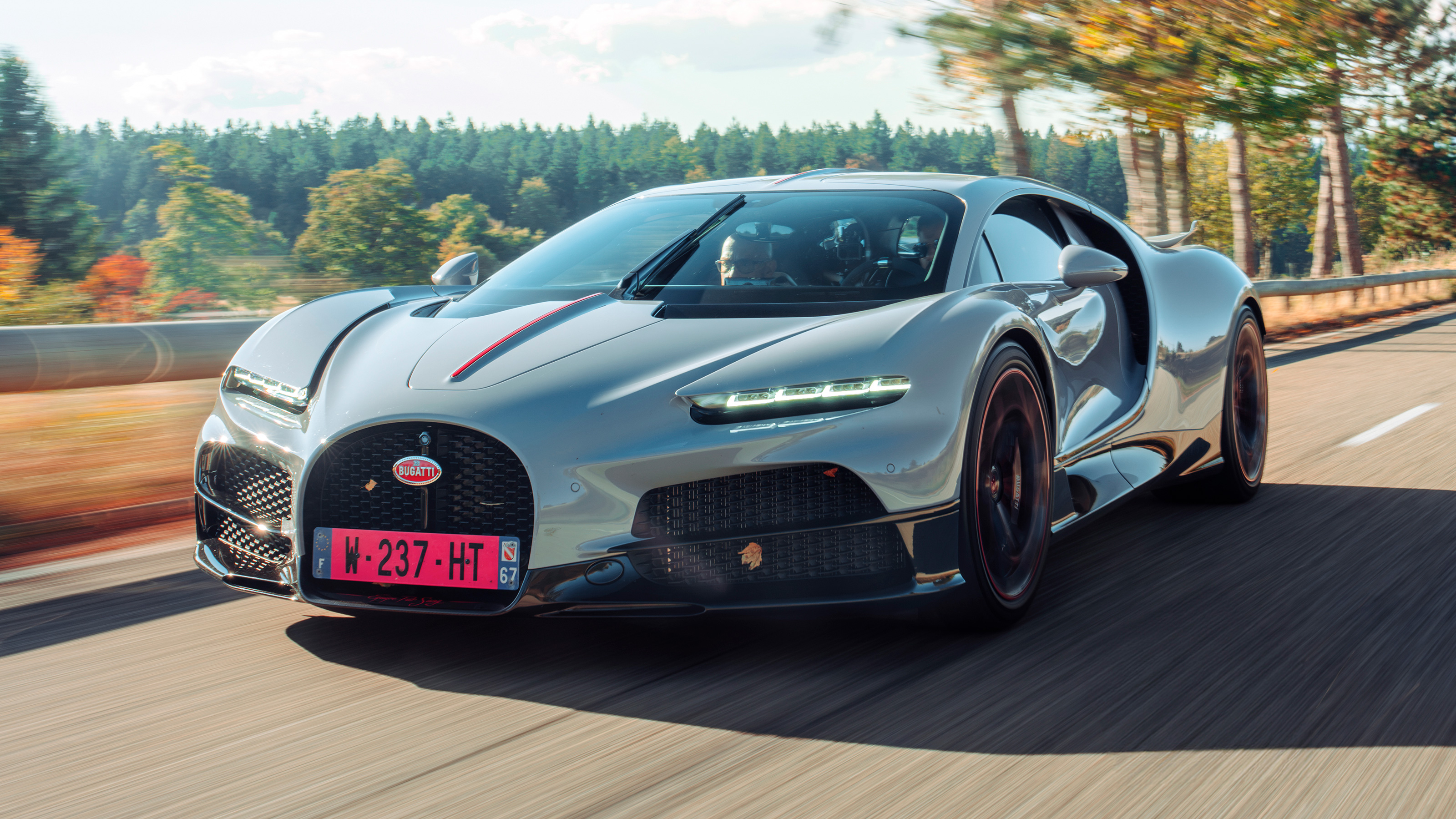
The Tourbillon is an entirely different character from the Chiron. Given that, I was surprised at how similar they looked. The Veyron and Chiron seemed styled around the wide, stubby W16, the skin reflecting what was contained within. Maybe it’s because the Bugatti signatures are so strong – the horseshoe grille, the C-surround, the open to the air engine bay – that it didn’t come across to me that the design had progressed that much. And particularly that it hadn’t adapted to reflect the engine that now lurked in the engine bay.
There is something sparer about the design, harder and more bony. That at least reflects the fact it is – as Mate is clearly proud of, and is potentially unique in the car industry – a hybrid that is lighter than the combustion car it replaces (here’s a fascinating fact: the V16, plus twin clutch gearbox, plus electric motor all put together are the same weight – about 430kg – as the W16 alone). But the decision was taken that the design ethos shouldn’t be adapted to reflect the longer, more slender engine.
A V16 with a crankshaft a metre long. 8,355cc. Four separate intakes. 986bhp and 664lb ft. It could have made more. Maybe one day it will. Mate tells the tale of phoning up Bruce Wood at Cosworth (this was before he’d taken control of Bugatti) and asking about the possibility of a V16 and Wood, after he’d got over the shock of being phoned by the ‘electric car guy’ as Mate described himself, trying to dissuade him, telling him they could make the power requirements with a V10 or V12. But of course it had to be a V16. So by the wild standards of these exotic naturally aspirated engines it’s not ridiculously stressed, developing 120bhp per litre, where the higher revving T.50 and Valkyrie are both well over 150bhp per litre.
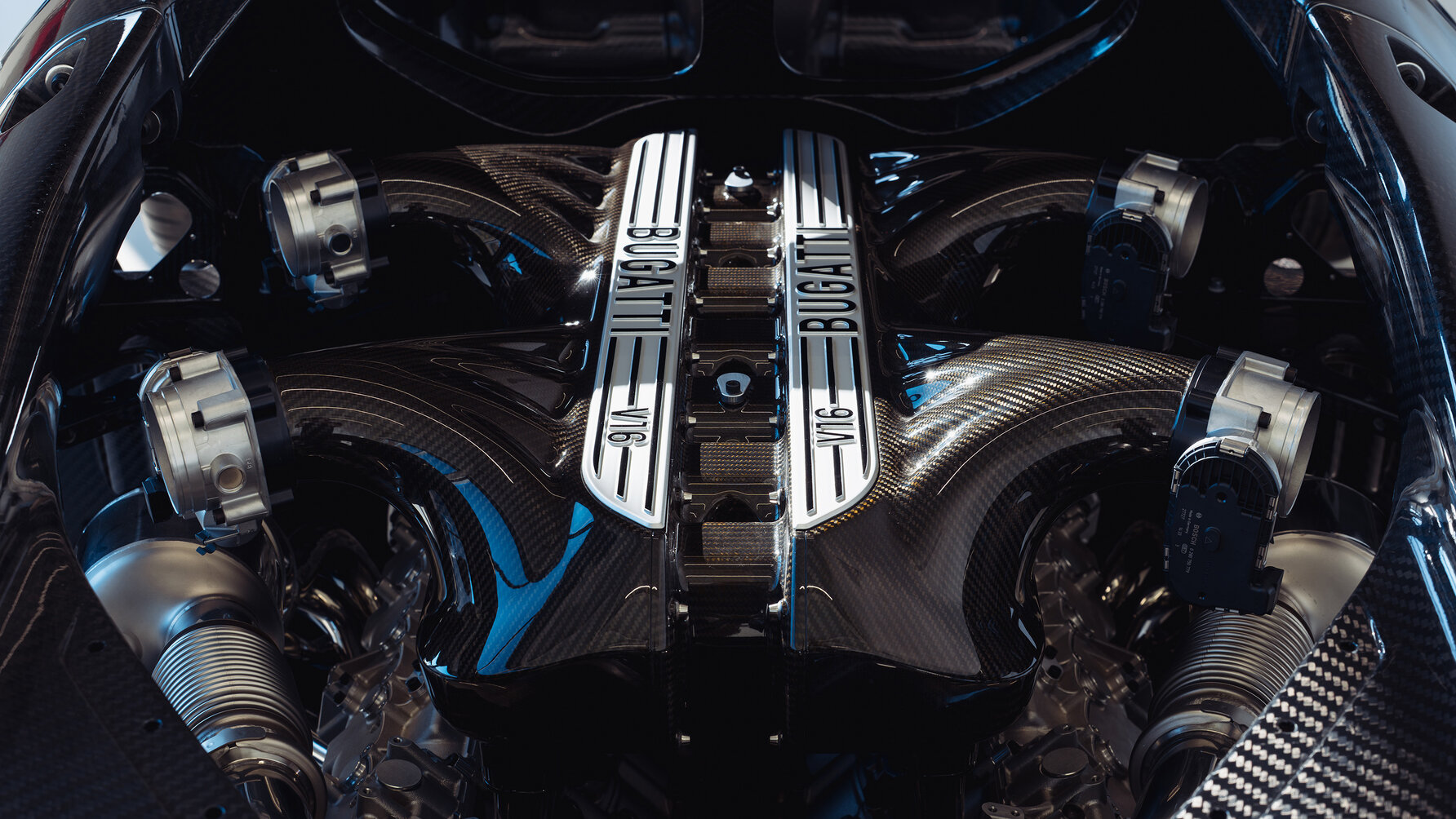
A few firms have used them, including Cadillac, Marmon and Maserati, but this is going back 100 years. A couple of prototypes and concepts have appeared more recently (Cadillac again with the Sixteen in 2003, and BMW’s 1987 Goldfisch E32 7-Series prototype), but as far as production goes, it’s just this and the 1991 Cizeta-Moroder V16T – which went one step further in the craziness stakes by choosing to put the engine in the car cross-ways.
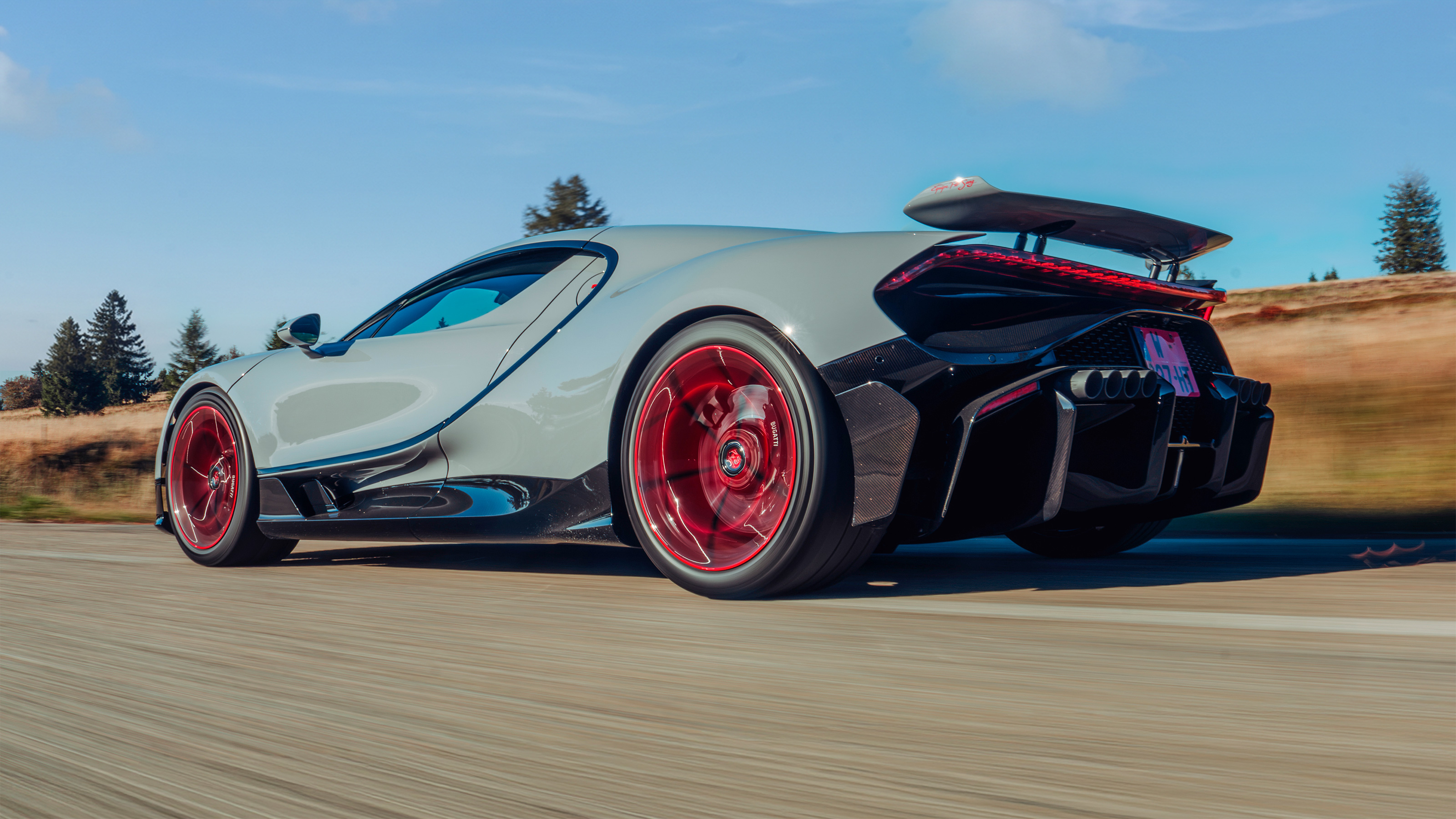
Bugatti has rightly mounted Cosworth’s V16 as the centrepiece but it doesn’t especially dominate the back of the car. Largely this is because of its position, so far forward that the first two cylinders are hard up against the bulkhead, just a handspan from the occupants shoulders. All about getting the masses as centralised as possible within the wheelbase. The gearbox used to sit in front, forcing the passengers to sit further apart. Now it’s at the back, with an electric motor slung on the side. A slimmer transmission tunnel means the passengers can sit closer together, means the glasshouse can be narrower, means the frontal area is lower, means the aerodynamics are better. It’s stuffed full of 25kWh of Rimac batteries to feed the three electric motors, with one each for the front wheels.
Essentially Bugatti has removed four turbos and replaced them with three electric motors. This is seen as controversial, but I’d take the motors over the turbos any day. Zero lag, instant max torque etc. The trouble is, as Mate points out, most firms have used the addition of electric motors to permit the subtraction of engine capacity (see most current Ferraris and McLarens for evidence). Not here. There’s not another hybrid I can think of that allows you to switch the electric power off completely and just enjoy the engine. Here you can.
Get all the latest news, reviews and exclusives, direct to your inbox.
That’s a question doing the rounds at Bugatti right now given hypercar customers seem fixated on mechanisation as the future in direct contrast to the wider car industry. A host of reasons I suspect: the right thing to do at the time development started, pushing new tech in all areas, performance benefits, making the link into Rimac and so on. But over lunch (four courses obvs) at Bugatti’s Molsheim HQ, some intrigues emerge. Ears prick up when I tell people I’ve recently driven Ferrari’s Dodici Cilindri Manuale, they start asking questions about the GMA T.50, then talk turns to Bugatti’s history and roots in lightweight cars back when Ettore referred to Bentleys as “the world’s fastest lorries”.
The thing with Mate’s dreams is that they often seem to become reality…
Clearly, plans are afoot for what happens after the initial 250 Tourbillons have been built. Inevitably there will be a roadster, but what after that? A nat-asp V16 in a lightweight chassis with a manual gearbox? We can but dream. The thing with Mate’s dreams is that they often seem to become reality...
Tourbillons will still be built in Molsheim. But they will start their journey into life at Rimac’s Zagreb campus in Croatia. Molsheim has been upgraded with the construction of the new La Manufacture building alongside the existing Atelier, but both are currently largely empty. Mate takes me for a tour and explains what’s going on. “We used to rely heavily on suppliers to produce components for the cars, but instead we have now moved a lot of that in house.”
This work, along with the bulk of the engineering, is now being done in Zagreb. The cars will largely be built and painted there, before being shipped to Molsheim for final assembly. This will enable Tourbillons to be built faster, helping to reduce wait times for customers that currently extend to over three years. Finding customers is not an issue for Bugatti, it’s supplying the demand.
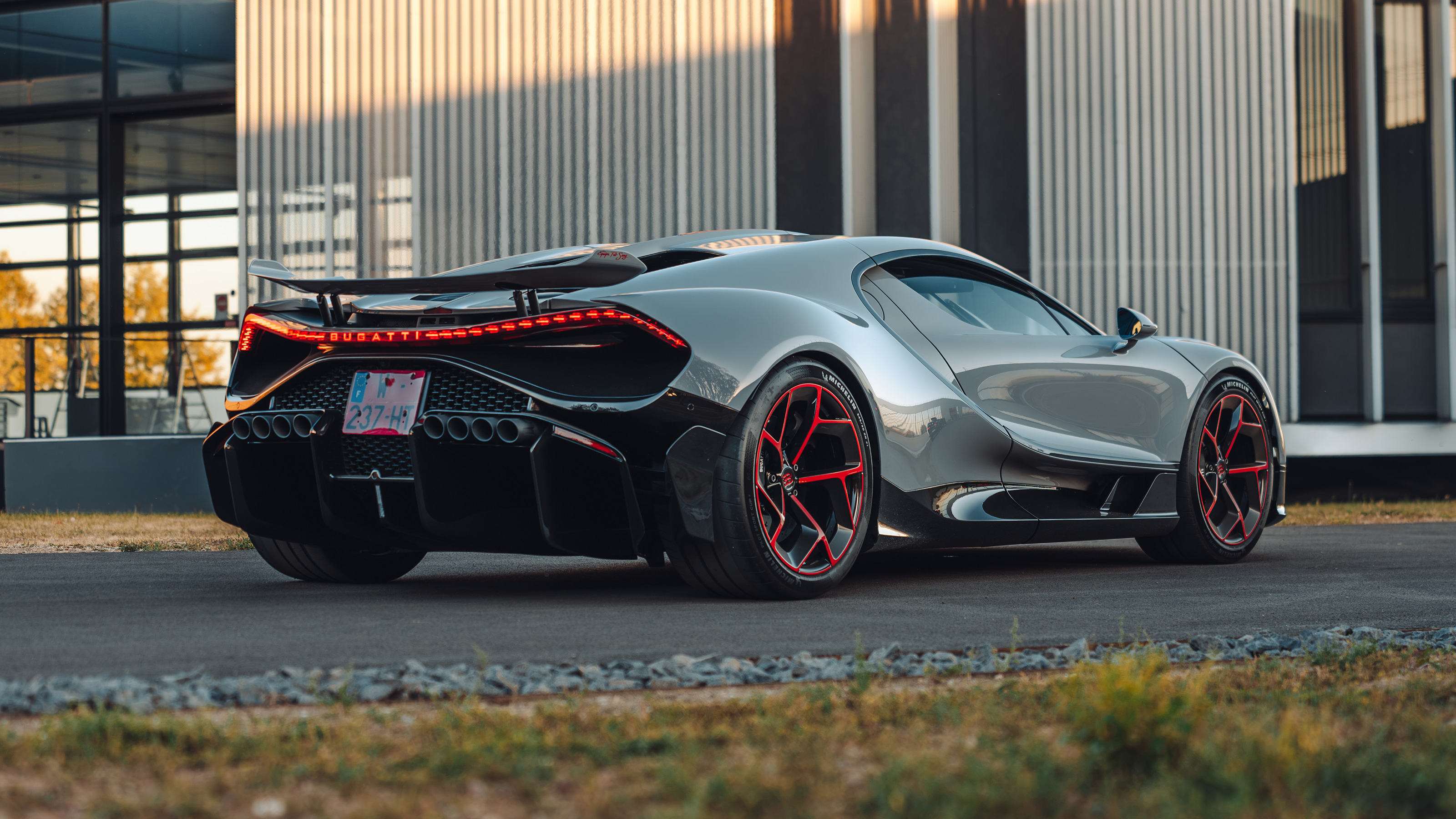
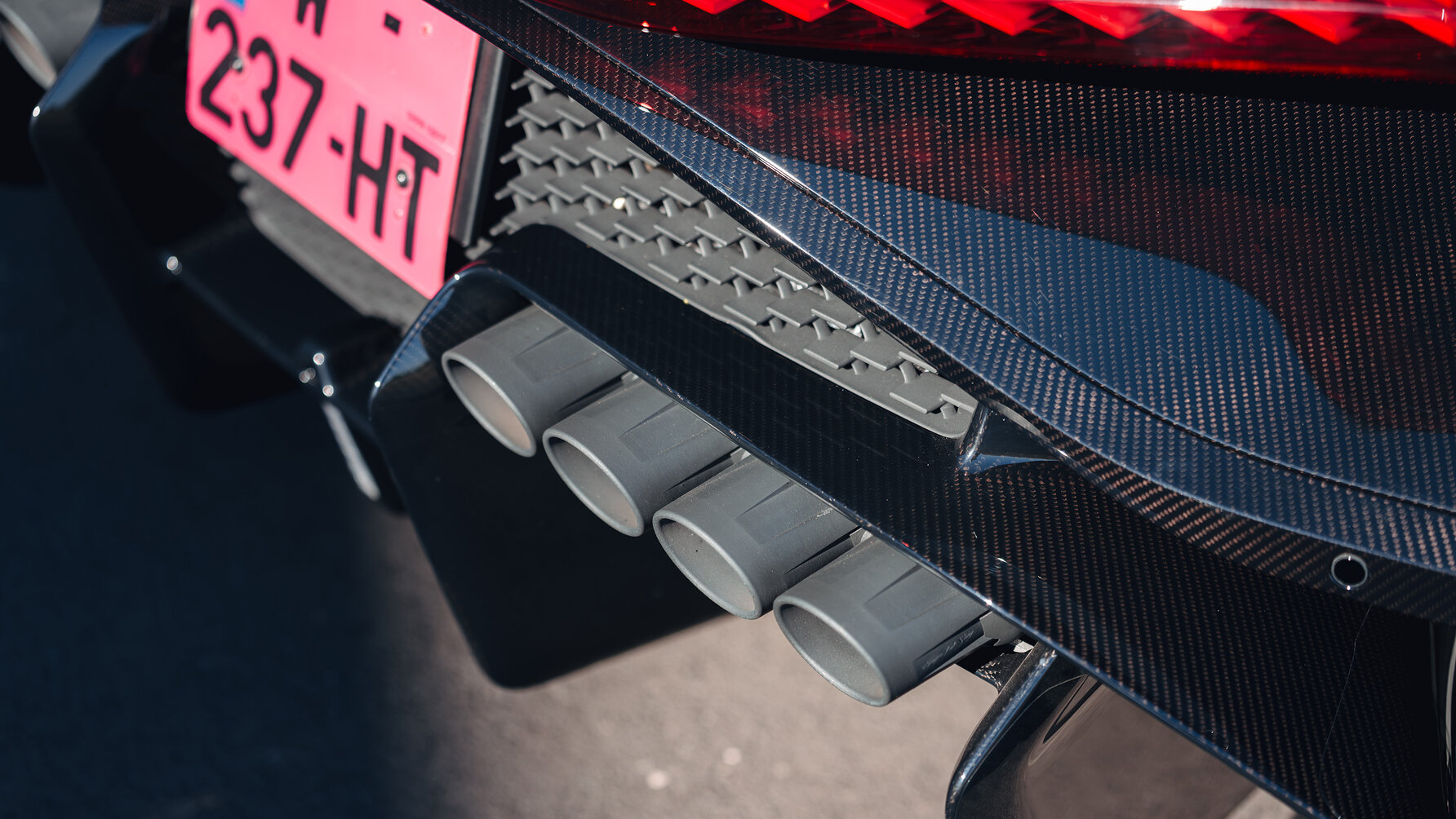
It has astonishing presence. This one is an Equipe Pur Sang, a motorsport-inspired cosmetic pack that most customers are opting for. Why? It’s got to be the eight exhaust pipes. They’re as easily pleased as the rest of us. And it is that rear view that’s most compelling, not only for the pipes and bold light bands, but for the diffuser and how far underneath the car you can see. It’s not quite a Valkyrie, but the V16’s narrowness has allowed a giant aero tunnel either side.
Here’s something else I hadn’t noticed before: the doors include the A-pillar surface, so there’s no join line at the top; pillar flows into roof. I suspect the wiper’s vertical resting position might look a little odd on a spec with a less overtly race vibe, but here it’s fine. And on the move I rarely notice it. The doors whirr up electrically, the hinges are minimal, elegantly invisible, I drop deep down into the seat, lower the door and wriggle into place. Mate drops in next to me. It’s cosy in here, you’re aware of how tightly packaged the Tourbillon is. Although height and backrest adjust, the seats don’t slide and the passenger footwell isn’t as deep as the driver’s – my feet are level with the back of the front tyres, room was needed to package the two electric motors and accessories.
Mate pulls the organ stop starter to fire up the engine. I love that feature. We look at each other and grin. “Let’s go and have some fun,” he says. And we’re off, through the outskirts of Molsheim, through villages, heading for the forests and hills of the Vosges. It’s the perfect start. This is where you see the adaptability of the Tourbillon. Of course we start with the V16 awake. Its huge capacity gives it that same floor-trembling character as the W16, people don’t so much hear it coming, as sense it via vibrations.
But when we enter a village, Mate twists the powertrain dial and we’re cruising in on electric. The V16 hadn’t felt dominant, it had been easy to talk over it, but when it goes it leaves a void. Thirty-seven miles of electric range is the promise, plus 800bhp of 4WD insta-thump. It’s impressive, but in practice EV is for towns alone.
Quite. Mate has been waiting for the opportunity to fully open the taps: it comes when the camera car pulls over and it’s astonishing. Unlike a 918 Spyder where you sense a handover from electric torque to petrol power as the revs rise, here the experience is all V16. I’m sure the electric impact could have been more dominant low down, but I suspect it’s been held back to blend in better and let the engine shine. So what those three motors do is support and enhance the V16s work. Now it took me few times to work this all out, because for the first couple all I could think was ‘holleeee Jeeeessssuuuuss’.
It’s ridiculous, and Mate knows it. “It’s really so fast. Maybe too fast,” he says. “Honestly, even compared to the Nevera, this feels so fast.” Now, the numbers say otherwise, Bugatti quoting 0–124mph in 5.0 seconds against 4.4 for the Nevera (the Chiron was 6.1). But what makes the difference is the experience of that acceleration. Which is the noise the engine makes. That low rev throb is gone. As the throttle plates open you hear this hiss, almost like a turbo wastegate as air is sucked hungrily in (we later discover you can play tunes with it) then there’s a section where it sounds like a pair of V8s in stereo or maybe a NASCAR, and then there’s what happens up top, where it’s like you’ve been swarmed by superbikes.
As the throttle plates open you hear this hiss… and then there’s what happens up top, where it’s like you’ve been swarmed by superbikes
“Now you need to try it with the windows down,” Mate insists. Oh my god. It’s a whole other level of volume, penetration and intensity. I’ve never heard a noise like it, somehow a combination of V8 thunder and screaming V12 musicality, a shriek, but with depth and richness, and with this metallic induction rasp that Mate nails in one: “It’s like an E46 CSL. And you know what? We haven’t tuned it at all. This is exactly how the engine came, we haven’t modified or enhanced it, there are no sound tubes, no nothing.”
Of all the engines I’ve experienced I think only the V12 in the T.50 beats this for being so multifaceted, for having so much going on across the rev range. But the fun thing here is that you can take half the power away and still have the same sonic experience. Just twist the powertrain dial to combustion only: marginally less terrifying g-force, all the aural benefits. Plus other benefits too. The V16 only feeds the rear wheels, so you now have a rear-drive naturally aspirated V16 to play with.
“And it drifts,” Mate tells me. “I insisted on it and the engineers said to me ‘this is not a key Bugatti attribute’ or something like that. And I said ‘it is now’.” So one of the setup parameters was that it should slip smoothly into oversteer and be easy to gather back up. I suspect the user group likely to indulge this feature is about one, but what more do you need to know about the man helming the good ship Bugatti?
On the way home later I try, and mostly succeed, to concentrate on the Tourbillon’s other facets. Mate had asked me what I didn’t like, what I’d change. I don’t get on with the ridge in the seat backs, the passenger doesn’t have an easy elbow rest on the console, but after that I’m struggling. I’d like to see more of the instrument binnacle of course, to watch the needles swinging back and forth because that is potentially the Tourbillon’s second greatest feature. The intricacy is all the more remarkable when you consider it had to be lightweight, “because if it was too heavy, it could vibrate the steering column”. Made up of some 2,000 mechanical components, including rubies “because they’re natural bearings, low friction and high hardness”, it weighs just 600 grams.
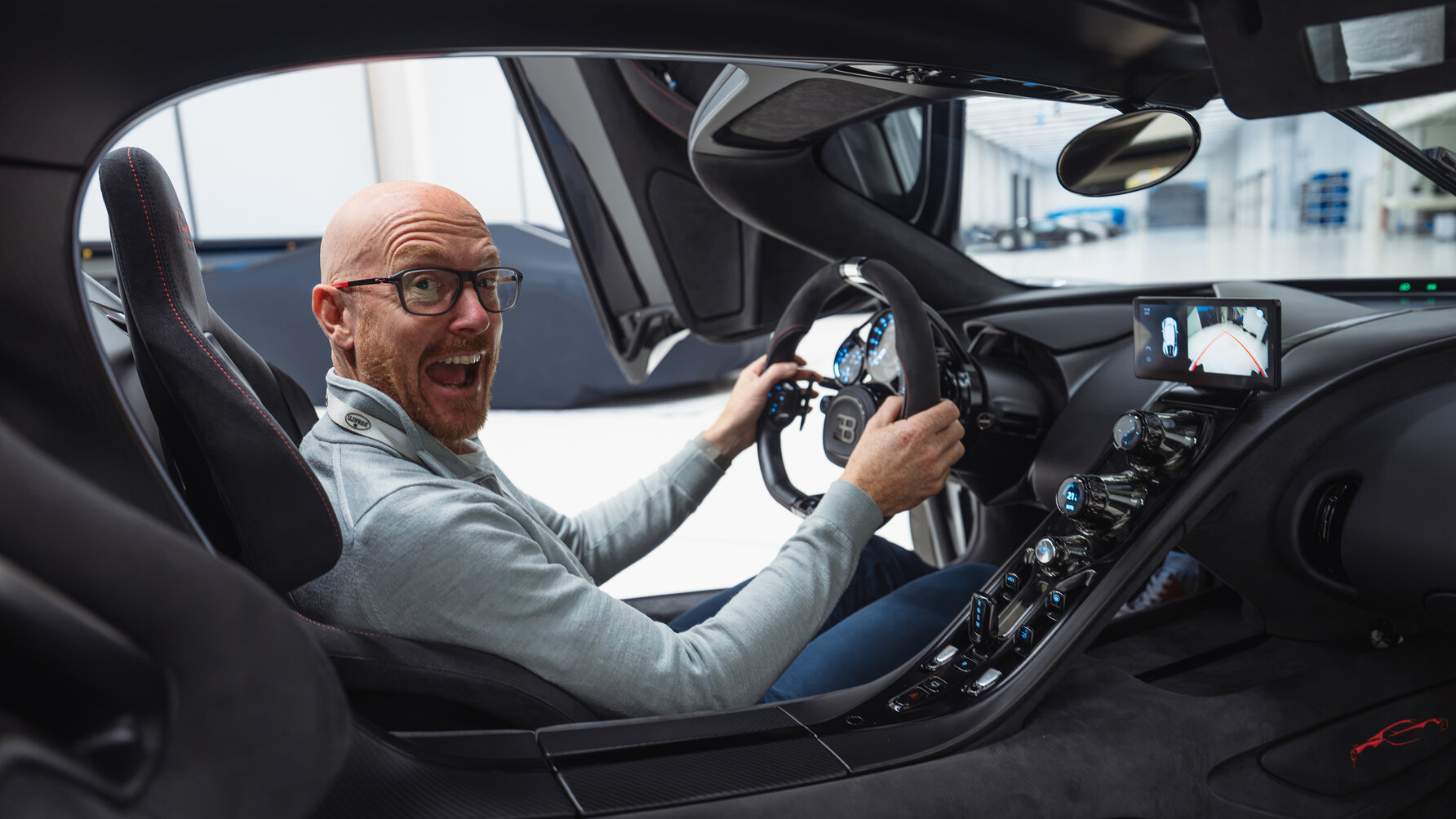
I sense we’ll be seeing more of that in future, exposed mechanisms to entertain the eye, occupy the mind and give you the sense of being inside a watch mechanism. I suspect some sort of exposed linkage gearbox will come in time. It’ll be a big improvement on the dull gear selector lozenge. In amongst all this there’s only one solitary carryover part from the Chiron: the interior light switch on the roof.
As I said at the start, it’s taking Bugatti in a subtle but noticeably different direction. It feels to me that the engine has led this change, that the rest of the car has been tuned to match the V16’s attitude and character. From what I can tell from the passenger seat it’s more athletic, changes direction with more appetite, rides with more connection yet still feels fabulously stable and planted. Refinement has probably taken a hit. You won’t mind.
It’s more athletic, changes direction with more appetite, and rides with more connection
It’s limited to 277mph. Maybe it’ll go faster than a Chiron, maybe it won’t. Mate is with me in thinking that chase is pointless, that the top speed chapter is over and what matters now is experience, connection. It’s a less Germanic approach, only to be expected now VW is no longer in charge. I’ve written before that every successful hypercar is built in the image of its boss. Pagani and Koenigsegg are good examples. And look at Bugatti: its first era was defined by Ettore himself, the second by Ferdinand Piëch, now it’s entering its third, steered by a man who’s first product is a V16 drift car. We have high hopes.
Get all the latest news, reviews and exclusives, direct to your inbox.
